
Devex Newswire: Hunger prevention becomes latest casualty of US aid cuts



Presented by Pivotal
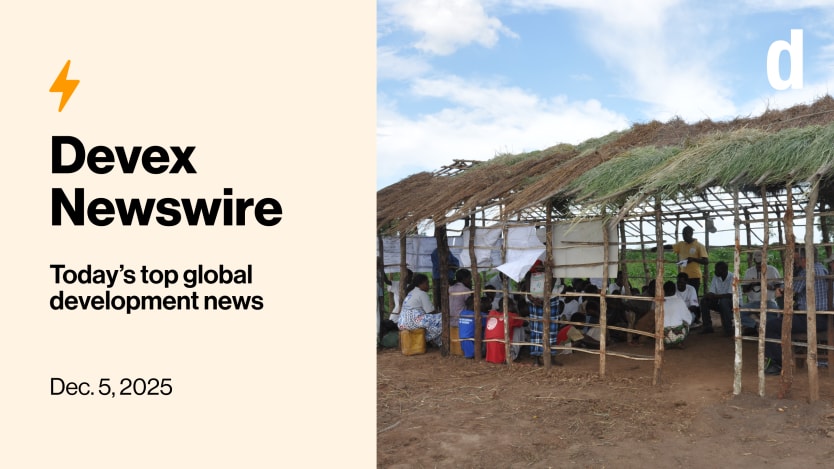
An ounce of prevention … apparently isn’t worth much to the Trump administration, at least when it comes to long-term development goals such as food security.
Also in today’s edition: Life at the U.S. State Department is, according to one survey, nothing short of miserable.
RIP to RFSA
RFSA. It’s one of those bland bureaucratic acronyms that masks the lifesaving nature of what it represents.
RFSA stands for resilience food security activity, which helps communities bridge the gap between emergency food aid and long-term stability by addressing the root causes of hunger. It’s also the latest development-related acronym to be axed by the Trump administration.
Just a day before Americans sat down to eat their Thanksgiving meals, organizations that work to provide food security abroad received an email notifying them that “the Department of State does not intend to obligate any additional incremental funding for future activities” — before throwing in: “We appreciate the hard work you and your team have dedicated to this activity.”
That activity was a small but critical subset of the U.S. government’s flagship Food for Peace initiative, which looks likely to be transferred from the State Department — which has run it since USAID was shuttered — to the U.S. Department of Agriculture, which promotes the interests of U.S. farmers, my colleague Elissa Miolene reports.
Whether the move would benefit the interests of people abroad remains to be seen, but the elimination of programs designed to fortify communities against hunger isn’t exactly encouraging.
“For us, the beauty of Food for Peace has always been that the bulk of it is taking care of emergency needs — and that’s for people that need food now,” says Emily Byers of Save the Children. “But it also recognizes that the most effective way to deal with emergencies is to stop them before they happen, so it invested a small part of Food for Peace resources in getting communities to the point where they wouldn’t need emergency assistance anymore.”
She wonders: “What is the long-term strategy here, if we’re cutting out any of the preventive part?”
Scoop: State Department ends support for some food security programs
+Listen: For the latest episode of our podcast series, Devex’s Adva Saldinger, Catherine Cheney, and Jenny Lei Ravelo discuss the top global development stories of the week, including the State Department’s $150 million grant to drone company Zipline.
State of disbelief
Abysmal doesn’t even begin to describe the mood at the State Department, at least according to a new survey that found a whopping 1 in 4 members of the foreign service have resigned, retired, or been removed from their posts — including nearly every staffer at USAID.
That’s the jarring revelation in a new report by the American Foreign Service Association, which paints a dark picture of morale inside the State Department after U.S. President Donald Trump took power this year — and took apart America’s foreign aid apparatus.
“An exponential crisis of unprecedented proportions,” says AFSA President John Dinkelman of the country’s foreign service corps. “The damage being done will take years — if not decades — to repair.”
AFSA aggregated the views of 2,100 active foreign services officers between August and September of this year, and the results are grim:
• Ninety-eight percent report poor morale
• Eighty-six percent say the year’s upheaval has undermined their ability to advance U.S. diplomatic priorities
• Seventy-eight percent report operating under reduced budgets
• Sixty-one percent are managing “significantly heavier workloads” due to staffing losses
And get this stunning stat: nearly 1 in 10 foreign service officers plan to leave the workforce this year, almost double the historic attrition rate, the survey found.
Yet budget cuts are only expected to deepen in 2026 as the Trump administration plans to continue slicing away humanitarian assistance, international peacekeeping, and economic development programs.
Read: Foreign service in crisis as 1 in 4 officers pushed out, AFSA warns
Flashing red
Life for thousands of Red Cross workers isn’t any rosier.
The International Committee of the Red Cross, or ICRC, will shed at least 2,900 positions next year as a result of declining donor contributions, my colleague Fiona Zublin reports. That represents 16% of its 18,000-strong workforce.
The cuts are driven by diminished funding from the U.S., U.K., and Germany, among others, which has created a “complex financial situation” — as ICRC chief spokesperson Christian Cardon diplomatically tells us.
The organization is trying to cushion the blow. Some of the positions at risk were those for which ICRC had budgeted, but not yet filled, and the organization expects about a third of total losses to be achieved through voluntary departures and not filling vacant positions. It will also make cuts in regional offices and headquarters “to spare the field as much as possible … where we have our core mandate being implemented,” Cordon says.
That core mandate is being tested like never before, as humanitarian crises pile up and aid money dries up.
ICRC’s future budget prioritizes support in critical conflict zones, including Sudan, Gaza, Ukraine, and the Democratic Republic of Congo. Cordon says important, neutral intermediary work between nations, such as between Israeli authorities and Hamas in the Gaza Strip, would continue — as would emergency health interventions, such as the medical supplies recently deployed to Sudan.
Read: The Red Cross is losing thousands of jobs. What will happen to its work? (Pro)
Related: Red Cross official calls on philanthropy to assist in crisis zones
+ Not yet a Devex Pro member? Start your 15-day free trial today to access all our expert analyses, insider insights, funding data, events, and more. Check out all the exclusive content available to Pro members.
Role-er-coaster
As many of our readers are painfully aware, the current job market is brutal, but not all roles are created equal. Some have been hit harder than others.
Devex heard from employers such as United Nations agencies and international NGOs that ongoing internal restructuring means they are not yet outlining upcoming hiring priorities. A lot depends on how the next U.S. fiscal year plays out for procurement contracts, says Uzma Ashraf Barton of the Society of International Development Washington.
So it makes sense that people who can drum up funds are in high demand. Recent job postings suggest that many organizations are reassessing their approach to revenue generation, says Katrina Roxas, director of Talent Solutions at Devex, and this has resulted in a surge in job postings in Washington, D.C., particularly for senior and executive-level roles.
And given the desire to tap private investment, private sector experience is also coveted. On the flip side, positions overseeing or supporting programming, such as audit-related roles, have seen significant drops in hiring this year.
For other roles, it’s a strange sort of status quo, with people neither being fired nor hired, but rather the existing workforce shouldering more of the burden. According to Kim Kucinskas of Humentum, across the sector, staff are “wearing many hats” and taking on hybrid roles, including business development and fundraising responsibilities.
Read: The roles most affected by aid cuts — and those which aren't (Career)
+ The sector is shifting fast, and top roles move before you ever see them. Today’s the last day to avail of up to 75% off a Devex Career Account annual membership and unlock early access to job posts, career advice, and profile visibility that put you ahead. Sign up now.
Must work miracles with less
Job competition is fierce everywhere, and the U.N. High Commissioner for Refugees is no exception — as a packed slate of candidates compete to lead the cash-strapped agency, which is grappling with record levels of global displacement.
Joanne Liu, a Canadian emergency pediatric physician and former international president of Médicines Sans Frontiérs, believes she’s up for the job, citing her experience as both a medical field worker and leader of the world’s premier medical relief agency.
“I’m someone who has worked at the front line of crises, and I’ve worked with refugees, and I think I’m the one rare candidate who ha[s] done that … for more than 30 years of my life,” she tells my colleague Colum Lynch as part of his series of interviews with the candidates. “I know how to fundraise from states and the private sector. This is what I’m bringing to the table.”
And bringing more money to the table is key. In the past year, the UN Refugee Agency has laid off about 5,000 workers, while the budget has fallen by more than $1 billion since 2024.
She recognizes that it’s “hard times” for UNHCR, particularly in an era when governments have found electoral success in vilifying migrants and refugees. She says there is a “key role” for UNHCR in stepping forward to “humanize the discourse.” Talking about displaced people “only in terms of figures and statistics is not reaching the public.”
But Liu has few illusions about the prospect of winning back the kind of financial support UNHCR could count on in the past.
“We need to accept that it will not go back [in] the short term to what it was before,” she says. Asked if she would have to impose greater austerity measures if appointed to the high commissioner post, she says: “I will hope with vigor that it will not happen, and then we’re going to be able to stabilize the organization.” Still, she notes, we would have to “diversify the stream of income.”
Read: Joanne Liu — Canadian former MSF leader makes bid for top UN refugee job
In other news
Pakistan has agreed to reopen two border crossings at Chaman and Torkham to allow the U.N. to send food and other relief supplies into Afghanistan. [Associated Press]
The U.N. has warned that Sudan’s Kordofan region risks a repeat of the mass atrocities seen in el-Fasher as the Rapid Support Forces advances. [Al Jazeera]
The Asian Development Bank has approved fast-tracked grants totaling $7 million to Sri Lanka, Thailand, and Vietnam to support emergency relief efforts after severe floods devastated parts of South and Southeast Asia. [ADB]
Thinking cap
Know the answer? Take the rest of our five-item news quiz!
Sign up to Newswire for an inside look at the biggest stories in global development.
About the author

Anna Gawel
Anna Gawel is the Managing Editor of Devex. She previously worked as the managing editor of The Washington Diplomat, the flagship publication of D.C.’s diplomatic community. She’s had hundreds of articles published on world affairs, U.S. foreign policy, politics, security, trade, travel and the arts on topics ranging from the impact of State Department budget cuts to Caribbean efforts to fight climate change. She was also a broadcast producer and digital editor at WTOP News and host of the Global 360 podcast. She holds a journalism degree from the University of Maryland in College Park.
Search for articles



Most Read
- 1
- 2
- 3
- 4
- 5