
Devex Newswire: Trump dramatically expands restrictions on aid groups




Presented by Munich Security Conference

For decades, U.S. policy toward funding abortion-related services abroad has been politically fraught but fairly predictable — Republicans oppose it, Democrats support it. But as with so many policies, U.S. President Donald Trump is the antithesis of predictable, and he’s expanding his administration’s anti-abortion stance to other hot-button issues — with potentially enormous repercussions for aid groups.
Also in today’s edition: A stark new reality for the world’s poor, a familiar face moves on, and a development finance institution faces accusations of abuse.
+ A year ago, the U.S. aid stop-work order changed everything. From the dismantling of USAID to the current legislative fight over the $50 billion foreign aid bill, the landscape of U.S. foreign assistance has been rewritten. On Jan. 29, join our reporters for an insider look at a historic year of layoffs, litigation, and what’s next for global development in 2026. Save your spot now.
‘Culture of fear’
Like clockwork, when Republicans come to power, they enforce the Mexico City Policy — or, as critics call it, the “global gag rule” — which blocks U.S. federal funding to international NGOs that provide abortion services, including information about abortion, even when those activities are funded by other donors. When Democrats are in power, they rescind the policy and restore the funding.
But this administration has taken the back-and-forth to the next level, dramatically broadening restrictions to encompass “gender ideology” and diversity, equity, and inclusion, or DEI — with U.S. Vice President JD Vance saying the changes enlarge the Mexico City Policy by three times.
The restrictions also apply across all foreign assistance funding — not just global health, but to areas such as humanitarian response, education, and agriculture — and for the first time, include U.S. NGOs and international organizations such as U.N. agencies, my colleague Adva Saldinger writes.
What does this mean in practice? Programs, for example, that promote women’s economic empowerment could arguably run afoul of the DEI rule.
Critics say the beefed-up policy is vague, unprecedented in scope, too far-reaching to realistically implement, and ideologically weaponizes foreign assistance.
“It’s really putting our finger on the scales to silence half of civil society or more on rights,” says Beirne Roose-Snyder of the Center for Global Equality. “We are saying we’re going to silence everyone who doesn’t agree with us.”
It’s too early to tell what the effects of the new policy will be, which some say is actually part of the problem.
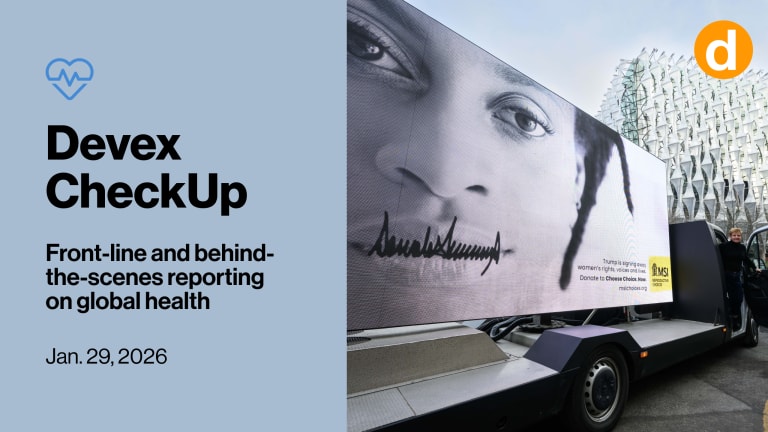
“A big part of its power is the chaos and confusion that it sows,” says Sarah Shaw of MSI Reproductive Choices. “It creates this culture of fear and no one individual wants to be the one that was responsible for losing their organization their U.S. funding so the safe position is to overimplement.”
Read: New US funding rules tie aid to abortion, gender ideology, DEI bans (Pro)
+ Curious about the insights that drive global development? For a limited time, experience Devex Pro with a 15-day free trial. Explore expert analyses, unlock hidden funding opportunities, connect with key players at exclusive events, and access a wealth of knowledge you won’t find anywhere else. Check out all the exclusive content available to Pro members.
ODA DOA
Foreign assistance is not just declining, it’s being redefined — with donor countries seemingly focused more on self-interest than selflessness. Where does this shift leave the world’s poorest and most vulnerable? Not in a good place, according to a new report from the European Network on Debt and Development, or Eurodad.
“Rich [countries] have reshaped what counts as ODA to advance their own domestic priorities, with minimal input from the Global South,” the report says. “This has led to far-reaching consequences for how and where aid is delivered, meaning that those who are most in need are being left behind.”
The report doesn’t exactly reveal anything most people in the sector don’t already know, but still, it shines an important light on OECD’s ODA modernization process, launched in 2012 to update decades-old accounting rules, my colleague Jesse Chase-Lubitz writes.
Specifically, it warns that aid is now increasingly delivered as loans rather than grants, spent within donor countries themselves, or used to de-risk private investment — often with little evidence of development impact.
Read: Global aid is leaving the poorest behind, new report warns
+ I’ll be discussing the expanded Mexico City Policy and Eurodad’s report on the next edition of our podcast, This week in global development, with Adva and Jesse. Stay tuned for the episode to drop later this week, and in the meantime, check out the full slate of past episodes here.
Arrivederci, Tessie
A big job move in the development space: Tessie San Martin is stepping down from her role as chief executive officer of FHI 360, one of the largest U.S.-based nonprofits in the world, my colleague Elissa Miolene scoops.
San Martin, who’s been CEO for the past four years, will be stepping down this calendar year, an FHI 360 spokesperson tells Elissa, though she will continue to serve as the organization’s leader until a successor has been found and onboarded.
“This is not a decision I have come to lightly; I love this job and this organization,” San Martin said in a statement to Devex. “I’m incredibly proud and honored to have worked with our inspiring global team. Together, we have navigated transformational change and put FHI 360 on the path to a new era of growth and influence.”
Those transformational changes — and challenges — came first in the form of the COVID-19 pandemic and then the collapse of USAID. As a result of the latter, FHI 360 had lost about half of its revenue and was forced to lay off a quarter of its workforce by the end of 2025. Even so, FHI 360 is still the second-largest USAID implementing agency, operating in 60 countries and all 50 U.S. states and territories, and employing more than 2,200 staff members across the world.
Exclusive: Tessie San Martin to step down from FHI 360's helm (Pro)
In-demand jobs
Like FHI 360 — and countless other NGOs — Save the Children US was also hit hard by the U.S. foreign assistance cuts, which forced it to lay off hundreds of staff.
It was rough, especially early in the year when the majority of contract terminations occurred, Douglas Mercer, managing director of talent attraction and acquisition with the organization, said during a recent Devex Career Briefing.
The layoffs hit some roles harder than others, he explained, noting, for example, that global health, international education, and child protection were heavily impacted during the first wave of layoffs.
“The least impacted positions were our fundraising and marketing positions,” said Mercer, and this “is where our regrowth starts to happen.”
Mercer said that restructuring the organization’s marketing, communications, and fundraising teams has been a priority as the organization, like many others in the space, adopts a more “private-first approach” — including individual, corporate, and philanthropic giving.
That’s led to job opportunities — a welcome change of pace in today’s constrained development market.
“We’re trying to rebuild those positions, and actually, they’re very competitive,” Mercer said. “It’s one marketplace … where we’re struggling to hire.”
Read: Why Save the Children US prioritizes donor engagement skills in hiring (Career)
+ Join us today for a Devex Career Briefing that will unpack how the recruitment landscape across Africa is evolving in 2026 and will give insights on where demand is growing, which sectors are hiring, and how professionals can position themselves competitively in a changing market. Register now. This event is exclusively for Career Account members. Not a member yet? Start your 15-day free trial today.
Complaint dispute
The Asian Infrastructure Investment Bank recently revamped its accountability mechanism, but a civil society watchdog group is questioning how effective that revamp is in light of alleged human rights abuses at a tourism development project in Indonesia.
As part of the project, now in its eighth year, AIIB approved a $248.4 million loan to the Indonesia Tourism Development Corporation to develop infrastructure for tourism in a coastal town. But locals, international NGOs, and U.N. experts have said that it is forcing more than 150 households that rely on fishing or livestock-based incomes to leave the coast for the mountains. It has also involved the deployment of Indonesian security forces to carry out violent evictions, according to the watchdog organization representing locals.
“The project may be nearing completion,” says one advocate. “But accountability can’t be retrofitted at the end. If AIIB’s new mechanism can’t handle a case like this, it raises serious questions about who it’s really designed for.”
AIIB disputes the allegations, stressing compliance with its environmental and social framework and highlighting project benefits and ongoing grievance resolution efforts. The bank says it is “aware of the allegations” and “has conducted due diligence through missions, meetings and field visits.”
Scoop: Emails reveal accountability standoff at AIIB over evictions
In other news
Oxfam has admitted to systemic staff vetting failures years after its Haiti abuse scandal and promises to tighten safeguards, triggering renewed scrutiny from the U.K. Charity Commission and calls for the board of trustees to resign. [The Telegraph]
Howard Buffett has signaled a shift in global philanthropy as he and his siblings Susan and Peter prepare to give away an estimated $146 billion of their father’s fortune, saying that fighting poverty requires stronger investment in the rule of law. [Fortune]
The World Bank has approved $200 million to support Lebanon’s poor and vulnerable households with cash transfers and basic services as the country recovers from economic collapse. [Reuters]
Sign up to Newswire for an inside look at the biggest stories in global development.
About the author

Anna Gawel
Anna Gawel is the Managing Editor of Devex. She previously worked as the managing editor of The Washington Diplomat, the flagship publication of D.C.’s diplomatic community. She’s had hundreds of articles published on world affairs, U.S. foreign policy, politics, security, trade, travel and the arts on topics ranging from the impact of State Department budget cuts to Caribbean efforts to fight climate change. She was also a broadcast producer and digital editor at WTOP News and host of the Global 360 podcast. She holds a journalism degree from the University of Maryland in College Park.
Search for articles



Most Read
- 1
- 2
- 3
- 4
- 5