Devex Pro Insider: Nerves in Davos, one year on from the fall of USAID
Highlights from Davos, and the latest career moves in the global development sector.
The big news last week was the World Economic Forum in Davos, Switzerland. It’s always a tricky event on the calendar for development leaders, as summarized excellently by my colleague Elissa Miolene. It’s a gathering of the elite — billionaires, CEOs, and heads of state. Nominally, it’s focused on finding solutions to the world’s big problems, but it’s an awkward discussion, given that there are plenty of people who think extreme wealth — as personified by those on the mountain — is actually the root of the problem. This year, for example, Oxfam greeted Davos with a new report showing that wealth inequality has grown vastly since the 1970s, and continues to grow at extraordinary rates. It’s just the latest of several such annual reports, and while previously they were greeted in many corners with a shrug, there’s a growing movement even in wealthy countries — and even among the wealthy themselves — that has identified the 1% as a problem for everyone. All of that being said, Davos remains a place where the aid sector can get things done, and development leaders were there in force. For the first half of the week, it was notably harder than in previous years for aid causes to cut through, I’m told by Elissa, who was there on the ground. That’s mostly down to U.S. President Donald Trump’s threat to invade Greenland, which left the town on edge. But after a rambling speech on Wednesday in which Trump complained, waffled, and hectored but said little new, followed by a climbdown of sorts after a meeting with Mark Rutte of NATO, the town seems to have relaxed. No one was going to fully dismantle the world order before Monday, and development folks could once again get their issues on the table. That doesn't mean it has been easy — development has proved in recent years to be more of an undercurrent than a main event — but at least it had a place on the agenda. Elissa told me about one conversation with an artificial intelligence expert — Davos is neck-deep in AI experts this year, by all accounts — who didn’t know that anyone had died as a result of the USAID cuts. Which goes to support the old axiom that when you’ve shouted about something until you’re blue in the face, and you think everyone is tired of hearing you, that’s the point at which ordinary people might dimly become aware of your presence. Davos has also had the usual logistical challenges — it’s bloody cold and hard to get anywhere except on foot — but Elissa told me it’s sunny and beautiful and there were a lot of nice hats being given out on the promenade. And the food prize went to Meta, which may be wrapped in a death struggle over the morality of social media, but was able to turn out a mean hot chocolate with whipped cream and a mint Aero bar. So the world’s not all bad. Finally, all week we’ve been bringing you “heard in the hallway” moments from the conference — check out Elissa’s fantastic series of newsletters to find out more — but this time we’ve got a “listened in the loo” moment. Apparently, pop star Katy Perry was at Davos because she’s dating former Canadian Prime Minister Justin Trudeau. But according to one bathroom mirror conversation, she’s been feeling left out because here, at least, it’s her boyfriend who’s the star. Maybe she’ll cry about it later. Bits and pieces One year on. This year, Davos brings back another memory — the first anniversary of the stop-work order that first sounded the death knell of the U.S. Agency for International Development. That order — published a year and a day ago today — was the first in a series of steps that have led us to where we are now — with a very different aid structure. So a number of the entries below look at how that’s shaken out. It’s hard to think back to the chaos and uncertainty of those days, as thousands of organizations scrambled to understand a fractured and contradictory set of instructions. We’ve heard since that this wasn’t anywhere in the plans; by many accounts, it was just a spur-of-the-moment decision from Elon Musk and the Department of Government Efficiency, which itself didn’t long outlast USAID. But it’s a decision that has had an enormous human cost. Nicholas Enrich, formerly a senior official in USAID, has written an account of those days, detailing the chaos and dysfunction within the organization, titled “Into the Wood Chipper,” after a famous phrase used by Musk during his reign at the agency. Devex, meanwhile, has spent the week looking back at what went before. You can check out some of the highlights here. And we’re not done yet. Stay tuned for a special downloadable on our coverage, as well as a report chronicling the impact of the aid cuts on the ground. Plus, exclusively for Pro members, we’ll be hosting a briefing on Jan. 29 with three of the reporters who were in the thick of the upheaval — Adva Saldinger, Elissa Miolene, and Michael Igoe — for an honest take on what it was like, and what lies ahead. Finally, a footnote to all of this craziness. USAID — what’s left of it — has reportedly hired Mike Benz, a right-wing conspiracy theorist whose posts about the agency being a den of spies caught Musk’s eye last year. It’s a somewhat surprising selection, although if you’ve followed the vitriol lobbed at the agency, perhaps it’s not all that surprising. Counting the cost. Meanwhile, attempts have been underway to measure the cost of the closure. An analysis by Impact Counter reckons that aid policy decisions in the last year have taken more than 750,000 lives — around 88 deaths an hour. A more recently published report from Aid on the Hill breaks down the reduction in spending since the decision to close USAID, finding there was a far greater fall in spending than previously expected. The report shows a 65% reduction in programmed funds — offering more detail on previous reporting from Devex — and identifies an especially sharp drop in sub-Saharan Africa. Moral hazard. There are some signs that the United States is moving back toward spending on foreign assistance, most notably a $50 billion appropriation for foreign assistance in Congress’ recent budget, which is down by around $10 billion from previous years, but up by around $20 billion from what the White House proposed. There are, of course, questions about whether the Trump administration will abide by the bill, and whether the State Department is even able to deliver on it with its current staffing. One possible guide to the current thinking on this comes from a recent blog from Michael Gonzales, the U.S. ambassador to Zambia, who writes that previous U.S. aid spending was misdirected. “Quite simply, we violated the central maxim of international development: the donor cannot want development more than the recipient,” he writes. “By doing so, we fueled moral hazard.” Gonzales has a series of proposals for what future aid might look like — basically, more like a mutually beneficial transaction, with what he calls “skin in the game” on the part of other governments. Trial on trial. The latest development organization that the Trump administration has hurled a rocket at isn’t even in the U.S., though. It’s the Africa Centres for Disease Control and Prevention, which, according to Futurism, a site covering science and technology, had the temerity to object to a drug trial that involved taking a bunch of kids in Guinea-Bissau, giving half of them the hepatitis B vaccine, and seeing what happened to those who weren’t vaccinated. Given that the answer would presumably be “die of hep B” in a lot of cases, this raised ethical questions. Africa CDC insisted the trial be halted, which the U.S. Department of Health and Human Services appeared to take issue with. “This is a powerless, fake organization attempting to manufacture credibility,” a source at HHS said, according to Futurism. Bulldozer diplomacy. The Israeli government has long had a considerable beef with UNRWA, the official U.N. agency responsible for delivering aid to the occupied Palestinian territories. Last week, it took the latest step to sideline the agency, according to The Guardian, and started bulldozing its headquarters in East Jerusalem. The Guardian quotes Roland Friedrich, UNRWA’s director in the West Bank, as saying that Israeli forces entered the compound, confiscated equipment, expelled private security guards hired to protect the site, and then called in the demolition crews. Friedrich said the actions were a breach of international law, but Israel claimed the compound did not have any immunity. Board battle. Another update to the long-running battle at Oxfam GB over the departure of its boss, Halima Begum — again from The Guardian. Balwant Singh, an Oxfam trustee, said he has “lost confidence in the board’s governance, integrity, transparency and accountability” a month after Begum was forced out as chief executive — a move which has split the U.K. NGO sector. “These failures are now sufficiently serious and systemic to warrant external regulatory intervention,” Singh said. For a full breakdown of Oxfam GB’s, well, breakdown, check out our story here. Moving on Tellef Thorleifsson has announced his intention to step down in the summer as CEO of Norfund, the Norwegian DFI, after almost eight years. He highlighted the rapid growth of the organization during his tenure. He has not given any indication of his next steps. Paul Weisenfeld has been named a nonresident fellow at the Center for Global Development. Weisenfeld most recently served as executive vice president for international development at RTI International, where he led a $380 million global portfolio spanning health, agriculture, economic growth, education, governance, water and sanitation, energy, and the environment. Zainab Usman has joined Columbia University’s Center on Global Energy Policy as a senior research scholar and managing director for international programs at the Energy Opportunity Lab, where she will lead CGEP’s work on energy for development in emerging markets. Her research will focus on how energy systems can support structural transformation and industrialization in low- and middle-income economies. Sam Taylor is starting a new role as director of communications for MSF Ubuntu, a new operational directorate established by the eastern Africa and southern Africa arms of Médecins Sans Frontières. Taylor had previously worked in a number of other communications roles at MSF. Max Slaughter has started a new role as head of communications at Medical Aid for Palestinians. Slaughter previously held other communications roles at MAP, and before that, worked in other health-related communications jobs. The U.S. International Development Finance Corporation has announced the appointment of Adrian Bastien as regional managing director for Jakarta. DFC said that Bastien’s arrival underscores the organization’s mandate to mobilize private capital globally, including in the Indo-Pacific region. Bastien has worked at DFC for a number of years and has 20 years of investment experience. David Theis is starting a new position as adviser for risk and issues management at the World Bank. Theis has worked at the bank for more than 20 years. Veronica Nyhan Jones is starting a new role as global manager of partnerships for smart development and cross-sector expertise at the World Bank. Jones has worked in the bank, mostly atyits private sector arm, the International Finance Corporation, for more than 20 years. Nidhi Bouri has joined the Gates Foundation as director of the exemplars in global health team. Bouri is the founder and director of Stand Up for Aid — a communications group focused on making the case for international development — and most recently served at USAID as deputy assistant administrator for global health. Previously, Nidhi held senior roles at the White House. WWF Africa has announced the appointment of Yvonne Godo as regional director for East and southern Africa. The charity said that Godo had two decades of leadership across conservation and complex multicountry systems, and brings “clarity, execution, and a deep commitment to impact for people and nature.” Anne Paisley has been appointed senior director at The ONE Campaign in Washington, D.C. “After more than six years at ONE, our work and mission feel more crucial than ever,” she said. “We need to build the policies, partnerships, and investments to drive a more equal and just future — one with Africa firmly at the global decision-making table.” Cristina Donini has been promoted to the role of head of research and development at Medicines for Malaria Venture, a Swiss-based medical research organization. Donini has spent well over a decade in varying roles at the nonprofit.
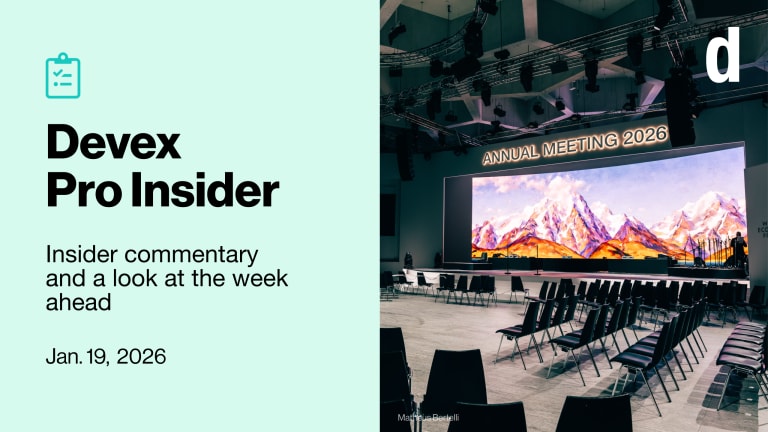
The big news last week was the World Economic Forum in Davos, Switzerland. It’s always a tricky event on the calendar for development leaders, as summarized excellently by my colleague Elissa Miolene. It’s a gathering of the elite — billionaires, CEOs, and heads of state.
Nominally, it’s focused on finding solutions to the world’s big problems, but it’s an awkward discussion, given that there are plenty of people who think extreme wealth — as personified by those on the mountain — is actually the root of the problem.
This year, for example, Oxfam greeted Davos with a new report showing that wealth inequality has grown vastly since the 1970s, and continues to grow at extraordinary rates.
This story is forDevex Promembers
Unlock this story now with a 15-day free trial of Devex Pro.
With a Devex Pro subscription you'll get access to deeper analysis and exclusive insights from our reporters and analysts.
Start my free trialRequest a group subscription Printing articles to share with others is a breach of our terms and conditions and copyright policy. Please use the sharing options on the left side of the article. Devex Pro members may share up to 10 articles per month using the Pro share tool ( ).
David Ainsworth is business editor at Devex, where he writes about finance and funding issues for development institutions. He was previously a senior writer and editor for magazines specializing in nonprofits in the U.K. and worked as a policy and communications specialist in the nonprofit sector for a number of years. His team specializes in understanding reports and data and what it teaches us about how development functions.