Does the development world need to worry about critical minerals?
As demand for lithium, cobalt, and copper surges, mineral-rich countries are rewriting the rules on who controls the resources driving the clean energy transition. So, what are they?
When Mali’s Bougouni project began shipping lithium to China last year, few outside the mining industry noticed. But for development financiers and climate policymakers, the move represented a much larger opportunity for the world’s poorest countries to benefit from their own resources. The lithium exports marked a much-needed diversification from exporting gold, which made up more than 80% of the country’s exports in 2023. But the Malian government also managed to get more out of the deal by requiring local subcontracting for at least 51% of operations and increasing its stake in these projects from 20% to 35% in 2023. Critical minerals are becoming the oil and gas of the 21st century. They are vital to green energy technology, iPhones, surveillance, and even X-ray machines — and world superpowers have noticed. While China has a hefty lead on the mineral race, the U.S. held its first ministerial on critical minerals on Feb. 4 and plans to stockpile them in the country, and the European Union passed a law in 2024 to start building up its own mineral reserves. “From a development perspective, critical minerals are an even better prospect than oil and gas,” Ibrahima Aidara, deputy Africa director for the Natural Resource Governance Institute, told Devex, pointing to the fact that minerals can power the green energy transition. “But for Africa, we need strong institutions and regulations, and resources to maximize the value addition. Otherwise, it’s going to be just as extractive as before.” Development organizations will increasingly find themselves operating in countries where mining shapes public finances, land use, labor markets, and environmental risk. Mining can compete with agriculture for land and water, disrupt food systems, and reshape local economies. Conversely, weak governance can exacerbate inequality, fuel conflict, and undermine development gains NGOs are working to protect. As popularity rises, mineral-rich countries in Africa, Southeast Asia, and Latin America are passing laws to keep hold of the treasure under their feet. But what exactly are these treasures? What do we call them? And how are they shaping the world’s geopolitics? Basic building blocks Raw minerals are naturally occurring substances extracted from the earth, such as iron ore, copper, lithium, or cobalt. They are the basic building blocks for everything from construction to energy production. But while all critical minerals are raw minerals, not all raw minerals are critical. A mineral is labeled critical when its supply is vital to a country’s economic and national security, yet is vulnerable to disruption. For example, lithium and cobalt are essential for batteries in electric vehicles, while rare earth elements power electronics and renewable energy technology. Critical minerals are scarce, concentrated in a few countries, or difficult to mine sustainably, making them strategically important for governments, investors, and industries that depend on stable access. “Not all minerals are critical for all nations,” Aparajita Banerjee, a senior researcher at the German Institute of Development and Sustainability, or IDOS. “The whole definition depends on what the industry is capable of.” Critical minerals are the backbone of the renewable energy transition. Without them, electric vehicles stall, wind turbines idle, and solar panels never leave the factory floor. According to the International Energy Agency, a typical electric vehicle uses six times more mineral inputs than a conventional car. Onshore wind plants require nine times more minerals than gas-fired power. Under current climate pledges, lithium demand alone could increase more than 40-fold by 2040, while demand for graphite, cobalt, and nickel could grow 20 to 25 times. For low- and middle-income countries, deposits of these minerals offer a chance to leapfrog into the clean energy economy, generate foreign revenue, and attract industrial investment. “Minerals have great potential for development,” said Aidara. “They are even sometimes fundamental in terms of providing critical input for development, such as energy, and they can also generate sufficient revenue to finance our development needs and priorities.” But that opportunity comes with risk. Mining is notoriously capital-intensive and environmentally harmful. Many mineral-rich countries are already burdened with debt, weak institutions, and competing development priorities. But more mineral-rich nations are seeing the value of their materials and limiting exports. “There is no development outcome generated by the exploitation of these minerals,” said Aidara. “In themselves, they cannot generate development until there is proper, good governance free of corruption and strong institutions.” Who controls the supply? Critical minerals are not evenly distributed, and many of the world’s largest reserves sit in low- and middle-income countries. The Democratic Republic of Congo alone accounts for around 70% of global cobalt production, a key input for electric vehicle batteries. Chile, Argentina, and Bolivia form the “lithium triangle,” holding more than half of the known global lithium resources. Indonesia dominates nickel production, while Peru and Zambia remain central to global copper supply — a metal essential for power grids, renewable energy, and electrification. Africa, in particular, has emerged as a cornerstone of the global critical minerals map. Beyond cobalt in the DRC, Zimbabwe and Mali hold lithium deposits, Namibia is developing rare earth projects, and South Africa remains a major producer of platinum group metals used in hydrogen and fuel cell technologies. Yet much of the continent’s output is exported in raw or semi-processed form, limiting domestic value creation and reinforcing long-standing development challenges linked to extractive dependence. Processing and refining, however, are concentrated elsewhere, which means that while developing countries supply the raw materials underpinning the clean energy transition, much of the economic value — jobs, technology, and profits — accrues further down the supply chain in wealthier or more industrialized economies. Closing this gap has become a central development question, shaping debates over export restrictions, industrial policy, and the role of development finance in supporting domestic processing. “We support the value addition of these policies. But it is not enough to just have a law or just political speech on value addition, like processing. You have to invest,” said Aidara. “But this requires big money and a lot of investment, which, given all the development priorities and the potential debt burden, almost any single African nation doesn’t have the resources to invest in that.” The geopolitics of minerals Governments worldwide are racing to secure strategic supply chains for renewable energy, semiconductors, and defense technologies. The U.S. launched Project Vault on Feb. 2, a plan to stockpile minerals in order to compete with China’s monopoly. The EU has passed a Critical Raw Materials Act, and alliances such as the Minerals Security Partnership, an initiative aimed at accelerating the development of secure, sustainable, and diverse critical energy mineral supply chains, aim to diversify supply away from Chinese dominance. But China’s dominance looms large. The country controls 60% to 90% of global processing for lithium, cobalt, graphite, and rare earth minerals and has invested heavily in upstream mining across Africa, Latin America, and Asia. For countries such as Mali, the Democratic Republic of Congo, and Chile, Chinese investment can provide much-needed capital and market access. But it also raises concerns over sovereignty, labor practices, and local value creation. "Right now, you have 97% of some of these elements controlled by one nation in one place,” said U.S. Secretary of State Marco Rubio, during the first U.S. critical minerals ministerial meeting on Wednesday. “That's just not healthy for the global economy." Other global powers are trying to respond. The U.S., EU, Japan, and Australia are creating joint investment platforms and offering concessional finance to develop domestic or allied supply chains. Development finance institutions — the African Development Bank, World Bank, and various export credit agencies — are stepping into the fray, sometimes for the first time, exploring ways to fund mining projects that meet social, environmental, and governance standards while remaining commercially viable. The developing world is watching this with the lessons from oil and gas clear in their mind. Global goals in decarbonization and defense can’t be met without minerals, yet the majority lie in low- and middle-income countries, effectively tying their development trajectories to the trajectory of critical minerals. The rise in demand could mean more bargaining power for the countries that hold the minerals. “Africa now has a choice,” said Banerjee. “Previously, it was only one buyer or two buyers. Now there is a plethora of choice.” But within the context of today’s geopolitical strife, Aidara said that the marketplace won’t work like it normally would for a product in high demand. “When you take into account the geopolitical dynamic, it's not just market factors determining the price,” he said, “It’s politics that forces you to choose the partners.”
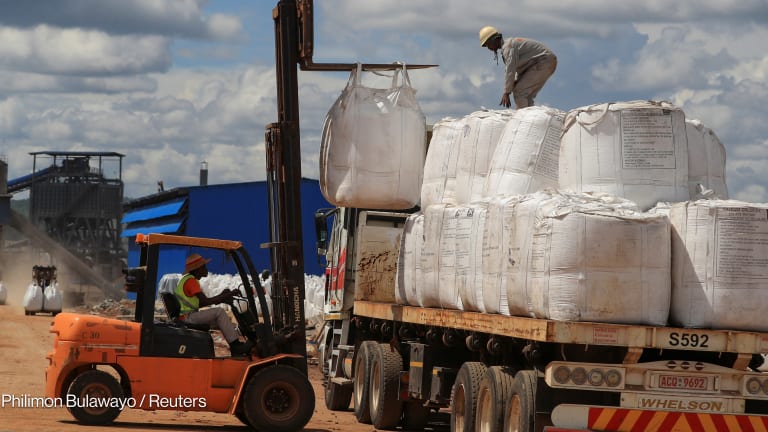
When Mali’s Bougouni project began shipping lithium to China last year, few outside the mining industry noticed. But for development financiers and climate policymakers, the move represented a much larger opportunity for the world’s poorest countries to benefit from their own resources.
The lithium exports marked a much-needed diversification from exporting gold, which made up more than 80% of the country’s exports in 2023. But the Malian government also managed to get more out of the deal by requiring local subcontracting for at least 51% of operations and increasing its stake in these projects from 20% to 35% in 2023.
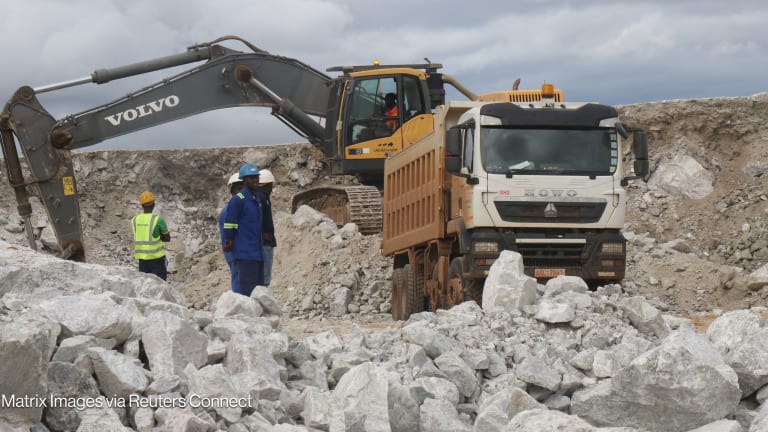
Critical minerals are becoming the oil and gas of the 21st century. They are vital to green energy technology, iPhones, surveillance, and even X-ray machines — and world superpowers have noticed. While China has a hefty lead on the mineral race, the U.S. held its first ministerial on critical minerals on Feb. 4 and plans to stockpile them in the country, and the European Union passed a law in 2024 to start building up its own mineral reserves.
This story is forDevex Promembers
Unlock this story now with a 15-day free trial of Devex Pro.
With a Devex Pro subscription you'll get access to deeper analysis and exclusive insights from our reporters and analysts.
Start my free trialRequest a group subscription Printing articles to share with others is a breach of our terms and conditions and copyright policy. Please use the sharing options on the left side of the article. Devex Pro members may share up to 10 articles per month using the Pro share tool ( ).
Jesse Chase-Lubitz covers climate change and multilateral development banks for Devex. She previously worked at Nature Magazine, where she received a Pulitzer grant for an investigation into land reclamation. She has written for outlets such as Al Jazeera, Bloomberg, the Organized Crime and Corruption Reporting Project, and The Japan Times, among others. Jesse holds a master’s degree in Environmental Policy and Regulation from the London School of Economics.