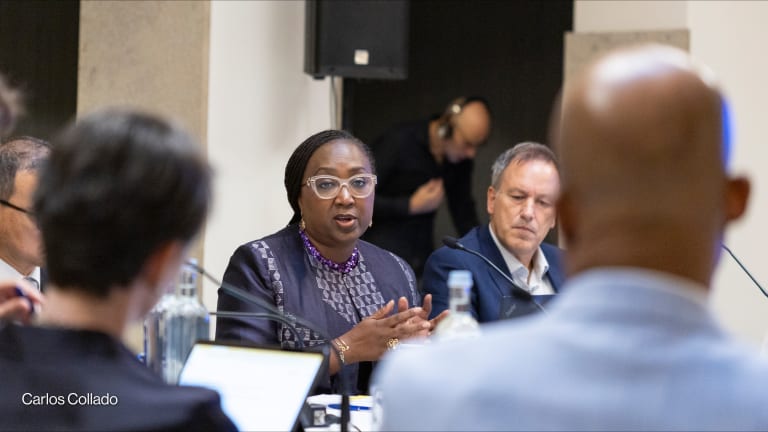
Exclusive: A COVID-19 initiative for vaccine delivery is winding down
The COVID-19 Vaccine Delivery Partnership's main focus has been to bring up vaccination coverage in 34 low- and middle-income countries with 10% or below vaccination rates. It’s achieved some successes, but far from countries' vaccination targets.
The COVID-19 Vaccine Delivery Partnership — an initiative from Gavi, the Vaccine Alliance; UNICEF; and the World Health Organization to support and accelerate COVID-19 vaccine delivery in low- and middle-income countries — is expected to wind down its activities in June. “We're suggesting, indeed, that the COVID-19 vaccine delivery partnership … winds down in its current form,” Ted Chaiban, global lead coordinator for the partnership, often referred to as CoVDP, told Devex. When the partnership was launched in January 2022, there was already an ample supply of vaccines. But countries struggled to get vaccines into people’s arms due to limited funding, and other competing priorities such as humanitarian emergencies that have strained health systems. COVID-19 cases and deaths have also started to decline, leading many policymakers and the population to think the virus is no longer a threat, and a vaccine is unnecessary. The partnership’s main focus has been to bring up vaccination coverage in 34 countries with 10% or below vaccination rates. It’s achieved some successes, with countries such as Tanzania and Zambia now having reached 46% vaccination rates, a significant increase from below 10% in January 2022. However, data from last month showed many countries were still far from their coverage targets for primary vaccinations. In Haiti, where there’s ongoing gang violence and a humanitarian crisis, only 2% of the population has been fully vaccinated. Meanwhile, after three years of the pandemic, aid institutions have started to discuss changes in the COVID-19 response. The Gavi board in December agreed “in principle” to explore integrating COVID-19 vaccines in its core programming. They hope countries will integrate COVID-19 vaccinations into their routine immunization structures and primary health care, and Chaiban said constituents of the partnership will support countries in those efforts. But he’s aware that countries are also dealing with a range of health priorities. “We can advocate and engage. But countries look at a range of health priorities and make their choices,” he said. A good run CoVDP ending is not unexpected. The partnership was never meant to be a permanent structure. Yet even with its short run, some experts believe the partnership was well able to serve its purpose — help increase vaccination coverage in some of the lowest-coverage countries — and, some argue, better than previous efforts to get COVID-19 vaccines into arms in many low- and middle-income countries. Before the COVID-19 Vaccine Delivery Partnership, the Country Readiness and Delivery, or CRD, workstream was set up under COVAX with a goal of supporting countries for COVID-19 vaccine introduction. “What CoVDP did with Zambia for example — getting [its vaccination coverage] to over 40%, I simply don’t believe the CRD could have gotten it there,” Fifa Rahman, a global health expert who has served as civil society representative to the Access to COVID-19 Tools Accelerator, told Devex. CoVDP, she said, “was certainly more visible about partnerships with countries,” and should’ve existed earlier, even before the deployment of vaccines under COVAX. But Krishna Udayakumar, director of the Duke Global Health Innovation Center, said it “makes sense” now for the world to transition to a more sustainable vaccination strategy to manage COVID-19 in the long term. “The challenge now is to ensure that there is an orderly transition and continued focus on this important issue over the coming months and years,” he wrote to Devex. That includes full COVID-19 vaccinations, including booster doses to high-risk groups, which will require “stronger routine immunization and primary health care systems … rather than parallel or stand-alone mass vaccination efforts,” he said. Chaiban himself stresses “the pandemic is not over,” and that there’s still a lot of work that “needs to be done." Many countries are far from vaccinating all of their high-risk groups. In Tanzania and Zambia, less than 50% of the health care worker population has been fully vaccinated. The rate is even lower for the elderly, at 10% and 13%, respectively. “My biggest concern is where we're going to be with the elderly, and how to continue to sustain the efforts with the elderly,” he said. Aid organizations will need to continue bringing the evidence to governments on why COVID-19 vaccinations remain important, and the aid community will need to make sure support is available for countries “to make that choice,” he said. Toward the finish line Before it winds down, Chaiban said the partnership will continue to support countries’ vaccination campaigns in the coming months. Countries such as Ethiopia, Mali, Niger, and Sudan have vaccination campaigns planned for 2023. The partnership also has several important meetings this year, including a global convening on vaccinations in humanitarian settings to guide both the current and future responses. That meeting aims to discuss how to better involve humanitarian organizations in a pandemic response, and how to navigate legal liabilities that challenged COVID-19 vaccination efforts in humanitarian settings. One other thing the world should heed from the pandemic — if they haven’t yet — is to invest in community health systems, including protecting and paying health workers a living wage. This has shown to have a huge impact on health outcomes, he said, and will pay dividends for the future. “That same system is also the ground zero for surveillance and pandemic preparedness and response,” he said. Chaiban said it would have been useful to set up CoVDP a few months earlier, but he stressed there was a lot of work focused on delivery before the partnership was set up, and that this kind of work will continue even “after this specific form of partnership is done.” “I think it's really important that you sometimes set things up for duration, and then when their time and the terms on which they were set up change, they are discontinued. But the cooperation continues in a different guise,” he said.
The COVID-19 Vaccine Delivery Partnership — an initiative from Gavi, the Vaccine Alliance; UNICEF; and the World Health Organization to support and accelerate COVID-19 vaccine delivery in low- and middle-income countries — is expected to wind down its activities in June.
“We're suggesting, indeed, that the COVID-19 vaccine delivery partnership … winds down in its current form,” Ted Chaiban, global lead coordinator for the partnership, often referred to as CoVDP, told Devex.
When the partnership was launched in January 2022, there was already an ample supply of vaccines. But countries struggled to get vaccines into people’s arms due to limited funding, and other competing priorities such as humanitarian emergencies that have strained health systems. COVID-19 cases and deaths have also started to decline, leading many policymakers and the population to think the virus is no longer a threat, and a vaccine is unnecessary.
This article is free to read - just register or sign in
Access news, newsletters, events and more.
Join usSign inPrinting articles to share with others is a breach of our terms and conditions and copyright policy. Please use the sharing options on the left side of the article. Devex Pro members may share up to 10 articles per month using the Pro share tool ( ).
Jenny Lei Ravelo is a Devex Senior Reporter based in Manila. She covers global health, with a particular focus on the World Health Organization, and other development and humanitarian aid trends in Asia Pacific. Prior to Devex, she wrote for ABS-CBN, one of the largest broadcasting networks in the Philippines, and was a copy editor for various international scientific journals. She received her journalism degree from the University of Santo Tomas.