
Climate change mandates more innovation in yellow fever vaccines




A yellow fever vaccine has been in existence since 1937, but climate change means the disease is emerging in new countries and areas within affected countries, exposing unvaccinated populations. Action must be taken to improve vaccine coverage and contain outbreaks, said experts on the sidelines of the World Health Summit held in Berlin in October.
“Yellow fever … is currently expanding, and we know that even within countries it’s spreading in many areas,” said Derrick Sim, managing director of vaccine markets and health security at Gavi, the Vaccine Alliance, which has an emergency stockpile of yellow fever vaccines for countries to access during outbreaks. In the almost-quarter-century of its existence, the stockpile has proven its utility: in that time, about 107 million doses of yellow fever vaccine have been shipped out to countries hit by outbreaks.
Yellow fever is a viral disease that can cause epidemics. Early symptoms include fever, headache, body aches, and general illness, but it can worsen dramatically, causing organ failure and potentially death. Mosquito-borne yellow fever is most prevalent in parts of Africa and Latin America, such as the Amazon, where warm, wet, and humid conditions allow mosquitoes to thrive. Across these two continents, it is estimated that between 31,000 and 82,000 people die from yellow fever each year.
While there is no specific cure, a single-dose vaccine provides lifelong protection. Vaccine coverage must reach between 60% to 80% of an at-risk population in order to reduce the risk of an outbreak. The problem, however, is that preventive mass vaccination campaigns — a key part of the World Health Organization’s Eliminate Yellow Fever Epidemics, or EYE, strategy — have typically been concentrated in existing high-risk areas. Now, those areas are expanding to places such as Tolima in Colombia and São Paulo in Brazil as rising temperatures create mosquito-optimum conditions in more locations at higher altitudes. At the same time, climate change has shortened the cycle of the vectors, making them more efficient in terms of reproduction.
To combat this, more vaccines are needed, but this is at a time when there are already regular reports of vaccine shortages and routine coverage remains suboptimal in the most affected countries, according to Gavi.
Routine immunization, said Sim, is important in reducing outbreaks, and Gavi needs to maintain a stockpile of the vaccine at all times to respond to any outbreaks. But rather than simply ramping up production, the problem is that the vaccine takes a long time to produce, and it can be challenging to decipher the right supply needed to meet the demand.
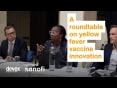
To discuss how improved vaccination efforts could help to prepare for future outbreaks amid global warming, global health leaders, regulatory authorities, educators, and frontline professionals came together at a roundtable cohosted by Devex and sponsored by pharmaceutical company Sanofi. On the sidelines, these were the experts’ key messages:
1. New technology can boost vaccine production
“Climate change is impacting the global environment, and using a different cell technology, we hope to improve the future supply of vaccines,” said Manuel Vangelisti, global project head of research and development at Sanofi, which has been producing a yellow fever vaccine since the 1950s. Sanofi has more recently been innovating the way yellow fever vaccines are produced and delivered, hoping to ensure more people are protected faster and more reliably.
Historically, the yellow fever vaccine has been produced using embryonated egg technology. Vero cell technology*, however, has the potential to improve stockpiling and quicker deployment. It also may offer more scalable manufacturing, improved formulation and shelf-life even amid higher temperatures, and greater resilience across cold chain and distribution systems, according to Sanofi.
2. New vaccines must be affordable
“Ensuring that innovations are affordable and accessible, especially in regions without donor support, is essential,” wrote Dr. Ana Rivière Cinnamond, PAHO representative to Panama, in an email to Devex. “The PAHO Revolving Fund plays a pivotal role in this regard, securing equitable and timely access to vaccines across the Americas.”
Gavi also helps by supporting countries to make choices around the vaccines and programs they want to invest in through its Gavi Leap strategy, which aims to optimize vaccine portfolios and increase immunization in lower-income countries. “With this, we are designing country vaccine budgets … and so we will work with our technical partners like WHO, UNICEF, and other members of the alliance to empower countries to take evidence-based decisions about their priorities for their national immunization programs,” Sim said.
Innovations such as a new yellow fever vaccine that would improve shelf life, thermostability, and production yields to get more vaccines out of the supply chain can drive greater operational efficiencies and benefits for countries and their programs, Sim added.

3. Local vaccine barriers must be addressed
Even if a new and improved yellow fever vaccine were to make it to countries most in need, such as Brazil, Ghana, and Nigeria, challenges on the ground make reaching vulnerable communities with the vaccine difficult.
An example shared by Anne Marie Borso Mbengue Seye, managing partner for global health at Performances Group, which works to bring private sector support to immunization efforts in public health centers, is the resistance from community members if they have to travel to a clinic for a yellow fever vaccination. “Sometimes you have this response from the community: ‘You are asking us to go out to get vaccinated, but we need to [travel] some 10 or 12 kilometers to reach the first health facility,’” she said, explaining that this is a deterrent.
Additionally, those in rural areas might be targeted for yellow fever vaccination while those on the immediate periphery of a city are not, Mbengue Seye said. Yet as climate change shifts the areas at risk, those populations could now be exposed. “Climate change has really changed the setting, and we see more and more threats in the cities,” she explained. To ensure coverage of any new vaccines, such issues have to be addressed, she said.
Dr. Ngashi Ngongo, principal advisor on programs management at the Africa Centres for Disease Control and Prevention, suggested working through local civil society organizations to ensure communities understand the risks that are related to diseases, the importance of necessary preventive measures, and the role they play in being able to inform when they see something abnormal happening. For example, if communities newly at risk of yellow fever were made aware of the signs of the disease, they would be able to notify the relevant authorities as cases emerge, potentially triggering preventative action.

4. Partnerships are crucial for pandemic preparedness
All those Devex spoke to highlighted how crucial cross-sector partnerships are in getting yellow fever under control amid increasing threats and addressing vaccine barriers.
“Looking ahead, bridging the gap between innovation and implementation for stronger epidemic preparedness requires coordinated, practical steps and inclusive partnerships,” said Rivière Cinnamond. “Fostering partnerships among governments, technical agencies, suppliers, and communities — alongside effective risk communication — will be key to translating innovation into real-world impact and building resilient health systems.”
Mbengue Seye believes partnerships at the regional level, in particular, are key “because there is no frontier for the vectors.” Often, vaccination centers are closer to border populations in the neighboring country, she explained, and allowing access wherever a vaccine is available is important in staving off yellow fever. “For us, we have to think regionally … and also include conflict areas and humanitarian settings,” she said.
Ngongo added that working with the private sector is especially critical to improving infrastructure, sharing real-time data, and accessing medical countermeasures, such as diagnostics, while partnering with research institutes allows for a better understanding of the likes of yellow fever as it emerges in new localities. “We want to learn more to understand the behavior of the outbreaks,” he said, “to understand the behavior of the vectors, and to understand the behavior of communities, to be able to tailor a response … to the context.”
*The vaccine candidate mentioned here is investigational and has not been approved by the U.S. Food and Drug Administration or any other regulatory agency worldwide. No conclusions regarding safety and efficacy should be drawn for such a candidate.
About the author

Devex Partnerships
Thanks for reading and for your interest in Devex. In collaboration with our partners, Devex’s partnerships editorial team produces content to promote a partner’s work or perspectives on a particular issue. It gives actors across the global development sector — including nongovernmental organizations, private sector stakeholders, aid agencies and government institutions — the opportunity to go beyond traditional advertising and tell their stories in an impactful way. If you’d like to learn more about how you can shine a spotlight on a particular issue with Devex, please email partnerships@devex.com. We look forward to hearing from you.
Search for articles


Most Read
- 1
- 2
- 3
- 4
- 5