Exclusive: World Vision braces for mass layoffs
Religious charities appeal for relief in confidential meeting with Peter Marocco, the State Department's enforcer of foreign aid cuts.
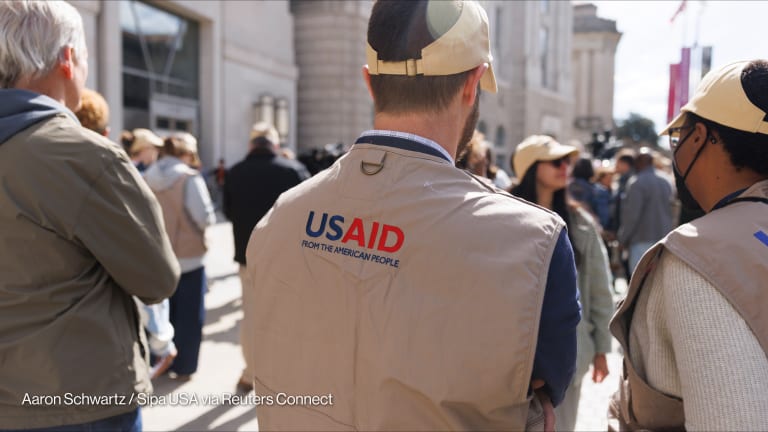
Aid organization World Vision is preparing to lay off as many 3,000 workers worldwide, underscoring the dire impact the U.S. foreign aid freeze has on the relief efforts of a core constituency supporting the Trump presidency: evangelical Christians. Edward Brown, vice president at World Vision, disclosed the layoff plans in a confidential meeting on Friday between representatives of mostly Christian faith-based aid groups and Peter Marocco, the U.S. State Department official overseeing the dismantling of the U.S. Agency for International Development. The State Department was also represented by Albert Gombis, the acting U.S. undersecretary for civilian security, democracy, and human rights. World Vision declined a request for comment. The State Department did not respond to a request for comment. But one Republican source told Devex on Wednesday that the State Department has begun this week to rescind termination orders for some contracts with World Vision and other aid entities, raising the prospect that the number of layoffs could be considerably smaller. Brown was one of several senior officials at faith-based charities seeking relief from a sweeping Trump administration crackdown on foreign aid, which has resulted in the absorption of USAID into the State Department. Other charities participating in the meeting included Samaritan’s Purse, World Relief, the International Justice Mission, or IJM, the Accord Network, Convoy of Hope, and the Adventist Development Relief Agency, or ADRA. Islamic Relief USA also participated in the meeting. But the largest Catholic relief organization, Catholic Relief Services, was not invited and did not attend, according to two sources. A spokesperson from the Catholic aid agency declined comment. The meeting comes just days before the State Department scheduled a meeting on Wednesday with members of the House Foreign Affairs Committee, where Marocco will try to defend the administration’s draconian foreign aid cuts and its elimination of USAID. The squeeze on faith-based groups runs counter to efforts of conservatives during the first Trump administration to elevate the role of local aid providers, particularly those from Christian religious relief outfits. It raised doubts about the current Trump administration to build on that approach. It also runs counter to recommendations of the Heritage Foundation’s Project 2025 — which has served as a rough blueprint for Trump’s governance strategy. Max Primorac, the author of the project’s section on USAID, proposed reforming the agency to better “champion the core American value of religious freedom,” educate its staff about the connection between religious freedom and development, and look to local NGOs, including faith-based organizations, to provide “less costly and more effective alternatives to the aid giants.” U.S. President Donald Trump issued an executive order on Feb. 7 establishing a White House Faith Office to ensure religious charities can “compete on a level playing field for grants, contracts, programs, and other Federal funding opportunities” and “welcomes opportunities to partner with such organizations through innovative, measurable, and outcome-driven initiatives.” At the same time, his administration has largely dismantled USAID, cutting funding for faith-based and secular aid groups alike. Friday’s meeting — which was characterized by the U.S. team as a “listening session” — did not provide participants with clarity on the fate of U.S. funding to faith-based groups. But it did shed light on the direction of U.S. foreign aid policy going forward, according to two sources. Marocco asked the participants to make the case for why the U.S. government should fund their charitable works, and encouraged them to consider philanthropic channels of funding, including their congregations and wealthy donors, according to one source. “The president and American people no longer have an appetite for foreign aid,” Marocco told the gathering, according to the source. Brown and other participants raised concern about the impact the initial freeze, and subsequent terminations, is having on their global operations, leading to steep job cuts and the hardship faced by aid recipients. At World Vision, the layoffs would represent about 9% of the charity’s global workforce of more than 34,000 serving in nearly 100 countries. It is unclear whether the Trump administration will extend special treatment to any of the faith-based groups or rescind the wave of termination notices that have landed in their email inboxes in recent weeks. Such a move would likely shrink the scale of layoffs. Marocco acknowledged that the process was “disruptive” for the aid organizations’ operation but insisted that it was necessary to eliminate programs the administration deems unworthy of U.S. support, according to a second source familiar with the exchange. Marocco said that the U.S. would likely eventually resume funding for some global health and humanitarian aid programs, the second source told Devex. But Marocco made clear that supplicants would need to make the case that their programs advance U.S. national security interests, according to the second source. Softer issues, like development aid and programs that promote democracy and governance, were unlikely to get the same level of support. At one stage in the 90-minute meeting, Gombis entered into a discussion with one of the relief agencies over the question of who would receive credit in the event that the U.S. resumed aid, according to the first source. It was unclear whether the U.S. or one of the representatives of a faith-based group raised that issue. Since the Trump administration first turned off the tap on the flow of foreign aid, faith-based relief organizations that receive large U.S. contributions — including Catholic Relief Services, World Vision, and others — have been forced to implement large-scale cuts. State Department waivers designed to ease the pain in lifesaving programs have offered little relief. “Millions of people rely on U.S.-funded humanitarian assistance for their survival, and these funding cuts are not just numbers — they represent children going hungry, mothers unable to access maternal healthcare, and entire communities left vulnerable to preventable diseases,” Lanre Williams-Ayedun, senior vice president of international programs at World Relief, said in a statement. “Without urgent action to restore these funds, countless lives will be at risk.” Marocco and other U.S. officials have imposed a series of bureaucratic hurdles that blocked the distribution of billions of dollars in funds, even in the face of humanitarian waivers and court injunctions, according to court records and U.S. government and independent assessments. On Feb. 28, Nicholas Enrich, the acting assistant administrator for global health at USAID, issued a memo claiming that it was “impossible” to distribute funds for programs with humanitarian waivers “due to administrative and bureaucratic challenges, including contradictory and shifting guidance regarding approval of required activities and failure of Agency leadership to process disbursement of funds for activities once approved.” Two days later, Enrich was placed on administrative leave. On Monday, the U.S. acting solicitor general, Sarah Harris, urged the U.S. Supreme Court to excuse the government from complying with a lower court decision requiring it repay $2 billion in foreign aid. Harris contended that plaintiffs’ claim that the freeze inflicted “extraordinary and irreversible harm” on them was no longer relevant, as the government review of foreign aid had been completed. In the meantime, the Trump administration sent out mass termination letters, killing off nearly 10,000 USAID and State Department contracts, effectively crippling America’s foreign aid operations. Update, March 5, 2025: This article has been updated with additional comments from a Republican source.
Aid organization World Vision is preparing to lay off as many 3,000 workers worldwide, underscoring the dire impact the U.S. foreign aid freeze has on the relief efforts of a core constituency supporting the Trump presidency: evangelical Christians.
Edward Brown, vice president at World Vision, disclosed the layoff plans in a confidential meeting on Friday between representatives of mostly Christian faith-based aid groups and Peter Marocco, the U.S. State Department official overseeing the dismantling of the U.S. Agency for International Development. The State Department was also represented by Albert Gombis, the acting U.S. undersecretary for civilian security, democracy, and human rights.
World Vision declined a request for comment. The State Department did not respond to a request for comment. But one Republican source told Devex on Wednesday that the State Department has begun this week to rescind termination orders for some contracts with World Vision and other aid entities, raising the prospect that the number of layoffs could be considerably smaller.
This article is free to read - just register or sign in
Access news, newsletters, events and more.
Join usSign inPrinting articles to share with others is a breach of our terms and conditions and copyright policy. Please use the sharing options on the left side of the article. Devex Pro members may share up to 10 articles per month using the Pro share tool ( ).
Colum Lynch is an award-winning reporter and Senior Global Reporter for Devex. He covers the intersection of development, diplomacy, and humanitarian relief at the United Nations and beyond. Prior to Devex, Colum reported on foreign policy and national security for Foreign Policy Magazine and the Washington Post. Colum was awarded the 2011 National Magazine Award for digital reporting for his blog Turtle Bay. He has also won an award for groundbreaking reporting on the U.N.’s failure to protect civilians in Darfur.