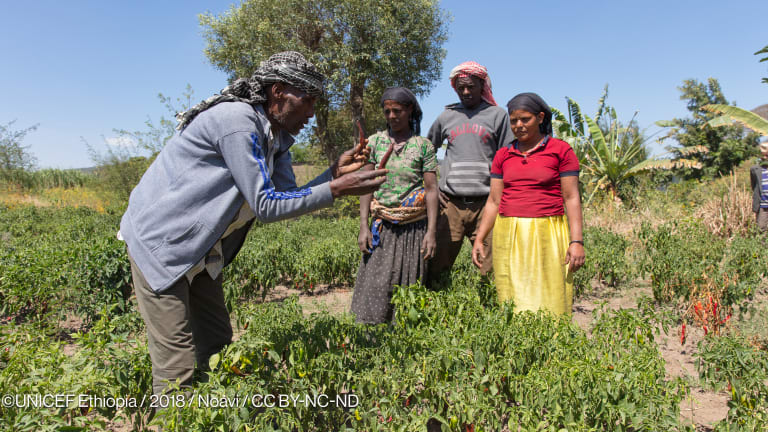
African groups want ‘reparations’ for Green Revolution’s shortcomings
Ahead of a major African agriculture conference, faith-based and civil society groups are calling on donors such as the Gates Foundation to pay for their role in allegedly damaging the continent's food systems.
African faith leaders, backed by civil society and farmer groups, are demanding “reparations” from donors to Africa’s Green Revolution for their role in allegedly damaging the continent’s food systems through industrial agriculture. In an open letter published this week, they say that donors should amend past mistakes by supporting agroecology, a system of sustainable farming that works with nature to produce food in ways that benefit the environment. Africa’s Green Revolution is the push to ensure food security by transforming agriculture and raising yields, often through extensive use of synthetic chemicals and fertilizers. The letter also asks major agriculture funders, particularly the Gates Foundation, to support Africa’s agroecology movement, which they claim can lead to a more sustainable, inclusive, and equitable food system. “As faith leaders, we have a responsibility as custodians of the Earth and of our faith communities to call out injustice and ensure the equitable sharing of resources for all, particularly the most vulnerable. It’s time for international funders to transition towards agroecology through respecting and supporting locally defined holistic approaches in Africa, by Africa,” they write. The letter is being organized by the Southern African Faith Communities’ Environment Institute, or SAFCEI, an environmental justice organization; with support from the Alliance for Food Sovereignty in Africa, or AFSA, the continent’s largest network of faith-based organizations and civil society groups representing more than 200 million farmers, fishers, pastoralists, and Indigenous peoples. It builds on a previous letter from 2021. The African continent contains some 60% of the world’s arable land, but over 140 million of its people face acute food insecurity. Meanwhile, its agricultural yields are among the world’s lowest. A rebranded conference The faith and farmer groups’ letter comes ahead of next week’s Africa Food Systems Forum, the continent’s largest agriculture conference, which is expected to draw some 3,000 heads of state, ministers, business leaders, and global development experts in Kigali, Rwanda. The forum aims to accelerate the transformation of Africa’s food systems by bringing together experts to discuss seed sector reform, private sector investment, and fertilizer and soil health. This year has a special focus on women’s leadership and investment in agribusiness. The annual event was formerly known as the Africa Green Revolution Forum, and it is hosted by AGRA, which rebranded in 2022 after being known since 2006 as the Alliance for a Green Revolution in Africa. The Gates Foundation is one of AGRA’s biggest funders, along with the United States and United Kingdom governments. AGRA in 2022 launched a new five-year strategy aimed at better addressing rising food insecurity on the continent through a greater emphasis on sustainable farming and markets and trade. Earlier that year, an independent evaluation found that AGRA’s strategy had “mixed” success in improving yields and had not achieved its goal of increasing incomes and food security for smallholder farmers. Critics have long targeted the organization for promoting a model of agriculture that relies too heavily on chemicals, along with expensive seeds, pesticides, and fertilizers. They also say it promotes monoculture farming, which is the growing of only one type of crop on large parcels of land. Each year critics use the forum to bring new attention to concerns around industrial agriculture and the Green Revolution’s shortcomings. According to this year’s letter, industrial-led agriculture has “failed” to meet the promise of reducing hunger on the continent and has instead led to the exploitation of smallholder farmers. As an example, it points to a new report on Zambia’s food crisis by the African Centre for Biodiversity which recommends an urgent shift to agroecological farming practices and principles. Zambia is one of the countries AGRA targets with its programs. The letter also says that grand promises of transforming Africa’s food systems have increased joblessness and inequality among millions of smallholder farmers. “AGRA’s political manipulation threatens to derail efforts to transition to more sustainable and locally-driven agroecological practices,” according to a press release announcing the protest letter. AGRA’s response In a five-page statement to Devex on Wednesday, AGRA disagreed with many of the points raised in the letter — while stressing that the organization welcomes the “open dialogue.” “We also emphasise the importance of evidence-based approaches supported by scientific research and extension services in helping smallholder farmers make informed decisions that enhance their livelihoods without compromising environmental health,” AGRA said. “We wish to ask SAFCEI to look into the research with a critical and open mind and realise that AGRA believes that transforming Africa’s food systems requires a comprehensive approach that integrates agroecology and the latest advancements in crop and soil science.” In response to SAFCEI’s opposition to an agricultural model reliant on costly synthetic inputs — namely seeds and fertilizers — AGRA said that without such interventions and its support for smallholder farmers, “the situation would likely be worse.” It cited its survey data showing largely positive outcomes for the 10.14 million farmers it has reached since 2017 — such as improved seeds, increased organic and inorganic fertilizer use, better access to formal financial services, and higher incomes. AGRA also said it does not advocate for the exclusive use of synthetic fertilizers. It called the “dichotomy” that SAFCEI presents between the Green Revolution and agroecology a “false choice.” “The path to inclusive agricultural transformation in sub-Saharan Africa will require a blend of agroecology and Green Revolution principles,” the organization said, adding that “organic methods can match the yields of conventional farming have not been convincingly proven, especially not on a scale that would make it a viable alternative for Africa.” What signatories want The letter calls on donors such as Gates to “make reparations” for the “ecological and social damage caused” by the Green Revolution by doing things such as promoting agroecological policies, such as seed and agricultural laws that give an edge to African communities over corporations. Signatories also call for more funding to Africa-based activities that focus on local knowledge systems and communities, along with supporting “the scaling up of the organic input supply chain, supporting the scaling up of participatory farmer-led research and community seed banking.” Food systems are becoming more vulnerable to pests and diseases, while malnutrition and micronutrient deficiencies are rising in many farming communities, according to AFSA. Meanwhile, soils are losing their fertility. “Industrial agriculture tends to benefit large agribusinesses and multinational corporations, while smallholder farmers often bear the brunt of the costs, leading to increased inequality and poverty in rural areas,” Kirubel Tadele, AFSA’s communications officer, told Devex. AFSA also noted that similar petitions opposing the Green Revolution in recent years have led to positive developments, such as African farmers’ stronger resistance to industrial agriculture models; African government-level policy shifts to better align with agroecological principles; and strengthened alliances among farmer groups and civil society networks to promote sustainable and equitable agricultural systems. Goals for the conference This year’s forum aims to accelerate Africa’s food systems transformation with women and the youth at the helm. This goal is tied to holding development partners accountable for helping African food systems to produce more and better food locally, build resilience to climate change, and improve African livelihoods while leveraging farmers’ potential to address global shocks, officials said. “Innovating, accelerating, and scaling are not just words, they are the pillars upon which the future of African food systems will be built. We are committed to leveraging the best of science, policy, and technology to drive this transformation,” the forum’s Managing Director Amath Pathé Sene said in a press release.
African faith leaders, backed by civil society and farmer groups, are demanding “reparations” from donors to Africa’s Green Revolution for their role in allegedly damaging the continent’s food systems through industrial agriculture.
In an open letter published this week, they say that donors should amend past mistakes by supporting agroecology, a system of sustainable farming that works with nature to produce food in ways that benefit the environment. Africa’s Green Revolution is the push to ensure food security by transforming agriculture and raising yields, often through extensive use of synthetic chemicals and fertilizers.
The letter also asks major agriculture funders, particularly the Gates Foundation, to support Africa’s agroecology movement, which they claim can lead to a more sustainable, inclusive, and equitable food system.
This article is free to read - just register or sign in
Access news, newsletters, events and more.
Join usSign inPrinting articles to share with others is a breach of our terms and conditions and copyright policy. Please use the sharing options on the left side of the article. Devex Pro members may share up to 10 articles per month using the Pro share tool ( ).
David Njagi is a Kenya-based Devex Contributing Reporter with over 12 years’ experience in the field of journalism. He graduated from the Technical University of Kenya with a diploma in journalism and public relations. He has reported for local and international media outlets, such as the BBC Future Planet, Reuters AlertNet, allAfrica.com, Inter Press Service, Science and Development Network, Mongabay Reporting Network, and Women’s Media Center.