


Presented by The Rockefeller Foundation
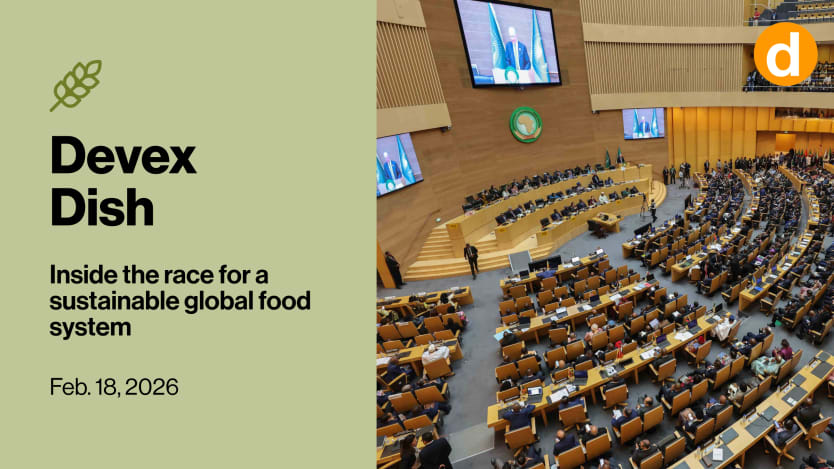
Agriculture and food security weren’t exactly headliners at the African Union Summit in Addis Ababa, Ethiopia, last week. But they were everywhere.
The summit’s official theme was water — and that thread ran straight through everything from mining to manufacturing to food systems. Africa faces a $64 billion annual water financing gap, with only $10.5 billion currently flowing in. In response, multilateral banks arrived with big ambitions, if not entirely new money, as Ayenat heard at the summit.
The continent’s biggest MDB, the African Development Bank, outlined a $1 billion investment program this year across 18 countries, which is expected to expand water access to 19 million people and sanitation to 12 million more. It also confirmed it is partnering on “Mission Water,” the World Bank’s new global water strategy, which aims to align multilateral development banks and other partners around a shared target that could reach more than 1 billion people globally. In eastern and southern Africa alone, the World Bank’s newly unveiled regional WASH plan, backed with about $1.6 billion, targets 30 million people across 12 countries over six years.
It’s not flashy, but it’s foundational. Water is the key input behind agriculture, health, mining, and industry — without it, none of the continent’s free-trade ambitions make sense. Which brings us to the other through line: the African Continental Free Trade Area, or AfCFTA.
The agreement, which would see countries reducing tariffs on almost all items over time, is in the early stages of implementation and has a long way to go in ensuring that countries are able to trade value-added products. At the summit, agricultural nonprofit AGRA and the AfCFTA Secretariat signed a memorandum of understanding aimed at translating the legal framework into practical outcomes for agricultural markets. The details were thin, but the intent is clear: Make intra-African food trade actually work.
“Trade will not transform Africa’s food systems unless farmers and agri-enterprises are able to produce competitively, meet international quality standards, and connect to reliable markets,” AGRA President Alice Ruhweza said at the signing ceremony in Addis. “This partnership is about making intra-African food trade work in practice.” The logic is hard to argue with. Many African countries remain heavily reliant on food imports, and when global supply chains seize up — as at the start of the all-out Russian invasion of Ukraine in 2022 — the vulnerability is immediate. Increased regional production and trade could cushion those shocks.
Nutrition, too, surfaced at the summit — especially in the context of declining official development assistance. The tension between ambition and fiscal reality was a recurring theme. At a side event convened by King Letsie III of Lesotho in his role as the AU nutrition champion, speakers pushed for scaling domestic resource mobilization. “For far too long, Africa has grown accustomed to a model where the bulk of national nutrition programs and multisectoral plans have been financed externally — over 75% of them through official development assistance,” Tendai Gunda of the Scaling Up Nutrition Movement told Ayenat. With most countries still allocating less than 1% of national budgets to nutrition despite malnutrition costing up to 11% of GDP annually, the closure of major USAID-funded programs and general aid reductions represent a wake-up call, she explained. “Nutrition is not a welfare issue; it is a core driver of Africa’s human capital, productivity, and economic resilience.”
On the farming front, AU Commissioner for Agriculture Moses Vilakati emphasized the importance of embracing digital transformation. In December, the AU hosted its first conference on digital agriculture — a signal that this is not a side conversation but an emerging priority. Vilakati argued that technology could help reverse a worrying trend among young people: “They are running away from agriculture,” he said. “But with digital transformation, while you are sitting here, you will be irrigating your farm at your own pace.”
Read: As multilateralism fractures, Africa seeks a more perfect union
See also: Amid water stress, experts want the world to get serious about irrigation
Don’t miss: Meet the agri-influencers drawing African youth to farming
+ There is a multitude of AI tools helping low-income farmers work smarter. Devex Pro members can dig into this piece that details the application of these tools and the farmers already using them across Africa and elsewhere. If you haven’t gone Pro, start your 15-day free trial now and access all our exclusive content, resources, and events.
In defense of food investment
More than 5,000 miles away in Germany, food systems advocates rubbed shoulders with defense and security officials at the Munich Security Conference last week while making their pitch: Invest in food systems now, or pay more later. “We’re not coming here to ask for money,” Máximo Torero, chief economist of the Food and Agriculture Organization, told our colleague Jesse Chase-Lubitz in Munich. “We’re coming here to tell them that there is a business case why they need to invest in what we do.” Though that may seem obvious to Dish readers, it was a tough message in an era where defense budgets are soaring — often at the expense of development aid funding.
Torero arrived in Munich with modeling in hand. A major soybean pest outbreak, already spreading in parts of the world, could slash yields by 30% in temperate regions and up to 50% in the tropics, with global losses reaching $54 billion, he said. Simulations of trade choke points told a similar story. When the Panama Canal or Suez Canal are disrupted — as seen during the Black Sea crisis — rerouted flows and higher costs ripple across markets. A full closure scenario of both canals could cost the global economy up to $95 billion annually, including $18 billion to $19 billion in food trade alone.
His message to NATO countries was that the investment required to buffer against these shocks is small compared to the risks. Torero is seeking $100 million to scale an anticipatory financing facility that would deploy insurance and early-warning systems across countries affected by food crisis. For an initial $36 million, he said, the mechanism could unlock up to $1 billion in coverage, delivering returns of up to $7 for every $1 invested and reducing the need for reactive humanitarian spending.
He wasn't the only one to bring this message to Munich: The conference featured 12 events focused on food, as well as a handful on water security. NATO has now established a food security working group — a sign the issue is gaining traction in broader security circles. But Torero left hoping for greater urgency. Defense leaders, he argued, are focused on feeding troops and addressing immediate geopolitical threats. What they risk overlooking are the slower-burning vulnerabilities — such as crop diseases, climate shocks, and trade bottlenecks.
Read Jesse’s recap: Development plays defense at Munich Security Conference
Related: At Munich Security Conference, development tries to stay relevant
From the archives: How maritime trade disruptions are hurting global food security
Didn’t you get the memo?
“A world that cannot feed itself is a world that can never be safe. We must recognize that food security and peacebuilding are two sides of the same coin.”
— Ban Ki-moon, former U.N. secretary-general, and Ismahane Elouafi, executive managing director of CGIARIn an opinion piece for Devex ahead of the Munich Security Conference, Ban Ki-moon and Elouafi had a similar message to Torero’s. While governments ramp up spending on defense, agricultural research remains underfunded, they wrote. In 2024, global military expenditure reached an unprecedented $2.7 trillion — a staggering contrast to the $15.2 billion needed annually in agricultural research to transform food systems, especially in fragile countries, according to the International Food Policy Research Institute.
Opinion: A memo to world leaders — food security is the basis of global stability
EAT sorrow
The Oslo-based foundation behind the groundbreaking EAT-Lancet report is closing its doors after nearly a decade. The EAT Foundation stated last week that its operational and funding model is “not sufficiently resilient for sustainable and ambitious operations in the years ahead.” The foundation’s board has decided on an “orderly wind down” this year while searching for new partnerships to continue some of the organization’s flagship initiatives.
Bringing home the bacon
Your next job?
Chair of the Scientific and Technical Advisory Panel
United Nations Environment Programme
Worldwide (remote)
“There are encouraging indications of interest in sustaining projects that have delivered significant impact over the past decade. The challenge hasn’t gone away,” says Gunhild Stordalen, EAT’s cofounder and executive chair. “If anything, it’s more pressing and the next chapter must be built to scale solutions in a way that is sustainable and fit for the world we are in.”
The landmark first EAT-Lancet report, published in 2019, found that food systems are a major driver of climate change and urged global adoption of a plant-based “planetary health diet.” It was both widely heralded and criticized, with some nutrition advocates saying its recommended diet was impossible to achieve in low-income settings and others attacking its message that the global north ought to eat less meat. A second iteration of that report released last October strengthened previous findings, while also emphasizing justice as a goal and driving force of food systems change.
Read: EAT Foundation to wind down after a decade of food systems work
See also: Planet at risk — new EAT-Lancet report warns food system overhaul is vital
Chew on this
Food systems are among the three key themes at the inaugural Mumbai Climate Week. [Devex]
The Crop Trust has launched an AI partnership with Google.org to support digital innovation in crop diversity conservation. [Crop Trust]
Jesse Chase-Lubitz contributed to this edition of Devex Dish.
About the authors

Ayenat Mersie
Ayenat Mersie is a Global Development Reporter for Devex. Previously, she worked as a freelance journalist for publications such as National Geographic and Foreign Policy and as an East Africa correspondent for Reuters.
Tania Karas@TaniaKaras
Tania Karas is a Senior Editor at Devex, where she edits coverage on global development and humanitarian aid in the Americas. Previously, she managed the digital team for The World, where she oversaw content production for the website, podcast, newsletter, and social media platforms. Tania also spent three years as a foreign correspondent in Greece, Turkey, and Lebanon, covering the Syrian refugee crisis and European politics. She started her career as a staff reporter for the New York Law Journal, covering immigration and access to justice.