


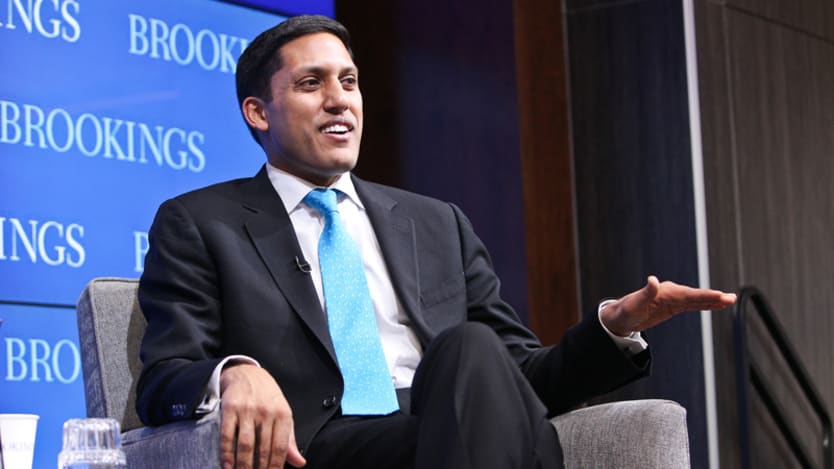
LONDON — Now is not the time to lay low. That is the advice for the new head of the U.S. Agency for International Development Mark Green from his predecessor Rajiv Shah.
Faced with looming budget cuts, three potential famines in East Africa and more than 65 million people displaced, Green must also navigate an administration determined to “get out of the business of development and aid,” Shah said, as U.S. Congress weighs President Donald Trump’s proposed 30 percent cut to the aid budget.
Mapping out Green’s obstacles in front of a small audience at the Overseas Development Institute in London last week, Shah — now head of the Rockefeller Foundation — praised Green’s credentials: “If we could’ve designed this the day after the election, you couldn’t do any better than Mark Green,” he said. But he also offered a sobering look at the implications of Trump’s proposed policy shifts.
See more related stories:
▶ USAID chief walks a tricky line on climate change
“It’s a disaster,” he told former USAID colleague, Alex Thier — now head of the ODI — during an onstage conversation. “[The] 30 percent proposed cut in the Trump budget obscures the fact that that 30 percent includes the entire operations of the State Department. Given that we’re not going to shut down a third of our embassies around the world, in practice, the cuts to aid and assistance are 50, 60, 70 percent in some areas.”
Such staggering cuts to the world’s most generous bilateral donor would not only compound the rising humanitarian crises, Shah said, but the shifts will likely reverse U.S. leadership on humanitarian food assistance, voluntary family planning, women’s and maternal and child health, “and on and on,” he said.
“It’ll basically create a negative influence as those things play out, if they play out as proposed,” he said. “The degree to which American humanitarian leadership is in question right now could not be overestimated.”
A different environment
While Shah celebrated Green’s capabilities and commitment “to the mission of development and humanitarian leadership,” he admitted the tone of the administration will be less cordial to even the most qualified development interests.
“I do hope he stays strong,” Shah said, “because unlike the working environment [Thier] and I had, I don’t think he’s entering a [National Security Council] principals’ table with everybody saying, ‘How can we help you?’”
Another strategy Shah suggested was to take advantage of his recent arrival and “go back in there and ask for a new budget.”
“He just got appointed, he should go in and say ‘you don’t want to be the president who on your watch let hundreds of thousands of children starve, and led to dismantling health programs that have extraordinary bipartisan support,’” Shah said.
Speaking to Devex after the talk, he described Green as a “seasoned political leader” whose experience working across the aisle will come in handy, particularly as he will be under pressure to revive smoldering aid interests in Congress; perhaps the last best hope for USAID.
“Mark Green should go in and say ‘you don’t want to be the president who on your watch let hundreds of thousands of children starve, and led to dismantling health programs that have extraordinary bipartisan support.’”
— Rajiv Shah, president at the Rockefeller FoundationWith a current approval rating of 9 percent, “Congress has not been known for civility or friendship and certainly not bipartisan action over the last decade,” Shah said. Yet it was during the past two decades that an embattled Congress managed to mark several aid milestones, including Electrify Africa and the President’s Emergency Plan for AIDS Relief.
He advised Green go in and saying: “Let’s rethink what we’ve been doing, given that there is this immediate crisis, given that we know the cuts in these programs will lead to real and immediate loss of life, and given that the last thing you want to be doing is sending troops or dealing with sending troops into places you’d rather not have to deal with in a military context. Let’s use our aid more aggressively in this context and just rethink the policy we’ve put forth.”
A changing sphere of influence
While it may be difficult for the new U.S. president to hear, the U.S. is falling behind when it comes to multilateral investment, Shah said. In order to catch up, he suggested that Green use USAID’s new “defensive position” to pursue reform, and to begin collaborating with China.
Read our series on China's expanding role in aid and development across the globe. From tensions in Ghana to projects in Pakistan, from climate financing to donor partnerships, from individual philanthropy to state-financed investment, we trace the past, present and future of Chinese aid.
“I’d point out that the most aggressive country that is using its soft power to expand its spheres of influence around the world is China, and the Chinese institutions, like the Chinese Development Bank and the Asian Infrastructure Investment Bank, are now larger in their global outlays in developing countries than the World Bank; and if you’re making a bet 20 years out, unless we partner with them, the Bretton Woods Institutions will be less important.”
More broadly, Shah suggested Green “make it about trade and investment, more about results in fragile states and national security hotspots,” as opposed to focusing on investments in middle-income countries. He said he believes that in the future, pursuing investments in fragile contexts such as Yemen and Northern Nigeria will yield “greater results for eliminating poverty than countries like Ghana.”
He also advised working with philanthropic institutions such as the Bill & Melinda Gates Foundation and the Rockefeller Foundation and the partners in the Giving Pledge community that “want to use their private capital to make the world a better place,” in order to “demonstrate these problems are solvable.”
At the end of the day, he said, Green will need to lean on the soft power argument.
“It’s reasonable to believe that leaders like Mark Green will be able to make the case that this 1 percent of the federal budget produces national security and economic benefits that far outweigh the cost, in a manner that’s compelling for this president to change [his] policy positions,” he told Devex.
Finally, he called on a higher power. “You never know, Mark could be very successful — and I think we have to hope and pray for that.”
What's the future of U.S. aid and development policy under the Trump administration? Read Devex news and analysis and subscribe to The Development Newswire.
About the author

Molly Andersmollyanders_dev
Molly Anders is a former U.K. correspondent for Devex. Based in London, she reports on development finance trends with a focus on British and European institutions. She is especially interested in evidence-based development and women’s economic empowerment, as well as innovative financing for the protection of migrants and refugees. Molly is a former Fulbright Scholar and studied Arabic in Syria, Jordan, Egypt and Morocco.


