
How Donald Trump signed the Global Fragility Act — and then kneecapped it
By Elissa Miolene // 30 April 2025
The first day that Donald Trump returned to the White House, the president used his inaugural address to make a promise. “We will measure our success not only by the battles we win, but also, by the wars that we end. And perhaps most importantly, the wars we never get into,” said Trump, speaking from the Capitol rotunda on Jan. 20. “My proudest legacy will be that of a peacemaker and unifier.” But today, the peacebuilding effort created during his first presidency — the Global Fragility Act — is hanging in the balance. The State Department bureau that once spearheaded that act is facing elimination, while the U.S. Agency for International Development, one of the initiative’s key players, has been all but dismantled. That’s caused lawmakers on both sides of the aisle to spring to the GFA’s defense — and from Congress to civil society to the State Department itself, many are still trying to keep what is today one of the last bipartisan aid efforts alive. “There are a lot of people trying to put Humpty Dumpty together again, but a lot of the damage is irreversible,” said one USAID staffer who worked on the GFA, and requested to speak anonymously as they are still employed by the agency. “That now rests on the shoulders of [the] State [Department].” Peace through prevention In 2019, the U.S. Congress passed the Global Fragility Act to fix what decades of foreign policy failures had made clear: the U.S. government wasn’t preventing conflict — or coordinating across its own agencies — as well as it could be. GFA was designed to change that. It required the Departments of State and Defense, and USAID — the so-called three Ds of U.S. foreign policy, because they cover development, defense, and diplomacy — to create joint strategies to prevent violent conflict and address its root causes. The fund also established two new funds in the U.S. Treasury to support such efforts: the Prevention and Stabilization Fund, which would be administered by the State Department and USAID; and the Complex Crises Fund, which would be administered by USAID. After Trump signed the act into law in 2019, it was taken forward by then-President Joe Biden the following year. In 2020, the U.S. government began implementing a strategy to prevent instability in a new way. And by 2023, the Biden administration had selected four countries and one region to hone in on: Haiti, Libya, Mozambique, Papua New Guinea, and Coastal West Africa, specifically the countries of Benin, Côte d’Ivoire, Ghana, Guinea, and Togo. “The [U.S. government] is pursuing a different approach to address the economic, social, and political drivers of fragility, committing nearly $2 billion in stability and conflict prevention-focused assistance in the priority countries and region,” reads the latest GFA report submitted to Congress, which covered the act’s efforts from 2021 to 2025. In Coastal West Africa, that meant hiring full-time staff to coordinate U.S. government diplomacy, assistance, and security across the region, along with efforts by the U.S. Treasury, Millennium Challenge Corporation, and the U.S. International Development Finance Corporation. In Mozambique, there has been much of the same: while USAID trained government officials to provide basic services for their communities, for example, American diplomats pushed their Mozambican counterparts on electoral accountability. All of that work was led by an interagency secretariat and other high-level committees, with members from the National Security Council, the State Department, USAID, the Department of Defense, the U.S. Treasury, and beyond. “It wasn’t just about development assistance. It was also about making sure that diplomacy and the security sector are all working together,” said Elizabeth Hume, the executive director of the Alliance for Peacebuilding. “Reform was needed, 100%. And that’s why we worked so hard to get the Global Fragility Act passed.” While the GFA focused on the U.S. government, it also pushed for wider peacebuilding investments. Rob Jenkins, the former assistant to the administrator at USAID’s Bureau for Conflict Prevention and Stabilization, explained how in Coastal West Africa, U.S. officials were working with those from the German, Dutch, and United Kingdom foreign offices — all of whom had contributed cash to the work — along with the local governments themselves. “To have one program being implemented by several donors, with money from several donors, I would think that that is exactly what this administration would like to see happening,” said Jenkins. “It is true burden-sharing, and it was, by all accounts, working effectively.” All that being said, GFA wasn’t perfect. Its progress was stunted by years of delays under the Biden administration, and country plans were only sent to lawmakers in 2023 — more than two years after a congressionally mandated deadline. Over time, the process also became “captured” by the State Department, Jenkins explained. “It really wasn’t the three Ds at that point,” he added. “It was the State Department making all the final decisions and driving things that both [Department of Defense] and USAID probably would have done a lot faster and simpler.” Despite the flaws, those involved with the process told Devex it was still the best approach the U.S. government had. And as each agency prepared to continue the GFA’s work, they had a longer-term vision in mind: the approach was meant to be iterative, Hume explained, and eventually rolled out to not just the target countries, but the rest of the world. “The GFA has had its challenges, but I’m still very much a believer,” said one State Department official familiar with the GFA, who spoke anonymously because they weren’t authorized to speak to the press. “It offers us a really valuable tool to reform the way we engage with a wide set of countries, and puts a greater focus on working with those countries to get ahead of conflicts.” ‘Fundamental questions’ In the lead-up to Trump’s return, the team behind GFA had all the evidence ready. “The transition paper for the incoming administration said: Here are the things we recommend that you do,” said the USAID staffer. “And part of that was how to better align some of our foreign assistance to our foreign policy.” Just weeks before Trump gave his inaugural address, the International Monetary Fund had released a paper on violence prevention, one that found for every $1 spent on prevention, the rate of return could be as high as $103. And given the bipartisan support for GFA — and the fact that it was signed into law under Trump — most thought it would survive the new administration’s cull of foreign aid. But days after the president’s return, USAID was placed in the administration’s crosshairs. Eighty-five percent of the agency’s programs were cut, and most of its staff — including those working on GFA — were either put on administrative leave or terminated. Such efforts meant that if the GFA’s work were to be continued, there would have to be a fundamental reshuffling of USAID’s conflict prevention programming. “About three-quarters of the programming that had been done for the GFA was being managed and implemented by USAID,” explained the State Department official. “So it raises fundamental questions about how we implement and approach the GFA now.” “There are no three Ds anymore,” Jenkins echoed. “There’s just two now. And that’s a problem.” On top of that, the State Department’s latest reorganization plan shutters the office once spearheading the GFA: the Bureau of Conflict and Stabilization Operations. While USAID handled many of the effort’s assistance programs, the State Department bureau has led the GFA’s strategy, while also chairing the interagency secretariat of State, USAID, and Department of Defense officials. In an agency-published blog post, Secretary of State Marco Rubio criticized the office above that bureau — the Under Secretary for Civilian Security, Human Rights, and Democracy — for having a “bloated budget and unclear mandate,” and stated it “provided a fertile environment for activists to redefine ‘human rights’ and ‘democracy’ and to pursue their projects at the taxpayer expense.” The offices beneath that team were either shuffled or sliced away, with the Bureau of Conflict and Stabilization Operations falling into the latter category. As of 2023, that team employed just under 120 people, most of whom are expected to face a reduction-in-force over the next 60 days. “I think [the GFA] can very much go forward with a [US]AID that is rolled up into the State Department,” said Shamil Idriss, the chief executive officer of the world’s largest peacebuilding organization, Search for Common Ground. “But the bottom line is that you need competent people to manage it, and you’ve got to have some money allocated to it so you can deploy to the front lines.” There is also no mention of conflict prevention within the proposed State Department structure — though in the agency-published blog post, Secretary of State Marco Rubio said that all “non-security foreign assistance” would be divided into regional bureaus or embassies. “The State Department would need to take on a greater role in managing some of the non-security programming, but there's no way that we could do the extent of what USAID was doing — or frankly, do it as well as USAID had been doing it previously,” the State Department official added. “In light of the reorganization, we really just don’t know what the future holds.” The State Department did not respond to a request for comment on this story. What’s next Late last week, a pair of Republican and Democratic lawmakers announced a bill to reauthorize the GFA and its corresponding funds until 2029. In an increasingly rare show of bipartisanship, the act was introduced by Rep. Michael McCaul, a Republican from Texas, and Rep. Sara Jacobs, a Democrat from California. "Protecting U.S. national security requires intentional work to prevent malign regimes and extremist groups from fostering and exploiting instability in their regions to expand their influence," said McCaul, who first introduced GFA in 2019. While GFA remains law, its funding mechanisms — the Prevention and Stabilization and Complex Crises funds — are nearing their expiry date. The legislation would extend the funds’ lifespans, while also requiring a yearly committee meeting with high-level GFA leaders to ensure “policy alignment,” a move that some experts feel is an attempt to preserve what may be on the State Department’s chopping block. “We're advocating internally that there has to be a clear process to ensure the GFA has a locus in the new structure, and ideally, a clear mandate, authorities, and some dedicated staff that can carry this thing forward,” the State Department official told Devex. “If it's just given to some officer in a particular bureau, the promise of GFA — and the vision that Representative McCaul and Representative Jacobs have for this — is not going to come to fruition.” Others are more optimistic. Idriss pointed to Rubio’s efforts to broker a peace deal between the Democratic Republic of Congo and Rwanda just last week, along with the sixth foreign policy priority outlined by the Trump administration: promoting lasting peace. And Hume highlighted calls from the Alliance for Peacebuilding’s 230+ organization network, which sent a letter to Rubio this afternoon that quoted the Secretary of State himself. “During your confirmation hearing, you noted, ‘Preventing crises is a lot cheaper and a lot better than dealing with crises after the fact,’” the letter states. “We could not agree more, but to prevent and reduce violent conflict and build sustainable peace in conflict-affected and fragile states, the State Department must retain its conflict experts.” Within that letter, the Alliance shared a series of recommendations for Rubio. Chief among them was placing a conflict unit within the Bureau for Political Affairs or the Office of the Coordinator for Foreign Assistance and Humanitarian Affairs, the latter of which Rubio has called a “reimagined” Office of Foreign Assistance. “This unit, regardless of where it is housed, must have the responsibility, authority, and resources to not only robustly implement the GFA, but also integrate conflict prevention and peacebuilding throughout ALL of the reorganized State Department’s diplomacy and assistance,” the letter continued. Key among those resources is staff, the letter states, along with the expertise of employees at both USAID and the State Department’s Bureau for Conflict and Stabilization Operations. If not, the State Department official said, the vision for GFA will fall flat — and the last five years of work may go with it. Meanwhile, one quarter of the world’s population — some 2 billion people — are living in contexts with high and extreme fragility, according to 2025 data from the Organisation for Economic Co-operation and Development, or OECD. “In the short term, it’s going to be utter chaos. But at some point, they’re going to wake up to the fact that they need assistance,” said Jenkins. “Maybe we don't want [what’s happening in] the Sahel to be spreading to our allies and going all the way down to the ocean in West Africa. If only we had some way to work in these environments. Well, we had them. They can rebuild them. But at the moment, they don't have it, and they don't even have any partners left to go to.”




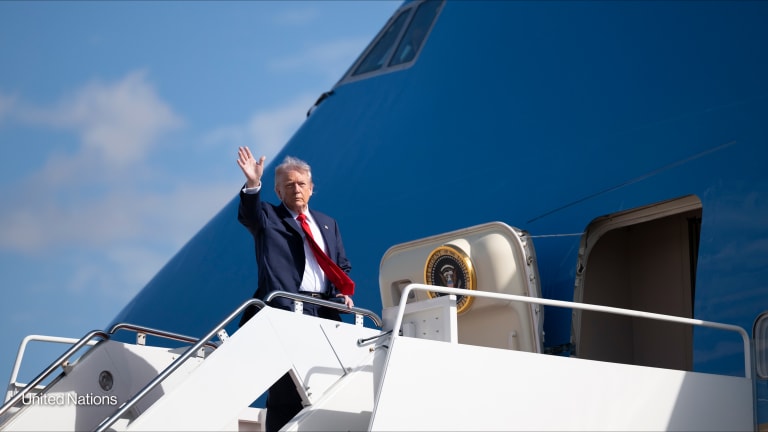
The first day that Donald Trump returned to the White House, the president used his inaugural address to make a promise.
“We will measure our success not only by the battles we win, but also, by the wars that we end. And perhaps most importantly, the wars we never get into,” said Trump, speaking from the Capitol rotunda on Jan. 20. “My proudest legacy will be that of a peacemaker and unifier.”
But today, the peacebuilding effort created during his first presidency — the Global Fragility Act — is hanging in the balance. The State Department bureau that once spearheaded that act is facing elimination, while the U.S. Agency for International Development, one of the initiative’s key players, has been all but dismantled.
Printing articles to share with others is a breach of our terms and conditions and copyright policy. Please use the sharing options on the left side of the article. Devex Pro members may share up to 10 articles per month using the Pro share tool ( ).
About the author

Elissa Miolene
Elissa Miolene covers U.S. foreign assistance from Washington, D.C. She previously covered education at The San Jose Mercury News, and has written for The Wall Street Journal, the San Francisco Chronicle, and other news outlets across the world. Before shifting to journalism, Elissa led communications for aid agencies in the United States, East Africa, and South Asia.
Search for articles


Most Read
- 1
- 2
- 3
- 4
- 5