Innovative finance brings new river blindness medicine to Africa
A new river blindness medicine is being introduced by a nonprofit pharmaceutical company in Ghana.
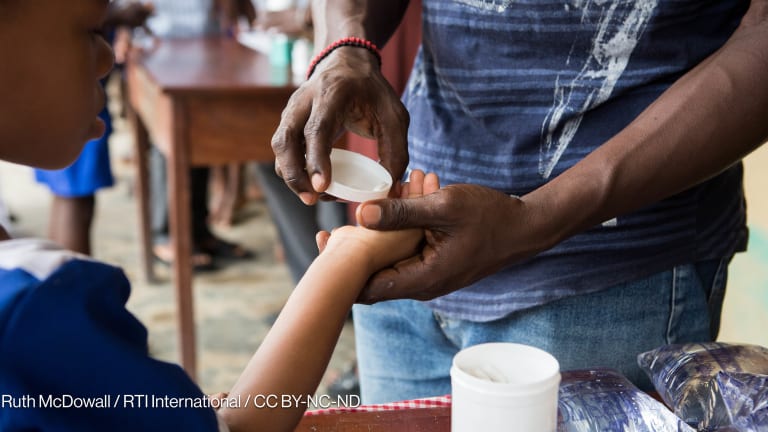
By Sara Jerving // 27 February 2025More than 30 years after the introduction of the first medicine for river blindness, a new medicine has been introduced in Africa by a nonprofit pharmaceutical company. The Australian-based Medicines Development for Global Health said it’s the first nonprofit to bring a novel medicine to market in an endemic country for any disease without a multinational pharmaceutical or generic company. It is now rolling out the new drug in one district of Ghana. Onchocerciasis, which is known as river blindness, results from the bites of infected black flies with a parasitic worm. Symptoms include severe itching, disfiguring skin conditions, visual impairment and in severe cases — permanent blindness. In 2023, at least 249.5 million people required preventive treatment against the disease and it was estimated in 2017 that 14.6 million of people who were infected had skin disease and 1.15 million had vision loss. More than 99% of infected people live in Africa and Yemen. To develop this new product and move it through regulatory processes, the nonprofit used a unique approach: impact investments, grants and philanthropic funds, along with the sale of a U.S. priority review voucher, said Sally Kinrade, vice president and project leader for onchocerciasis and lymphatic filariasis at Medicines Development for Global Health. “We’ve shown that there is another way to do this,” she said. A first To fund the development of this new drug, Medicines Development for Global Health worked with impact investors, the Global Health Investment Fund, which initially supported it during its submission of the drug to the U.S. Food and Drug Administration, or FDA. The U.S. FDA offers a priority review voucher to companies that develop new medicines for a list of neglected diseases that achieve regulatory approval. FDA then gives the developers a voucher that has an estimated value of about $100 million to accelerate the review of their next medicine, or to sell to another company. In 2019, Medicines Development for Global Health sold its voucher to Novo Nordisk. The impact investors were repaid with the voucher sale proceeds. Medicines Development for Global Health used the remainder of those funds to support ongoing work in neglected disease research and product development. “This may be a new model that could support more work in developing other medicines for global health needs where the funds are limited and you need to have the expertise of big pharma, but not necessarily the costs that go with it,” Kinrade said. Mass drug administration The strategy to tackle river blindness hasn’t been to seek out those with the disease and treat them solely, but to treat entire communities without knowing who was infected — because everyone’s at risk. It’s known as mass drug administration, where the drug serves as prevention and treatment. For decades Merck’s ivermectin was the only drug used in these campaigns and it has been successful at significantly reducing river blindness. But in 2018, FDA approved moxidectin. Studies have shown this new drug is more effective than ivermectin in suppressing the parasites. And key to that is the length of time the drug stays in the body, Kinrade explained. Clinical trials have shown that moxidectin stays in the body much longer than ivermectin. Around 15 hours after swallowing the old drug, about half of ivermectin remains in the body. Whereas, between 20 to 30 days after swallowing the new drug, about half of moxidectin remains in the body, she said. This leaves more time for the medicine to kill baby worms that cause the disease, ensuring the body isn’t reinfected. The microscopic larvae, known as skin microfilaria, live primarily on the skin of an infected person and when a black fly bites a person with these larvae, they can pick them up and pass them to the next person. “The benefit is the long durability of the treatment effect,” Kinrade said. This could mean there’s a need for fewer mass drug administration campaigns, which involve mobilizing community health workers, who are often volunteers, to deliver medicine house to house. “It's a huge effort and communities get tired of that. Every year or every six months, they have to line up and get treated,” Kinrade said. “People just say: ‘Oh, I can't be bothered anymore.’” And although ivermectin has helped in reducing transmission of the disease — there are places where it hasn’t been able to stop transmission when given once or twice a year, Kinrade said. New infections can last in the body for 12 to 15 years — with adult worms continuing to produce new worms regularly — making it difficult to eliminate new infections easily. Ghana takes the lead Following the U.S. regulatory body’s approval of moxidectin, the Ghana Health Service asked Medicines Development for Global Health for access to the drug in 2023. The company submitted a regulatory dossier to the Ghana Food and Drugs Authority, which announced that it approved the drug last December. “This is a milestone review and authorization by an individual endemic country,” Kinrade said. The next step is to get the medicine included in the guidelines from the World Health Organization, which is what most endemic countries rely on — and this could greatly expand access to its use in other countries, rather than having individual national regulatory bodies approve it. Last year, WHO started the process for assessing moxidectin, Kinrade said. This will include reviewing Ghanaian and American regulatory approvals. This process could take one to two years, and then there will be a need for treatment guidelines, which could happen in 2026, Kinrade said. Up next, Kinrade said they will need to find a sustainable model for financing the scale-up and supply of the medicine in countries. Currently, Ivermectin is donated by Merck. But Medicines Development for Global Health, as a nonprofit company, cannot donate its new drug unless they partner with a funder to cover the cost of manufacturing, or find another sustainable funding mechanism, Kinrade said. “The donation model is no longer what it used to be. Many companies want to get out of that, and so paying for the costs of providing medicine is something that everyone's trying to find a solution for,” she said. “A new, bespoke model is going to be needed, or even several, to help support new technologies in general, into the [neglected tropical diseases] space.” The company also didn't anticipate this drug would be used at the same scale as the old drug, but rather concentrated in hot spots. Kinrade said the disease burden is “quite a patchwork of scenarios” across the African continent. There’s also a need to map out where the new drug is needed.
More than 30 years after the introduction of the first medicine for river blindness, a new medicine has been introduced in Africa by a nonprofit pharmaceutical company.
The Australian-based Medicines Development for Global Health said it’s the first nonprofit to bring a novel medicine to market in an endemic country for any disease without a multinational pharmaceutical or generic company.
It is now rolling out the new drug in one district of Ghana.
This article is free to read - just register or sign in
Access news, newsletters, events and more.
Join usSign inPrinting articles to share with others is a breach of our terms and conditions and copyright policy. Please use the sharing options on the left side of the article. Devex Pro members may share up to 10 articles per month using the Pro share tool ( ).
Sara Jerving is a Senior Reporter at Devex, where she covers global health. Her work has appeared in The New York Times, the Los Angeles Times, The Wall Street Journal, VICE News, and Bloomberg News among others. Sara holds a master's degree from Columbia University Graduate School of Journalism where she was a Lorana Sullivan fellow. She was a finalist for One World Media's Digital Media Award in 2021; a finalist for the Livingston Award for Young Journalists in 2018; and she was part of a VICE News Tonight on HBO team that received an Emmy nomination in 2018. She received the Philip Greer Memorial Award from Columbia University Graduate School of Journalism in 2014.