Judge rules Trump’s USIP seizure unconstitutional, oversteps authority
The 102-page opinion will have the effect of undoing the “unlawful” firings of USIP board members and the resulting actions, including the transfer of USIP’s iconic D.C. property.
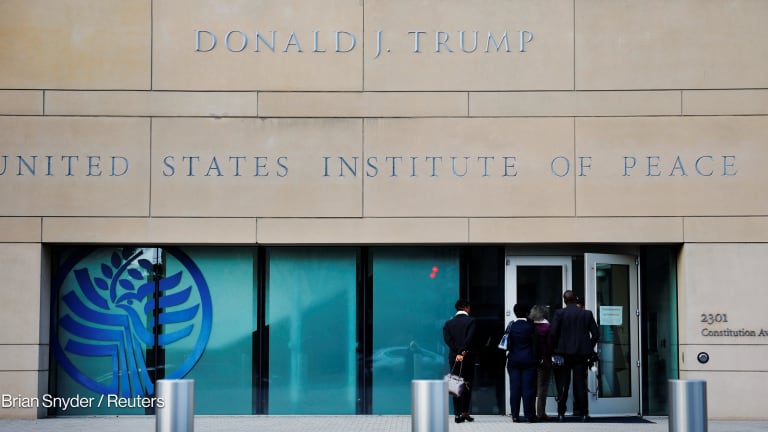
A federal judge has ruled in favor of the U.S. Institute of Peace, declaring that President Donald Trump’s efforts to dissolve the organization violated constitutional law and represented a “gross usurpation of power.” The decision follows months of legal back-and-forth around the U.S. Institute of Peace, an independent nonprofit organization established by Congress in 1984. For decades, the institute conducted research, training, and peacebuilding activities across the world. But earlier this year, the Trump administration removed the majority of USIP’s board, replaced its leadership, and seized its headquarters. The institute filed a lawsuit that challenged Trump’s authority to do so — and on Tuesday, District Judge Beryl Howell issued an opinion stating that those actions were unlawful. “The President’s efforts here to take over an organization outside of those bounds, contrary to statute established by Congress and by acts of force and threat using local and federal law enforcement officers, represented a gross usurpation of power and a way of conducting government affairs that unnecessarily traumatized the committed leadership and employees of USIP, who deserved better,” Howell wrote. Congress placed clear restrictions on the president’s ability to remove USIP board members, and the administration’s actions violate those laws, she wrote. Actions taken since — to reduce the agency to statutory minimums, remove its president, and terminate nearly all of its staff — were done by “illegitimately-installed leaders who lacked the legal authority to take these actions, which must therefore be declared null and void,” she wrote. The 102-page opinion, issued on Monday, will have the effect of undoing the “unlawful” firings of USIP board members and the resulting actions, including the transfer of USIP’s iconic D.C. property. It also underscores the limits of executive power in altering or dismantling entities established by Congress without legislative approval or in contravention of existing laws. ‘Blunt force’ takeover In February, Trump targeted USIP — along with several other aid agencies, such as the U.S. African Development Foundation and the Inter-American Foundation — with an executive order, stating that all those groups were “unnecessary,” and as a result, should be dissolved. Within weeks, staff from the budget-slashing Department of Government Efficiency, or DOGE, brought agents from the Federal Bureau of Investigation to the institute’s headquarters. After a standoff with Washington, D.C. police, the group took control of the building through what the judge described as “blunt force.” “With a newly installed USIP president, the Administration then handed off USIP’s property for no consideration and abruptly terminated nearly all of its staff and activities around the world,” she added. And by early April, all but four of USIP’s 300 staff were terminated — and Nate Cavanaugh, a 28-year-old staffer affiliated with DOGE, had taken over as president. While the agency continued to unravel, the government argued that the USIP fell under Trump’s control because it was situated within the executive branch. But those representing the institute made the opposite argument, stating that the USIP was independent from the president for a reason. William Murphy, lead attorney for the institute, described how USIP staff often engage with countries the U.S. government would not, such as North Korea — and that if those staff were actually representing the executive branch, the programs or research they were trying to deliver “wouldn’t work.” Ultimately, the judge agreed, finding that USIP should not be considered part of the executive branch because it does meet with other nations to carry out the president’s foreign policy objectives. “The USIP board, management and staff look forward to restarting USIP’s programs to promote and facilitate peaceful conflict resolution around the world,” the organization said in a statement on Monday afternoon. Update, May 19, 2025: This article has been updated with a comment from USIP.
A federal judge has ruled in favor of the U.S. Institute of Peace, declaring that President Donald Trump’s efforts to dissolve the organization violated constitutional law and represented a “gross usurpation of power.”
The decision follows months of legal back-and-forth around the U.S. Institute of Peace, an independent nonprofit organization established by Congress in 1984. For decades, the institute conducted research, training, and peacebuilding activities across the world. But earlier this year, the Trump administration removed the majority of USIP’s board, replaced its leadership, and seized its headquarters.
The institute filed a lawsuit that challenged Trump’s authority to do so — and on Tuesday, District Judge Beryl Howell issued an opinion stating that those actions were unlawful.
This article is free to read - just register or sign in
Access news, newsletters, events and more.
Join usSign inPrinting articles to share with others is a breach of our terms and conditions and copyright policy. Please use the sharing options on the left side of the article. Devex Pro members may share up to 10 articles per month using the Pro share tool ( ).
Elissa Miolene covers U.S. foreign assistance from Washington, D.C. She previously covered education at The San Jose Mercury News, and has written for The Wall Street Journal, the San Francisco Chronicle, and other news outlets across the world. Before shifting to journalism, Elissa led communications for aid agencies in the United States, East Africa, and South Asia.
Adva Saldinger is a Senior Reporter at Devex where she covers development finance, as well as U.S. foreign aid policy. Adva explores the role the private sector and private capital play in development and authors the weekly Devex Invested newsletter bringing the latest news on the role of business and finance in addressing global challenges. A journalist with more than 10 years of experience, she has worked at several newspapers in the U.S. and lived in both Ghana and South Africa.