Lessons from Togo on using technology to improve lives
Cina Lawson, Togo’s minister of Digital Economy and Transformation, explains how governments can use digital tools to provide their citizens with better access to public services, including cash aid.
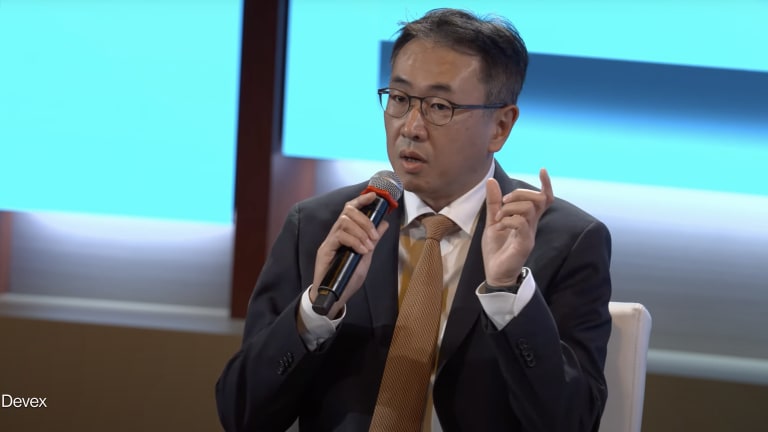
Togo has emerged as a model for how governments can use digital tools to provide their citizens with better access to public services, including cash aid. A shining example was how during the COVID-19 pandemic, the country’s Novissi emergency cash transfer program used machine learning to analyze call records and satellite imagery in order to prioritize assistance for the lowest-income people and send money to their mobile phones. Togo has since distributed $34 million to 920,000 people, or 25% of its adult population. Now, with $100 million from the World Bank, the government is building on what it learned from Novissi to expand its social safety net program. The goal is to send cash transfers to the 1.8 million people living in extreme poverty in the country. “It’s never about technology. It’s always about what technology can do,” Cina Lawson, Togo’s minister of Digital Economy and Transformation, said Wednesday at Devex’s summit on the sidelines of the United Nations General Assembly in New York. “Digital transformation has to serve a purpose. And the purpose has to be to better include our citizens.” Here’s what Togo has learned about how technology can support global development priorities. 1. Ensure access to connectivity Prior to working in government, Lawson spent her career in the telecommunications industry. She saw technology as “the tool that could enable real change on the continent,” she said. A majority of the population in Togo now has access to mobile phone technology, and adoption has skyrocketed in the last decade. Access to mobile devices increased from 33% in 2010 to 78% in 2021. During the same period, access to mobile internet increased from 1% to 74%, and access to mobile money increased from 1% in 2013 to 57% in 2021. Now, as Togo continues to improve access to mobile phone technology, it’s also focusing on high-speed internet. 2. Create “an enabling environment” for the private sector Lawson has changed regulations to increase private sector participation in the country’s digital transformation efforts. It’s critical to create “an enabling environment” for companies, she said, particularly when they have expertise the government lacks. Cybersecurity has emerged as one priority where private sector partnership is critical. The Togolese government worked with Asseco Data Systems, a Polish cybersecurity company, to set up a cybersecurity service company. “We said, ‘no, cybersecurity is a service. Let’s work with people who can actually deliver services.’ And most of the time, it’s the private sector,” Lawson said. Now, the Togolese government is partnering with the United Nations Economic Commission for Africa to create the African Cybersecurity Center to promote coordinated cybersecurity approaches on the continent. 3. Design projects to reach the lowest-income people At the outset of the COVID-19 pandemic, the Togolese government wanted to figure out how to support people working in the informal sector, as mobility restrictions prevented them from making a living. “How can we give them cash to support them?” Lawson said. “We said, ‘We need to build a platform to distribute digital cash so that they would receive it directly, with no intermediaries’.” Novissi, which means solidarity in the Éwé language, was built to work with 2G phones, which are still in use by 30% of the Togolese population — mostly the lowest-income people the government was trying to reach. Togolese citizens registered with biometric identification, which can include fingerprints, facial scans, and iris scans. The Novissi platform determined eligibility based on people’s professions and locations. Then the Togolese government used Unstructured Supplementary Service Data, or USSD, technology to ensure that people with 2G phones could receive mobile money payments. 4. Commit to external collaborators As the pandemic continued, the Togolese government partnered with individuals and organizations developing new methodologies to measure poverty and distribute aid. “We did not know how long the pandemic would last,” she said. “You can’t go around distributing cash not knowing if you’re going to be fighting [the] pandemic for an additional year. So we had to be very efficient in prioritizing beneficiaries.” Lawson contacted Esther Duflo, the Nobel prize-winning development economist who co-founded and co-directs the Abdul Latif Jameel Poverty Action Lab. She put Lawson in touch with researchers at the University of California, Berkeley. They used satellite imagery and artificial intelligence to draw a poverty map ranking Togo’s districts from lowest to highest income and used call data records to generate the phone numbers of people who earn less than $1.25 a day. Lawson said she was on Zoom calls with these researchers every Thursday afternoon for a year. Lawson and her colleagues also collaborated with GiveDirectly, a nonprofit organization that sends no-strings-attached cash grants to people living in extreme poverty. It provided $10 million of the $34 million the Togolese government distributed through Novissi. Lawson said this money served as a sort of demonstration before the Togolese Ministry of Finance was ready to take this leap to “pay out people based on AI.”
Togo has emerged as a model for how governments can use digital tools to provide their citizens with better access to public services, including cash aid.
A shining example was how during the COVID-19 pandemic, the country’s Novissi emergency cash transfer program used machine learning to analyze call records and satellite imagery in order to prioritize assistance for the lowest-income people and send money to their mobile phones.
Togo has since distributed $34 million to 920,000 people, or 25% of its adult population. Now, with $100 million from the World Bank, the government is building on what it learned from Novissi to expand its social safety net program. The goal is to send cash transfers to the 1.8 million people living in extreme poverty in the country.
This article is free to read - just register or sign in
Access news, newsletters, events and more.
Join usSign inPrinting articles to share with others is a breach of our terms and conditions and copyright policy. Please use the sharing options on the left side of the article. Devex Pro members may share up to 10 articles per month using the Pro share tool ( ).
Catherine Cheney is the Senior Editor for Special Coverage at Devex. She leads the editorial vision of Devex’s news events and editorial coverage of key moments on the global development calendar. Catherine joined Devex as a reporter, focusing on technology and innovation in making progress on the Sustainable Development Goals. Prior to joining Devex, Catherine earned her bachelor’s and master’s degrees from Yale University, and worked as a web producer for POLITICO, a reporter for World Politics Review, and special projects editor at NationSwell. She has reported domestically and internationally for outlets including The Atlantic and the Washington Post. Catherine also works for the Solutions Journalism Network, a non profit organization that supports journalists and news organizations to report on responses to problems.