
Making COVID-19 vaccinations convenient in South Sudan through faith





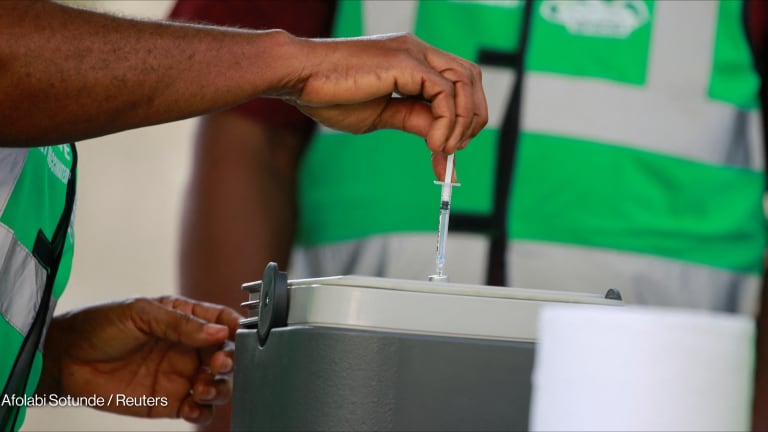
While rolling out COVID-19 vaccines in South Sudan, the Catholic Medical Mission Board found there was a key group of people not showing up in large numbers to get the jab — women. Many were too busy managing other aspects of their lives — such as raising children and working.
“They are very busy. They don't really have the luxury of time to go out and walk to the facility,” said Jacqueline George, South Sudan country director for CMMB, a faith-based international nonprofit that has been involved in COVID-19 vaccination programming since it began in the country last June.
Part of our Focus on: Faith and Development
This series illuminates the role faith actors and their communities play in strengthening global development outcomes.
But despite their hectic lives, one constant in women’s lives was attending places of worship. It’s estimated about 60% of the population in South Sudan is Christian, 33% follow animist religions, and 6% are Muslim.
“We decided to go out to the communities, to the churches. And that's where we found the women,” she said. CMMB sets up vaccination tents outside places of worship, whether it is a church on Sundays or a mosque on Fridays.
“It was more convenient if we were on their way, rather than asking them to stop everything and come out to the facilities,” she said.
They first hold meetings sensitizing religious leaders — answering questions about the vaccines and convincing them of their importance, so they can then relay that messaging to their congregations.
“Those are the first groups we try to get on board. Because unless we convince them, we can't convince their communities,” she said.
The religious leaders then speak about the benefits of vaccination during the service, often with health professionals present to answer questions from the congregation. Women church groups are also trained to mobilize other community members.
They have found this is a successful means of reaching women — of the about 80,000 people CMMB has vaccinated, 52% are women. Before this programming, only about a quarter were women.
CMMB’s work takes place in seven of the nation’s 80 counties. According to the World Health Organization, it is the vaccination partner with the highest level of uptake per facility in the country. According to CMMB, over 15% of the total number of people who are fully vaccinated in South Sudan were vaccinated at their facility.

Reaching women
For many women, this point of contact within a religious setting is the only opportunity to learn about COVID-19 vaccines. They might not own a radio or have time to listen to one, George said, adding that a very limited number of people across the country own televisions, most of whom are in the capital city of Juba. This limits the government’s ability to deliver health messages to people living in remote areas.
“There are also language barriers. We have 64 different tribes in South Sudan,” she said. “We are in a post-conflict country … and people have been very isolated in their different tribes. Breaking that is very difficult. It's almost as if everybody has been kind of growing in a different direction.”
When engaged on the vaccine, many South Sudanese women have questions, including whether they impact fertility and whether pregnant and lactating women could take the vaccine. There has also been confusion on why COVID-19 gets so much attention in a country with a high disease burden of other illnesses, such as malaria.
“The idea was that if more and more people got vaccinated, then they could have church as normal.”
— Jacqueline George, South Sudan country director, Catholic Medical Mission Board“Suddenly, everybody is just interested in COVID-19 and visiting far-to-reach areas [with vaccines],” she said. “I think that in itself, created its own fears.”
But after these questions were addressed, George said women have generally been willing to get the jab. And now CMMB teams up with women that have subsequently become pregnant after vaccinations, to help convince other women of the vaccine’s safety.
“We use them as ambassadors to go out and say: ‘I used to be one of the hesitant women. I took it and now I'm pregnant,’” she said. “That has been really helpful. I think over time, those kinds of fears are going away. It's not really the dominant issue now.”
Beyond places of worship, CMMB found it was able to reach women at nutrition centers when they brought children in for malnutrition treatment.
“We really go to places where women congregate for one reason or another — and that really helps a lot,” she said.

Involving faith leaders
To launch vaccines, CMMB hosts events attended by political, church, and community leaders, as well as their congregations.
For example, last June, the governor of Yambio, the capital of Western Equatoria state, was the first to take the vaccine during a launch event. This was followed by his cabinet members, as well as Samuel Peni, who is the bishop of Yambio and archbishop of Western Equatoria state Episcopal Church, as well as mosque leaders. The local radio stations were present at the event, which helped to broadcast the messaging to the broader community that was not able to attend the event.
Religious services can be a hotbed of infection, where the virus can spread easily among crowds of people in a tight space, George said, adding that religious services were banned during government lockdowns. Given this, one of the motivations behind vaccinations has been ensuring the safety of religious services.
“The idea was that if more and more people got vaccinated, then they could have church as normal,” George said.
Prior to the vaccine launches, CMMB had jingles that rang from the back of pickup trucks that would broadcast messaging around the vaccine and where people could get them. The organization also works with community volunteers that conduct door-to-door visits, handing out leaflets to families, explaining where they can get vaccinated.
“You have to keep at it,” she said. “Not all the communities are the same. You have to find different ways of reaching them and convincing them to take the vaccine.”
Broader challenges
But it’s not as simple as that. The country still faces significant barriers to achieving wide-scale vaccination. Key challenges include access to cold chain infrastructure, limited roads and ICT infrastructure, and severe flooding that can last for months on end, with communities accessible only by boat. There is also limited funding for rollouts, George said.
There also haven’t been high levels of reported deaths from COVID-19, or severe cases needing intensive care units in the country, making some question the necessity of receiving a vaccine.
“Some people think maybe they really don't need it,” George said, adding that there is a perception among some that it’s no longer a problem.
“There is really a need to work more with church leaders and see how we can take this to the next level ahead of all of the different variants coming out,” she said.
Devex, with support from our partner GHR Foundation, is exploring the intersection between faith and development. Visit the Focus on: Faith and Development page for more. Disclaimer: The views in this article do not necessarily represent the views of GHR Foundation.

About the author
Sara Jervingsarajerving
Sara Jerving is a Senior Reporter at Devex, where she covers global health. Her work has appeared in The New York Times, the Los Angeles Times, The Wall Street Journal, VICE News, and Bloomberg News among others. Sara holds a master's degree from Columbia University Graduate School of Journalism where she was a Lorana Sullivan fellow. She was a finalist for One World Media's Digital Media Award in 2021; a finalist for the Livingston Award for Young Journalists in 2018; and she was part of a VICE News Tonight on HBO team that received an Emmy nomination in 2018. She received the Philip Greer Memorial Award from Columbia University Graduate School of Journalism in 2014.
Search for articles


Most Read
- 1
- 2
- 3
- 4
- 5