



Presented by Pivotal
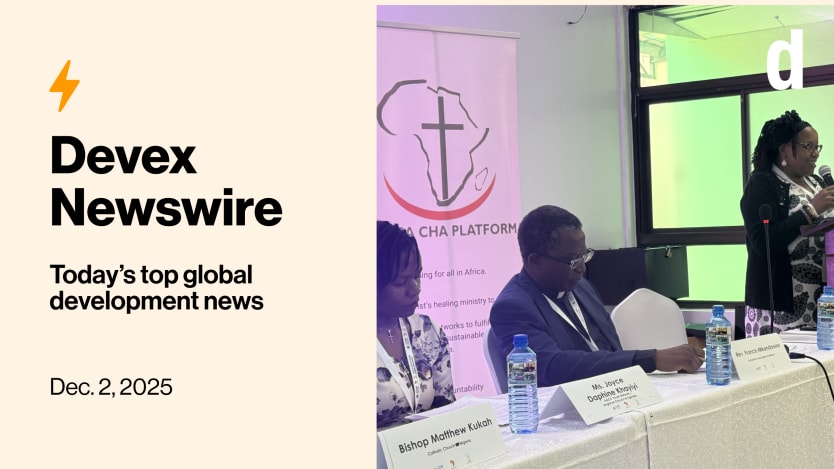
The U.S. State Department is wasting no time forging ahead with its “America First” global health strategy — and it’s bringing African faith groups into the mix.
Also in today’s edition: The collapse of a U.K. NGO prompts accusations that its Kenya team got ripped off in the process.
Faith value
The State Department’s “America First Global Health Strategy” is a big deal. In many ways, it’s the first incarnation of U.S. President Donald Trump’s vision for what global development should look like, and everyone in the sector is scrambling for insights into what ultimately rises from the ashes of USAID’s implosion.
So it’s notable that State Department officials are consulting with local faith-based organizations during their ongoing tour of African countries where U.S. teams are negotiating bilateral health agreements. It’s not necessarily a surprising move — the inclusion of faith-based groups in U.S. foreign aid is a key pillar of the administration.
But my colleague Sara Jerving saw parts of the strategy unfold at the African Faith and Health Leaders Consultation in Nairobi, where Christian faith leaders from across the continent — including bishops, reverends, and NGOs — gathered. Part of their message was to ensure faith-based communities are prioritized in negotiations and future U.S.-funded health care delivery.
And at least on the surface, it appears their pleas are being heard by State Department officials such as Brad Smith, the department’s senior adviser for the Bureau of Global Health Security and Diplomacy.
“One of the best things that has happened is that they’ve invested time and are going country-to-country to get to know what the faith networks really are, what their capacities are, what their demands are,” says Doug Fountain, executive director at Christian Connections for International Health.
Several leaders say that while African faith-based networks were included in previous American administrations, they would often get sidelined by larger American-based organizations — “the middleman,” as Karen Edvai Sichali Sichinga of the Churches Health Association of Zambia put it.
“Chances of local entities getting this funding was really slim,” says Dr. Tonny Tumwesigye, executive director of Uganda Protestant Medical Bureau. “These discussions are different in a way that they are involving us.”
“The emphasis has changed to how do we deliver on American ideas and strategies by working with local organizations?” adds Fountain. “That’s what feels different right now. That hadn’t been the case so much in the past.”
Read: State Dept taps African faith groups for bilateral health deal consults (Pro)
+ Are you aiming to maximize your impact in the $200 billion aid industry? Discover deeper insights with Devex Pro. From Nov. 26 to Dec. 3, we’re offering an exclusive Black Friday deal: Get 50% off on an annual Devex Pro membership. Sign up now. This is a unique opportunity to access our comprehensive resources at a significantly reduced cost.
No time to DI
Did money expected to go toward severance payments for the laid-off employees of a U.K. NGO that went bust instead get channeled to liquidators? That’s the charge being levelled by some.
The U.K. NGO in question is Development Initiatives, which collapsed last year, leaving around 50 U.K. and Kenyan staffers out of work within days. No severance was provided to the East Africa teams — which had been central to DI’s localization strategy — even though new liquidation documents show that more than £107,000 was held in its Kenyan bank accounts at the time.
In a public LinkedIn post, Bill Anderson, who served as DI’s data and innovation lead, wrote that U.K. employees received statutory redundancy but “our colleagues in East Africa … received zero compensation,” describing them as “left destitute.” He also alleged that over £100,000 in DI’s Nairobi accounts — money that he said was “rightfully deposited there for East African operations” — was subject to “repatriation” attempts by U.K. liquidators to cover insolvency costs.
Another former DI staff member, Martha Getachew Bekele — now director and cofounder of Development Transformations, the organization formed by much of DI’s former Africa team — described what she called the “painfully personal” inequities experienced by the team in the region.
But not everyone sees something nefarious. A former DI employee who asked to remain anonymous tells Devex contributing reporter Susannah Birkwood that the organization had been “on a sincere and determined path” to shift leadership and decision-making to its African team. “There was a real sense of us moving in that direction, but the organisation ran out of time.”
They also emphasized that DI’s experience mirrored broader pressures affecting midsized NGOs. “Nothing about DI’s experience was unique,” they say. “Other organisations hit the same challenges. It’s a very difficult period for the sector.”
Read: Recent NGO collapse prompts anger as Kenya funds sent to UK (Pro)
Background reading: Development Initiatives, group using data to ‘end poverty,’ goes bust (Pro)
Pound for pound
Weight-loss drugs such as Ozempic and Wegovy have soared in popularity in high-income countries like the United States, where people are willing to pay a pretty penny for the chance to slim down.
But the high costs of these drugs could be significantly tamed after their patent expires in several major markets in early 2026. That’s good news for people hoping to access treatments shown to be incredibly effective in combating obesity and metabolic diseases, with one study estimating their universal availability could reduce global obesity prevalence by 20% and save 28 million lives over a period of five years.
But the news is a double-edged sword, writes Devex contributing reporter Catherine Davison. The same property that seems to spur weight loss — GLP-1, a natural hormone that regulates blood sugar levels — also helps control diabetes. The concern is that the profitable weight-loss market will prompt companies to divert resources and production away from the diabetes care market, says Jayasree Iyer, CEO of the Access to Medicine Foundation.
But won’t the availability of generic GLP-1 drugs, whose potential benefits range from reducing cardiovascular disease to curbing addiction, still be an overall plus for people in lower-income countries? Not necessarily.
“Very steep generic competition is going to happen over this drug, so the prices are going to fall tremendously,” says Leena Menghaney, a public health and intellectual property expert. But she warns that without strict regulations and government policies, access will remain elusive for lower-income countries: “It’s such a lucrative drug that everyone wants to sell it to high-income and upper-middle-income countries first.”
Read: Ozempic generics are coming. But will low-income countries benefit?
WHO’s 2 cents
GLP-1 drugs could fundamentally reshape how we fight obesity, which was associated with 3.7 million deaths in 2024 — a number projected to double by 2030. The World Health Organization has taken note, issuing its first guideline on treatments to support millions of people struggling with obesity.
The guideline specifically recommends GLP-1 therapies, which may be used by adults — as long as they aren’t pregnant — for the long-term treatment of obesity, my colleague Jenny Lei Ravelo writes. WHO Director-General Tedros Adhanom Ghebreyesus says the “new guidance recognizes that obesity is a chronic disease that can be treated with comprehensive and lifelong care.”
But the recommendations come with uncertainties and say more evidence is needed on the benefits and potential harms associated with longer use of GLP-1 therapies.
They also come with the caveat we’ve already underscored: access, with WHO warning that “GLP-1 therapies are projected to reach fewer than 10% of those who could benefit by 2030,” even with the anticipated rapid expansion of production of these medicines.
Read: WHO issues recommendations for weight-loss drugs to treat obesity
In other news
A new UNDP report warns that without stronger investment and safeguards, AI could widen global inequality by helping wealthy countries advance while leaving poorer and marginalized communities further behind. [AP via ABC News]
The U.K. has withdrawn $1.15 billion in export finance for TotalEnergies’ controversial Mozambique gas project, citing rising risks amid accusations that the scheme fuels climate harm, human rights abuses, and regional insecurity. [The Guardian]
U.N. Secretary-General António Guterres has proposed a 15% cut to the organization’s 2026 core budget, including an 18% reduction in staff, as the U.N. faces a deepening cash crisis driven by mounting U.S. arrears. [Reuters]
Sign up to Newswire for an inside look at the biggest stories in global development.
About the author

Anna Gawel
Anna Gawel is the Managing Editor of Devex. She previously worked as the managing editor of The Washington Diplomat, the flagship publication of D.C.’s diplomatic community. She’s had hundreds of articles published on world affairs, U.S. foreign policy, politics, security, trade, travel and the arts on topics ranging from the impact of State Department budget cuts to Caribbean efforts to fight climate change. She was also a broadcast producer and digital editor at WTOP News and host of the Global 360 podcast. She holds a journalism degree from the University of Maryland in College Park.
Search for articles


Most Read
- 1
- 2
- 3
- 4
- 5