Malawi struggles to fill development gaps after US aid cuts
Malawi is scrambling to keep critical health, education, and development programs afloat after deep cuts to U.S. foreign aid exposed the country’s heavy reliance on donor funding.
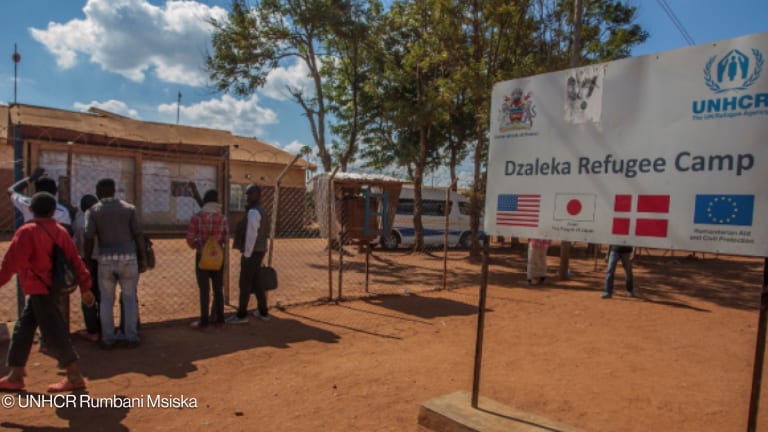
Malawi’s development programs are in limbo as the government struggles to plug gaps left by the United States’ aid cuts. With the Malawian kwacha plummeting, an additional 435,000 Malawians were expected to fall below the poverty line last year — experts told Devex the country will be hard-pressed to make up the shortfall, despite changes to the tax regime and a bilateral deal with the United States for health funding. The U.S. government, through USAID, had been supporting Malawi with over $350 million annually across sectors, including HIV/AIDS, basic health, agriculture, and education. Malawi also benefited from compacts with the Millennium Challenge Corporation, or MCC, launching a second $350 million compact aimed at improving transport networks and land productivity in 2022. However, following a U.S. federal directive to reduce foreign aid spending, most development projects have been halted, and MCC has shut down operations in Malawi. Amid mounting macroeconomic pressures — including high inflation, unsustainable fiscal and debt dynamics, and declining official development assistance — economist Gilbert Kachamba said the USAID cuts have deepened existing vulnerabilities, and that the government’s response so far is insufficient to address the scale of the crisis. “The important thing is the self-sustainability of the country after aid. What the country now needs is a structural transformation beyond simple responses, including balancing austerity measures with the need to protect vulnerable populations,” Kachamba said. Devastating impact The loss of U.S. assistance is being acutely felt in Malawi’s health sector, particularly in the fight against HIV/AIDS. Six projects worth an estimated $176.5 million under the President’s Emergency Plan for AIDS Relief, or PEPFAR, have been terminated. The U.S. has been a cornerstone funder of Malawi’s HIV and AIDS response, and reduced funding could lead to shortages of antiretroviral therapy and jeopardize the country’s hard-won progress toward the 95-95-95 targets. That could be compounded by the U.S. decision to withdraw from 66 international entities, including 31 United Nations agencies such as the U.N. Population Fund, or UNFPA, which supports sexual and reproductive health and rights. Malawi — which has received more than $1.8 billion in U.S. investment through PEPFAR since 2003 — has been forced to reduce PEPFAR-supported resources by 45%. Ulemu Chirwa, district HIV and nutrition officer for Lilongwe, said her office is responding by integrating services so patients accessing HIV care can also receive family planning, diabetes screening, and blood pressure checks. Beyond health care, the aid cuts have left nearly 60,000 refugees at Dzaleka refugee camp facing food shortages following reduced funding to the UN Refugee Agency and the World Food Programme, both of which have scaled down operations in Malawi. The education sector has also been hit hard. The U.S. had been providing around $25 million for basic education and $8.5 million for post-secondary education, supporting teacher training, learning materials, and infrastructure. Finding solutions In response, the Malawian government has allocated $13.3 million in the 2025/2026 budget to mitigate the impact of aid cuts in the health sector and plans to recruit 6,000 health workers. The government is also pursuing financial reforms, including revisions to the tax regime. Malawi has increased pay-as-you-earn and value-added tax, introduced bank and mobile money transfer levies, and is considering pension and inheritance taxes, aiming to raise more than 2.323 trillion Malawian kwacha ($1.34 billion) through tax revenues. However, with the wage bill and statutory obligations consuming 90% of domestic revenue, analysts say the government’s capacity to fund essential services through local resources remains severely constrained. Opinions on the tax reforms are mixed. Some analysts argue they are necessary to boost revenue and reduce donor dependence, while others warn they could erode household incomes, fuel inflation, and worsen welfare outcomes. Bertha Bangara-Chikadza, president of the Economics Association of Malawi, said taxation alone cannot resolve Malawi’s fiscal challenges but described the reforms as a signal of renewed fiscal discipline and a reminder of the need to prioritize production and economic growth. Meanwhile, NGOs affected by the aid cuts have begun coordinating more closely to avoid duplication. Davies Mwachumu, advocacy and marketing manager at AIDS Healthcare Foundation Malawi, said the national and international NGOs are also increasingly localizing projects, working with community-based organizations as another cost-cutting strategy. Malawi also signed a five-year, $936 million bilateral health compact with the U.S., under which Washington will provide up to $792 million, while Malawi commits to increasing annual health spending by $143 million. The compact is expected to improve health infrastructure, disease surveillance, and outbreak response, offering partial relief after USAID funding cuts. But its success will depend on whether it can address deeper structural issues, including ongoing donor dependence. Health rights activist George Jobe told Devex that if done well, the compact could help improve health outcomes in Malawi, but was quick to point out that its success is far from guaranteed, requiring the government to work hard to ensure the compact translates into tangible benefits for patients and healthcare providers. Long-term implications While the government scrambles to secure alternative funding, the aid cuts are already having far-reaching economic consequences. Although the national budget includes domestic financing, donor support still accounts for the majority of funding for key social services. Studies show that 73% of the country’s development project funding comes from donors, with 55% of the health budget externally financed — leaving Malawi vulnerable to external shocks. As a result of the cuts, Malawi’s gross domestic product was projected to shrink by $127 million last year, with cumulative losses reaching $1.3 billion by 2030. With a growth forecast at 3.2% and debt at 86% of GDP, it is estimated that a large percentage of the country’s 8.1 trillion Malawian kwacha (around $4.6 billion) national budget will go toward interest payments, nearly double what is allocated to health and education combined. Despite the Malawi government reaffirming its commitment to protecting vulnerable households amidst concerns over food insecurity, economic and development experts still warn that in the absence of U.S. assistance, this will be a tall order. Mavuto Bamusi, a renowned Malawian political and economic analyst, said the country needs to rationalize tax incentives, strengthen tax compliance through digitalization, and enhance transparency. He also recommended a focus on productive sectors such as agriculture — and said the country “should explore alternative funding sources, such as partnerships with private sector entities, to support development projects.”
Malawi’s development programs are in limbo as the government struggles to plug gaps left by the United States’ aid cuts. With the Malawian kwacha plummeting, an additional 435,000 Malawians were expected to fall below the poverty line last year — experts told Devex the country will be hard-pressed to make up the shortfall, despite changes to the tax regime and a bilateral deal with the United States for health funding.
The U.S. government, through USAID, had been supporting Malawi with over $350 million annually across sectors, including HIV/AIDS, basic health, agriculture, and education. Malawi also benefited from compacts with the Millennium Challenge Corporation, or MCC, launching a second $350 million compact aimed at improving transport networks and land productivity in 2022.
However, following a U.S. federal directive to reduce foreign aid spending, most development projects have been halted, and MCC has shut down operations in Malawi.
This story is forDevex Promembers
Unlock this story now with a 15-day free trial of Devex Pro.
With a Devex Pro subscription you'll get access to deeper analysis and exclusive insights from our reporters and analysts.
Start my free trialRequest a group subscription Printing articles to share with others is a breach of our terms and conditions and copyright policy. Please use the sharing options on the left side of the article. Devex Pro members may share up to 10 articles per month using the Pro share tool ( ).
Madalitso Wills Kateta is a Malawi-based Devex contributing reporter. He specializes in gender, human rights, climate change, politics, and global development reporting. He has written for the Thomson Reuters Foundation, The New Humanitarian, African Arguments, Equal Times, and others.