
Money Matters: How much has the US State Dept spent on aid in 2025?


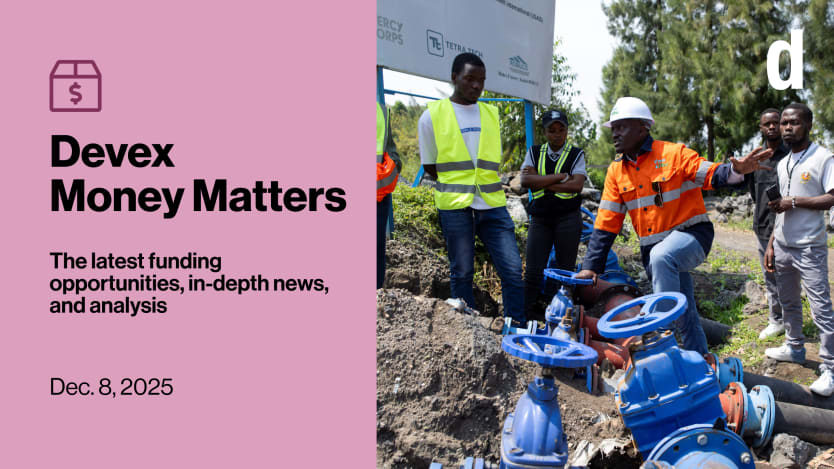
On the face of it, data on U.S. aid spending in 2025 presents a better-than-expected picture, with tens of billions going to development. But look a little closer and the picture gets less rosy.
Also in today’s edition: The World Bank plans to cut 22,000 jobs, and Germany follows through on funding cuts.
+ Are there topics you want to read more about in Money Matters? We want your feedback.
Not a good State
The U.S. fiscal year came to a close in September, and most of the data on what was spent is now available from a U.S. government site, foreignassistance.gov. The figures are still labeled as provisional, so new spending could be added, but it’s in a sufficiently finished state that we’re able to analyze.
Unfortunately it’s not possible to identify the dates that aid was disbursed, so we can’t draw definitive conclusions, but we can see that $32.5 billion was disbursed in fiscal year 2025.
That’s a lot less than the figure of $68 billion for the prior year, but it’s still a lot of money, so on the face of it, things look better than we might expect.
But a closer look suggests that the vast majority of the funding went to projects agreed under the Biden administration, with little going to new projects initiated since the transfer of aid to the State Department.
Read: What did the US spend on aid in 2025? (Pro)
+ This Wednesday at 9 a.m. ET, we’ll host a major event on how to navigate the job market in 2026. It’s open to holders of Devex Career, Pro, and Pro Funding memberships, so sign up now.
Funding activity
We publish tenders, grants, and other funding announcements on our Funding Platform. Here are some of those viewed the most in the past 10 days.
The African Development Bank has approved a $24.6 million loan to revitalise and expand agro-industrial production in Tanzania.
The European Union has announced a €1.35 million ($1.6 million) call for proposals to support civil society organizations in sustainable development in Yemen.
German funder GIZ is seeking expressions of interest for a climate change program focused on a just transition to a low-carbon economy in South Africa.
Another German agency, KFW, has announced a call for proposals to strengthen institutional capacity and youth engagement in Lebanon.
The OPEC Fund for International Development has signed a $30 million loan to modernize health services and improve access to quality care in Fiji.
The World Bank has launched a call for expressions of interest to develop a digital transformation strategy and asset management in Bangladesh.
+ Interested in more funding coverage? Start a five-day free trial of Devex Pro Funding today and explore funding opportunities from over 850 funders with the data analysis and industry intelligence you need to win them.
Long story short-term
The World Bank has vowed to remove an amazing 22,000 short-term consultants, or STCs, from its roster in the coming months, with all of those roles due to be gone by January 2027. It’s an astonishing shift in how the bank will do business, and it’s prompted a huge alarm, as well as plenty of questions.
The bank’s reliance on STCs comes for a familiar reason, seen at many other development organizations — shareholders haven’t agreed on sufficient staffing budgets to hire permanent staff, so the bank has raided other budgets to pay for consultants to cover the gap.
As a result, many people feel that it’s right that the bank reduced its reliance on this type of work. But there’s a lack of confidence that viable alternatives exist.
Some suggest that the real reason for the shift is changes to visa policy in the U.S. — where many short-term contractors are currently located.
Read: Mounting questions over World Bank’s sweeping consultant purge (Pro)
‘Quite a departure’
The United States has signed its first bilateral health deal, with Kenya, which will see it invest $1.6 billion in the African country over the next five years.
It’s a shift to a new development policy which sees the U.S. sign bilateral deals with individual governments, in a move away from a more multilateral approach, with one prominent Kenyan official calling it “quite a departure.”
The U.S. says it intends to sign dozens of deals with low- and middle-income countries in the coming weeks, although the truth of this is still to be seen.
Read: The US signs first bilateral health deal with Kenya for $1.6 billion
+ On Tuesday, Dec. 16, we will host a Devex Pro Briefing with Neil Buddy Shah of the Clinton Health Access Initiative and Mark Dybul, former U.S. global AIDS coordinator, to dive inside the U.S. bilateral health agreements. Save your spot here.
No boost from Berlin
German humanitarian aid funding looks likely to be more or less flat in 2026 — effectively a cut once adjusted for inflation.
That’s according to a recently approved federal budget — the first from the country’s new government.
And the cuts will be accompanied by a substantial restructure in the German foreign office, which is expected to entail job losses among staff working on international development.
Read: Germany overhauls foreign office amid major humanitarian budget cuts (Pro)
Does development need a good sheikh?
With funding dropping all over the world, one country is bucking the trend — Qatar.
Qatar has a GDP of around $220 billion, and living standards are far higher than in most western European countries. In recent years, its main aid agency, the Qatar Fund for Development, has been particularly active in nearby nations, such as Syria.
So what does the future hold for this growing powerhouse in the region? My colleague Elissa Miolene has the answers.
Read: Qatar’s quiet rise as a development powerhouse (Pro)
Related: From China to the Gulf — the donors reshaping global development (Pro)
+ Not yet a Pro member? Start your 15-day free trial today to access all our expert analyses, insider reporting, funding data, exclusive events and briefings with sector leaders, policymakers and influencers, and more.
Sign up to Money Matters for an inside look at the biggest stories in development funding.
About the author

David Ainsworth@daveainsworth4
David Ainsworth is business editor at Devex, where he writes about finance and funding issues for development institutions. He was previously a senior writer and editor for magazines specializing in nonprofits in the U.K. and worked as a policy and communications specialist in the nonprofit sector for a number of years. His team specializes in understanding reports and data and what it teaches us about how development functions.
Search for articles


Most Read
- 1
- 2
- 3
- 4
- 5