
Money Matters: Trump pulls funding from dozens of international groups


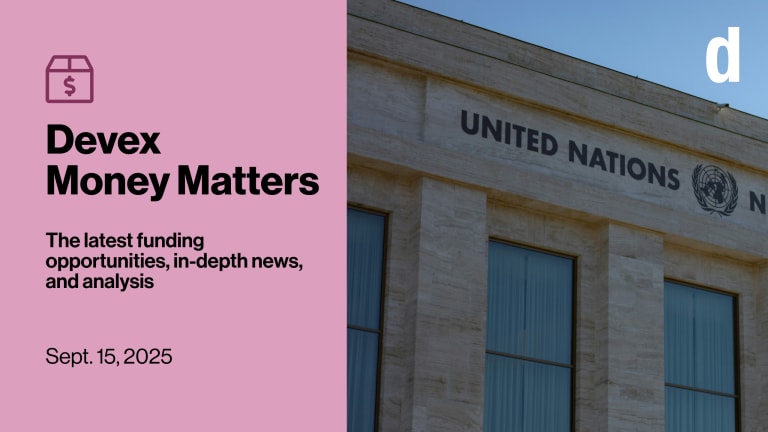
Last week brought another jolt to the global aid system: President Donald Trump pulled the United States out of dozens of international institutions both within and outside of the United Nations, halting the country’s funding to groups across the world.
Also in this edition: The U.S. freezes Somalia funding and fails to spend most of its education budget — yet advocates see signs that a rebuild may be underway.
+ Are there topics you want to read more about in Money Matters? We want your feedback.
Defund and desist
Last week, President Donald Trump issued his latest blow to the aid sector: withdrawing the United States from 66 international organizations, including 31 United Nations groups that he claimed “no longer serve American interests.”
That meant the end of U.S. participation — and critically, funding — for agencies centered on climate, democracy, trade, and the environment, among a host of other topics. It’s the result of a long-overdue review on international organizations, one that the Trump administration first announced in early 2025.
“President Trump is ending U.S. participation in international organizations that undermine America’s independence and waste taxpayer dollars on ineffective or hostile agendas,” the White House wrote in a fact sheet, several months after that review — which was meant to last 180 days — was meant to be concluded. “Many of these bodies promote radical climate policies, global governance, and ideological programs that conflict with U.S. sovereignty and economic strength.”
The move came just days after the U.S. State Department announced it would be providing the U.N. with $2 billion in so-called anchor funding for humanitarian crises, my colleague Colum Lynch reports — a sharp drop from the $8 billion to $10 billion of voluntary funding that the U.S. has given in previous years.
Read: Trump withdraws, defunds dozens of international orgs and treaties
+ Interested in learning more about aid and funding? You can sign up to three briefings for our professional members this week. On Wednesday at 9 a.m. ET, we’ll hold a Career Briefing with World Bank insiders on how to secure a spot in the bank’s new Pioneers internship program.
On Thursday at 10 a.m. ET, we’ll sit down with experts to discuss the development finance trends to watch out for this year.
And on Friday at 9 a.m. ET we’ll have a Pro Funding Briefing with Riva Kantowitz, founder and CEO of the Radical Flexibility Fund, on how her organization uses a hybrid investment strategy to create impact, sustainability, and community commitment.
Funding activity
We publish tenders, grants, and other funding announcements on our Funding Platform. Here are some of those viewed the most in the past 10 days.
The Global Climate Partnership Fund has committed $15 million to expand climate finance solutions in Benin.
The government of Denmark has released $20 million to expand recovery efforts in Ukraine.
German development bank KfW is inviting companies to provide services for project implementation on solid waste management in Egypt.
The government of South Korea has contributed $500,000 to provide cash assistance to families affected by Cyclone Ditwah in Sri Lanka.
French development finance institution Proparco is providing $10 million to strengthen the development of renewable thermal energy and industrial decarbonization in Brazil.
+ Stay ahead in this crucial time for global development by signing up for a Devex Pro Funding membership today and gain unlimited access to the latest funding opportunities from top donors as well as the industry intelligence to win them. Sign up with a five-day free trial now.
Zero tolerance, zero funding
The U.S. has also stripped funding to Somalia, ending support to the country after it accused Somali officials of destroying a U.S.-funded World Food Programme warehouse, and illegally seizing the food aid within.
“The State Department has paused all ongoing U.S. assistance programs which benefit the Somali Federal Government,” the State Department says, adding that the Trump administration has a “zero-tolerance policy for waste, theft, and diversion of life-saving assistance.”
But while Somali authorities confirm they demolished the warehouse, both the government and WFP say the food aid wasn’t destroyed or looted, my colleague Ayenat Mersie reports — with the government stating the food remained “under the custody and control” of the U.N. agency.
Either way, the freeze is expected to hit Somalia hard: The U.S. has long been the biggest humanitarian donor in the country, obligating $1.2 billion to the conflict-affected nation in 2023, and $420 million the following year.
Read: US freezes aid to Somalia over dispute on destroyed WFP warehouse
All aboard the desertification train
Despite that, not all is bad in the region. A new food security initiative is preparing its first call for proposals — the Global Flagship Initiative for Food Security, which is backed by up to $10 billion from development finance institutions in the Gulf.
Members of the initiative — from governments, research institutions, civil society groups, and private companies — can submit proposals that are vetted by a scientific advisory committee before donors determine what to support and how to finance it, writes Ayenat. Funding can come as grants, loans, or blended finance, with different Arab donors offering different instruments. But the focus, she adds, is on the Horn of Africa — and to fund projects in dryland and desertification-prone regions such as Somalia, where one-third of land is severely degraded.
“The main idea of that innovation commission was to identify and promote the scaling of cost-effective, evidence-based, scalable, and impactful innovations,” says Conrad Rein, the initiative’s secretary.
Read: Arab-backed food security platform moves toward first funding round
An OECD deep dive
The Somalia freeze and the Gulf-backed food push are both unfolding against a broader retreat in global aid — one that was already underway before Washington’s latest cuts came into force.
According to OECD figures released in mid-December, Development Assistance Committee members disbursed a combined $214.5 billion in official development assistance in 2024. That total represents a 6% real-term decline — a cut that took place even before the sweeping aid cuts by the United States and aid pullbacks by other major donors took hold.
Our data analyst Miguel Antonio Tamonan takes a closer look, mapping where aid flowed across sectors, countries, and donors one year before the aid sector was upended. Just under a quarter of the world’s aid went to international organizations, such as the World Bank Group and the U.N. system; one-third went toward what’s described as “nonsector allocable aid,” which goes toward broader objectives as opposed to a specific thematic area.
But when it came to aid distributed across sectors, Miguel finds that social infrastructure and services took more than half the total — some $54.2 billion in 2024. That includes programs revolving around education, government and civil society, health, population and reproductive health, and more.
Read: Which sectors received the most aid in 2024? (Pro)
+ Not yet a Pro member? Start your 15-day free trial today to access all our expert analyses, insider reporting, funding data, exclusive events and briefings with sector leaders, policymakers and influencers, and more.
A for optimism
Speaking of education funding, advocates in the space are optimistic that 2026 may look better than 2025 — a year that saw the total devastation of education programs funded by the U.S.
Out of 165 USAID education programs, only two were spared during the institution’s obliteration, Devex contributor Gabriella Jóźwiak reports, both of which are still at work in Jordan. In fact, the U.S. government failed to spend 93% of its $922 million international basic education budget in 2025, and pulled support from the Global Partnership for Education, Education Cannot Wait, and UNESCO the same year.
But Anna Roberts, the director of government relations at the Basic Education Coalition, is cautiously optimistic — telling Gabriella that the State Department’s boost in hiring, recent appropriations bills, and related special envoy appointments may be signaling a better year ahead.
“We’ll rebuild,” Roberts says. “It’s going to be slow, and it’s going to look different. But we will.”
Read: Will the US start funding global education again in 2026?
Sign up to Money Matters for an inside look at the biggest stories in development funding.
About the author

Elissa Miolene
Elissa Miolene reports on USAID and the U.S. government at Devex. She previously covered education at The San Jose Mercury News, and has written for outlets like The Wall Street Journal, San Francisco Chronicle, Washingtonian magazine, among others. Before shifting to journalism, Elissa led communications for humanitarian agencies in the United States, East Africa, and South Asia.
Search for articles



Most Read
- 1
- 2
- 3
- 4
- 5