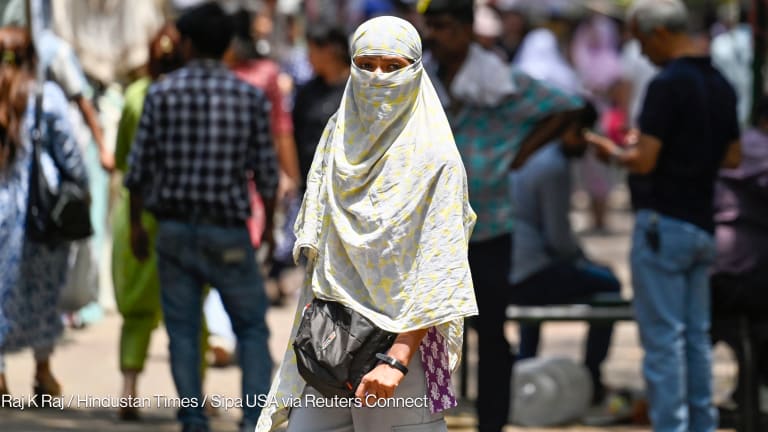
New data reveals escalating health risks due to climate change
The effects of climate change vary across the world, but they lead to the same outcomes — putting people’s health at risk.
From deadly storms to searing heat waves, the world is facing record-breaking threats to health due to climate change, warns the latest Lancet Countdown report. People over 65 years old are dying much more due to heat, 167% higher than in the 1990s. And high temperatures are also affecting labor productivity, with $835 billion in potential income losses in 2023. Many parts of the world are also experiencing enormous amounts of rainfall leading to heavy flooding that puts people more at risk of drowning and other injuries as well as the spread of infectious diseases. This week, Spain experienced its worst flooding in decades after being hit by a year’s worth of rainfall in just a day. The Philippines, a typhoon-prone country, saw an increase in leptospirosis cases this year compared to 2023. Other places are experiencing extreme drought events, with data revealing almost half of the world’s land area was affected by extreme drought for at least one month in 2023. Countries such as Namibia and Zimbabwe have recently allowed the killing of elephants and other wild animals to feed hungry communities suffering from extreme drought conditions. The drought in the Amazon is also isolating communities that rely on the river for transportation, forcing people to drink contaminated water, and leading to respiratory problems. The changing climate is also making it more suitable for the spread of vector-borne diseases such as dengue, with transmissions by dengue-carrying mosquitoes Aedes albopictus and Aedes aegypti showing increases of 46.3% and 10.7%, respectively, since 1951. The report also found tremendous loss in tree cover since 2001, with over 459 million hectares of tree cover lost due in part to deforestation and wildfires. The result? Reduced capacity for the world to absorb heat, and reduced human exposure to green spaces linked to better mental health, Marina Romanello, executive director of the Lancet Countdown, said during a webinar last week. But of great concern is the action by governments and companies in the face of these health threats, she said. “Despite years of monitoring and of raising the alarm, despite all of the different reports of the Lancet Countdown and other scientists that have put forward the enormous urgency of climate change for a healthier future, we see governments [and] companies continuing to fuel the fire of climate change, increasing the risk to people’s health and to people’s survival,” Romanello said. The good and the bad … Romanello took a jab at countries’ continued heavy subsidy of fossil fuels — $1.4 trillion in 2023 — and said it could have been used to help countries transition to a healthier, livable future. In 27% of countries, she said the total amount allocated to fossil fuel subsidies exceeded that of their national health budgets. In addition, 114 of the largest oil and gas companies expanded their oil and gas production plans, “going against all of our commitments and efforts to tackle climate change,” she said. “By 2040 they are currently on track to exceeding the levels of emissions compatible with keeping global mean temperatures to 1.5 degrees [Celsius] by 189%,” she said. But there are some positive developments, such as the adoption of cleaner sources of energy. In 2021, 10.5% of the electricity used globally came from clean renewable energy sources. Jobs in the renewable energy sector also reached a record high of 13.7 million. Deaths from air pollution due to fossil fuel also declined by almost 7%, largely due to a reduction in pollution from coal burning. “This tells us that by phasing out fossil fuels, by phasing out coal, we could be saving millions of lives every year, and this is proof that that change is actually possible,” Romanello said. The report asks countries to redirect their fossil fuel subsidies to support the transition toward clean energy and improving access to clean energy sources, and that they prioritize health as they update their nationally determined contributions — which includes what they plan to do to reduce greenhouse gas emissions and adapt to climate change impacts — in 2025. A focus on adaptation finance For health experts, the report underscores the need for countries to work on their adaptation plans, with the impact of climate change no longer a risk but a reality. “We’re now in a reality where we have to adapt or die,” said Patrick Verkooijen, CEO of the Global Center on Adaptation. According to the report, the number of countries that have developed their health national adaptation plans has increased from 4 to 43 in 2023. But Verkooijen asked: “What is planning without financing?” In 2021, close to 200 countries adopted the Glasgow Climate Pact, which urged high-income countries to double their climate adaptation financing by 2025. But according to a Brookings Institution analysis, adaptation finance still accounts for a small percentage of climate finance at 5% in 2021-2022. The report recommends that countries ensure the new finance target that they are expected to decide at COP29 — which begins more than a week after its release — will address the health impacts caused by climate change. “The reality is, [on] adaptation, we’re moving not fast enough. Health is there in the planning stage, but not in the action phase,” Verkooijen said.
From deadly storms to searing heat waves, the world is facing record-breaking threats to health due to climate change, warns the latest Lancet Countdown report.
People over 65 years old are dying much more due to heat, 167% higher than in the 1990s. And high temperatures are also affecting labor productivity, with $835 billion in potential income losses in 2023.
Many parts of the world are also experiencing enormous amounts of rainfall leading to heavy flooding that puts people more at risk of drowning and other injuries as well as the spread of infectious diseases. This week, Spain experienced its worst flooding in decades after being hit by a year’s worth of rainfall in just a day. The Philippines, a typhoon-prone country, saw an increase in leptospirosis cases this year compared to 2023.
This article is free to read - just register or sign in
Access news, newsletters, events and more.
Join usSign inPrinting articles to share with others is a breach of our terms and conditions and copyright policy. Please use the sharing options on the left side of the article. Devex Pro members may share up to 10 articles per month using the Pro share tool ( ).
Jenny Lei Ravelo is a Devex Senior Reporter based in Manila. She covers global health, with a particular focus on the World Health Organization, and other development and humanitarian aid trends in Asia Pacific. Prior to Devex, she wrote for ABS-CBN, one of the largest broadcasting networks in the Philippines, and was a copy editor for various international scientific journals. She received her journalism degree from the University of Santo Tomas.