Protests push South Africa to name gender violence a national disaster
Women flooded the streets of Johannesburg on Friday, one day before the G20 leaders’ summit was set to begin. The result? President Cyril Ramaphosa declared gender-based violence a national disaster.
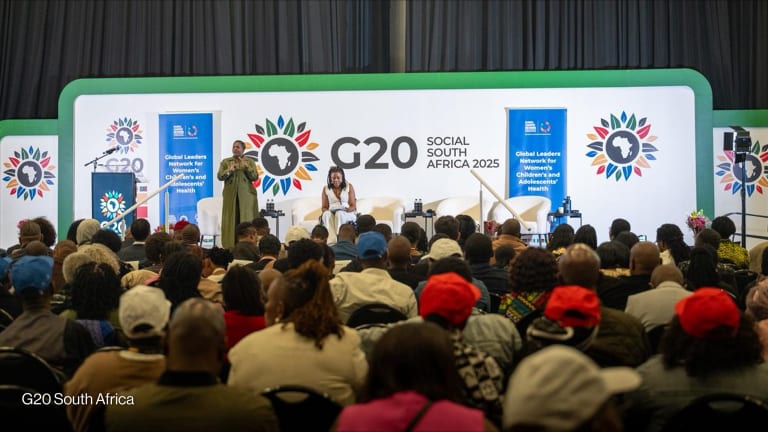
Johannesburg, South Africa — On Saturday, the world’s most powerful heads of state descended on Johannesburg for the Group of 20 leaders’ summit. But one day earlier, women flooded the streets to protest the soaring rates of gender-based violence — in numbers that dwarfed any delegation — leading the South African government to officially declare gender-based violence a natural disaster across the nation. “The violence perpetrated by men against women erodes the social fabric of nations,” said South African President Cyril Ramaphosa, speaking at the G20 Social Summit just before the official declaration. “We have agreed, among all social partners, that we need to take extraordinary and concerted action — using every means at our disposal — to end this crisis.” Ramaphosa classified gender-based violence as a national crisis on Thursday. The government elevated it to a national disaster some 24 hours later, stating that after a “thorough reassessment of previous reports,” along with updated input from government agencies and civil society groups, gender-based violence now meets “the threshold of a potential disaster.” For months, South African nonprofit Women for Change had been pushing for that recognition, encouraging women across the nation to stay home from work, avoid spending money, and protest in the streets on Friday, Nov. 21, just before the G20 leaders’ summit began. “We refuse to allow South Africa to present itself as a ‘stable, growing economy’ while women’s bodies are the battlefield beneath it,” the organization wrote. “The G20 Women’s Shutdown is a direct message to the world that you cannot speak of progress while women are dying.” In Johannesburg, that meant thousands of women — dressed all in black — crowded the gardens, streets, and squares of the country’s largest city, shouting for something to be done in the name of gender-based violence. In Cape Town, that meant the coastal promenade was packed with protesters, carrying posters with CHANGE alongside them. And when the clock struck noon, thousands across the country lay still on the ground for 15 minutes — a silent tribute to the 15 women killed in South Africa every day. That’s a rate six times the global average, according to Women for Change. “It felt liberating, but painful,” said Kgopotso Radebe, the founder and executive director of Abundance in Light, a South African advocacy organization focused on gender-based violence. “We shouldn’t be crying, or even protesting like this as women. We should be protected — and we should feel safe in our own country.” It’s something Radebe knows intimately. The 31-year-old is a survivor of gender-based violence, and for the past five years, she has been forced to relive the trauma in court. She’s been in and out of the legal system since 2020, Radebe told Devex — and while that’s involved appearing more than 10 times in court, the man who abused Radebe is still living free. “Sometimes you lose hope in the system,” she said. “You follow the laws, you listen, you wait, and you take the advice that they give you. But is it really supporting us, the victims, in any way, shape or form?” Radebe is far from alone. In South Africa, 1 in 3 women have experienced physical violence, according to Women for Change — and each day, nearly 120 women report rape cases to the police. It’s not a new issue for South Africa, nor for its government: In 2019, Ramaphosa declared gender-based violence and femicide a national crisis, which led to the country developing a strategic plan to combat the issue. But the term “crisis” doesn’t carry as much weight as a disaster — though Ramaphosa proposed a council to lead the strategy’s implementation, for example, five years later, that council is still not operational. In the years since, the issue has only gotten worse: Between 2022-23 and 2023-24, femicide rose by nearly 34%, Women for Change reported, referencing government statistics. In theory, declaring gender-based violence a national disaster should allow for emergency funding to be released — a move that would speed projects up, streamline support, and drive further action. But in last week’s declaration, the government noted that it “does not invoke emergency powers,” but instead “reinforces and strengthens the systems already in place,” including the nonoperational gender-based violence committee. The declaration shifts the responsibility of managing gender-based violence to the executive branch, and pushes governmental bodies to strengthen their support to existing gender-based violence response structures. It’s not yet clear if that means additional funding will be released to tackle the issue, and the South African government did not respond to media inquiries in time for publication. “We need to know what is next. We need to hear from them — and not just hear, but see it implemented,” said Radebe. “We’ve still got a long way to go, but I’m still not losing hope in my country.”
Johannesburg, South Africa — On Saturday, the world’s most powerful heads of state descended on Johannesburg for the Group of 20 leaders’ summit. But one day earlier, women flooded the streets to protest the soaring rates of gender-based violence — in numbers that dwarfed any delegation — leading the South African government to officially declare gender-based violence a natural disaster across the nation.
“The violence perpetrated by men against women erodes the social fabric of nations,” said South African President Cyril Ramaphosa, speaking at the G20 Social Summit just before the official declaration. “We have agreed, among all social partners, that we need to take extraordinary and concerted action — using every means at our disposal — to end this crisis.”
Ramaphosa classified gender-based violence as a national crisis on Thursday. The government elevated it to a national disaster some 24 hours later, stating that after a “thorough reassessment of previous reports,” along with updated input from government agencies and civil society groups, gender-based violence now meets “the threshold of a potential disaster.”
This article is free to read - just register or sign in
Access news, newsletters, events and more.
Join usSign inPrinting articles to share with others is a breach of our terms and conditions and copyright policy. Please use the sharing options on the left side of the article. Devex Pro members may share up to 10 articles per month using the Pro share tool ( ).
Elissa Miolene reports on USAID and the U.S. government at Devex. She previously covered education at The San Jose Mercury News, and has written for outlets like The Wall Street Journal, San Francisco Chronicle, Washingtonian magazine, among others. Before shifting to journalism, Elissa led communications for humanitarian agencies in the United States, East Africa, and South Asia.