
Q&A: IDEO chief Tim Brown says inclusive growth is a design challenge




DAVOS, Switzerland — Some of the attendees at the World Economic Forum’s annual meeting in Davos have a hard time making it from one place to another in the Congress Center, the building that is the buzzing center of activity at the high-profile summit.
Tim Brown, chief executive officer of the human-centered design firm IDEO, is one of those people whose attempts to get from meeting to meeting are often interrupted by those seeking his insights on the way forward, as the rise of technology creates opportunities and poses risks for societies across the globe.
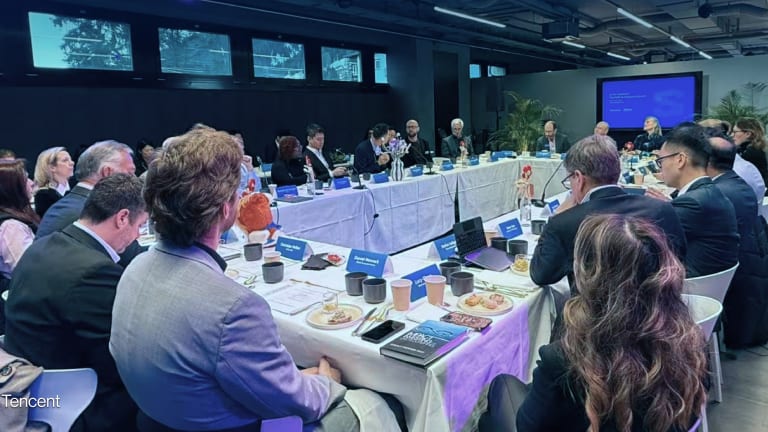
Last week, he moderated a dinner at the Hard Rock Hotel in Davos, under the theme Human by Design. Participants divided into different tables for discussions facilitated by leaders including Stewart Butterfield, the CEO of the chat tool Slack, music artist will.i.am, and surgeon and author Atul Gawande. They talked about the role and responsibility of design in this era where technology and society are coming together.
Brown said he sees this question of how to achieve equitable progress amid technological change as a design challenge. Devex caught up with Brown in Davos last week, to discuss the role of human centered design in maximizing the benefits and minimizing the risks of this transition. This interview has been edited for length and clarity.
There is a lot of interest from professionals working in global health, international development, and humanitarian response in human-centered design. IDEO is in high demand for challenges including those captured by the United Nations Sustainable Development Goals. Can you tell me more about your definition of design thinking, and why you think there is so much interest in applying this approach to big global challenges?
Design thinking is all about gaining insight into the needs of people, turning those insights into ideas that you try out really quickly and iteratively through prototyping, and then getting those things as they turn out to be right and work into the world.
It’s a very simple idea. There’s nothing complex about it. It’s just hard to do and it’s hard to do it well. It requires you to have certain skills: Empathy, curiosity, optimism. You need to go out into the world and really watch and study how people live their lives.
Whatever the question or problem is that you’re trying to tackle, don’t assume you know the answer, because you’re not the customer in many cases. Look at the experience of people through their eyes. And the insights you get from that, you need to be able to lift those up in order to help you decide: What might be the problem we’re really trying to solve?
Understanding what the question is that you’re really trying to tackle is an important skill to have. Let’s say your studying why people in villages don’t have bank accounts. Is it because the banks aren’t in the villages, or because people don’t trust the system? If they don’t trust the system, what might you design that starts to build trust?
The reason we’re seeing interest in human-centered design for the SDGs is that we’re trying to serve folks who have great needs, and if you only look at that through a business lens or a technology lens, it’s going to be very hard to be successful. Design thinking is a way to look at innovation by serving the needs of those people. So it’s not surprising to me that there’s interest in the tools we make available to help people in this sector take on the skills of design thinking.
I was really struck by the power of design thinking for development when I traveled with a team of designers from Silicon Valley to Tanzania. While I was initially skeptical, I saw the power of the model, because it was the people they were trying to serve who provided them with the answers. How do you think we can use human-centered design on more locally developed solutions in developing country contexts?
There are all kinds of cultural assumptions that come when you fly in from Silicon Valley, no matter how good a designer you are, and how curious you are, and how open to input you are. You have certain assumptions because of your own experiences. The best is when you have local designers solving local problems, because that’s when you have the deepest understanding.
See more related topics:
► A human-centered approach to design for development
► How to develop a human-centered design mindset
► Q&A: How human-centered design works at the world's largest foundation
One of the great challenges we have that we are trying to work on together with some others is how do we build the base of talent in sub-Saharan Africa and Southeast Asia and other regions? There just aren’t many designers working there today. And the ones who are there for the most part perfectly understandably want to work on commercial things rather than more social oriented things. That’s going to take a long time to solve that problem, but it will get solved eventually.
We’re planning to open our first office in Africa this year for our nonprofit IDEO.org. Not sure I’m allowed to say much more than that but more to come. We’re actively looking to recruit talent from there and other places into IDEO.org and also into IDEO. We’re looking to expand our IDEOU platform, which currently is only in English and very expensive. And Design Kit is now available in many languages, which will help people at least get curious about what the potential of design thinking might be for them.
You’re involved with the World Economic Forum’s Center for the Fourth Industrial Revolution in San Francisco. There have been many sessions and side events asking how to achieve inclusive growth and equitable progress in this era where technology and society will come together in new ways. Can you expand on the role of design thinking in the Fourth Industrial Revolution?
For me the best definition of design came from the computer scientist Herbert Simon who said, “Whenever we’re shaping the world to meet our needs then we’re designing.”
So here comes the Fourth Industrial Revolution, all of this technology. It’s happening. So we either let technology do what it wants to do, or we shape it to meet our needs. And therefore it’s a systems design problem: A problem of understanding how society will gain the most benefit from these technologies.
We need to shape the technologies and business and products and services that get built by those businesses as best as possible to meet the needs that we have. The thing we’re trying to think about in this session is: What are those inflection points? It’s not what the solutions are, and so many of them aren’t apparent yet especially because these technologies are evolving very quickly.
But we can ask where the inflection points are. For example, if we’re worried about social media addiction for instance, which is a very real problem that people are beginning to talk about, what are the inflection points where we might think about design being different? Is it the design of devices or experiences? Is it the business model that supports the business providing us with this technology? Is it how we educate our kids? Is it regulation? What are the things that will make the most difference? We can’t change everything. So let’s pick the areas we believe we have evidence that we might have an impact and go work there.
One of the criticisms of these meetings is just how many people are not represented. What is your response to this criticism?
It’s a perfectly legitimate criticism. On the other hand, I would say the alternative, which would be to not have these meetings, would be less effective. I’ve been coming here long enough to see what happens, which is that ideas that seem very nascent and way out in the future and not that relevant to business that start being talked about one year, half a dozen years later become mainstream.
A good example is the Circular Economy. It’s a complex idea about how do we completely reinvent our whole industrial system? But if we don’t do it, we won’t be able to build the kind of wealthy economies that Africa deserves, or other parts of the world deserve. We won’t have the resources. We won’t even have the materials. We simply won’t have enough, unless we reinvent these systems. Well those systems are going to get reinvented by the guys who run the business, unfortunately mostly guys, so the fact that these conversations are going on is at least a start. I see Davos as the start of many things, not the end of anything.
I think the mistake is sometimes a community like this one believes it can solve a problem. That’s not appropriate. But it can certainly provide an awful lot of resources so that other people can solve the problem.
It won’t do that unless it believes in the need, and so having these conversations creates more belief in and better understanding of the need.
Read Devex coverage of the World Economic Forum Annual Meeting in Davos.
About the author

Catherine Cheneycatherinecheney
Catherine Cheney is the Senior Editor for Special Coverage at Devex. She leads the editorial vision of Devex’s news events and editorial coverage of key moments on the global development calendar. Catherine joined Devex as a reporter, focusing on technology and innovation in making progress on the Sustainable Development Goals. Prior to joining Devex, Catherine earned her bachelor’s and master’s degrees from Yale University, and worked as a web producer for POLITICO, a reporter for World Politics Review, and special projects editor at NationSwell. She has reported domestically and internationally for outlets including The Atlantic and the Washington Post. Catherine also works for the Solutions Journalism Network, a non profit organization that supports journalists and news organizations to report on responses to problems.
Search for articles


Most Read
- 1
- 2
- 3
- 4
- 5