• News
    • Latest news
    • News search
    • Health
    • Finance
    • Food
    • Career news
    • Content series
    • Focus areas
    • Try Devex Pro
  • Jobs
    • Job search
    • Post a job
    • Employer search
    • CV Writing
    • Upcoming career events
    • Try Career Account
  • Funding
    • Funding search
    • Funding news
  • Talent
    • Candidate search
    • Devex Talent Solutions
  • Events
    • Upcoming and past events
    • Partner on an event
  • Post a job
  • About
      • About us
      • Membership
      • Newsletters
      • Advertising partnerships
      • Devex Talent Solutions
      • Contact us
Join DevexSign in
Join DevexSign in

News

  • Latest news
  • News search
  • Health
  • Finance
  • Food
  • Career news
  • Content series
  • Focus areas
  • Try Devex Pro

Jobs

  • Job search
  • Post a job
  • Employer search
  • CV Writing
  • Upcoming career events
  • Try Career Account

Funding

  • Funding search
  • Funding news

Talent

  • Candidate search
  • Devex Talent Solutions

Events

  • Upcoming and past events
  • Partner on an event
Post a job

About

  • About us
  • Membership
  • Newsletters
  • Advertising partnerships
  • Devex Talent Solutions
  • Contact us
  • My Devex
  • Update my profile % complete
  • Account & privacy settings
  • My saved jobs
  • Manage newsletters
  • Support
  • Sign out
Latest newsNews searchHealthFinanceFoodCareer newsContent seriesFocus areasTry Devex Pro
    • News
    • The Future of Global Health

    Rapid US health deals spark concerns over lack of public consultation

    Many are concerned that the State Department is signing these agreements with countries too fast and without public participation.

    By Sara Jerving // 10 December 2025
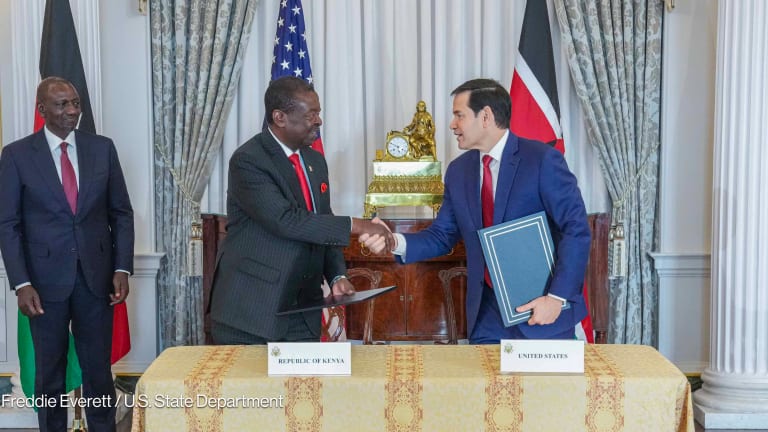
    The United States is on a rapid-fire quest to sign dozens of new bilateral health agreements with countries in the coming weeks. In the past week, it’s inked deals with Kenya, Rwanda, Liberia, and Uganda. This is part of the new “America First” global health strategy that prioritizes direct agreements with governments as opposed to funneling money through nongovernmental organizations. It also aims to leverage faith-based organizations and the private sector. But concerns around this process are mounting. Forty-six civil society organizations published a letter to African government leaders on Wednesday expressing wide-ranging concerns around the deals in areas such as data sovereignty — and stating the terms are dictated by the U.S. and not by African interests. They wrote that the agreements have a “rushed timeline and extremely limited inclusion of civil society.” “Bilateral partnerships should be co-developed, mutually beneficial, aligned with national interests, and consistent with regional and international efforts to strengthen health systems and disease response,” the letter stated. The lack of public participation is particularly concerning for many because the agreements involve African countries putting forward their own taxpayer dollars for cofinancing. The Kenyan government, for example, is bolstering its agreement with the U.S. by adding $850 million from its own budget. Because the memorandums of understanding dedicate public resources, they should involve robust public participation, Aggrey Aluso, executive director of the Resilience Action Network Africa, told Devex. These agreements are helping define national health priorities that are going to receive investments for years to come — and those priorities should reflect the needs of the country, not the U.S., he said. In that vein, Kenyan Sen. Okoiti Omtatah is seeking a court order to suspend the agreement, saying it violated the country’s constitution when it was signed without public participation and parliamentary approval. “No consultations were held with health stakeholders, civil society, or affected members of the public prior to the signing,” he said. Many are also concerned that African nations are losing collective bargaining power by negotiating directly with the U.S. instead of as a continental bloc — and that this could leave some countries that have less geopolitical clout with less leverage at the negotiating table. “I call it a divide and conquer approach that the U.S. adopted,” Aluso said. “It's one of the biggest failings, and probably a strategy that was well calculated to isolate and conquer, so to speak, to get the maximum from countries that are vulnerable.” A key element of the “America First” global health strategy is to support countries with disease surveillance and early detection, but Aluso said these are cross-border issues and would benefit from a collaborative approach. He said he hopes that early signers of the agreement make their agreements public so that others can use them as a reference point to secure stronger agreements for themselves.

    Related Stories

    The US signs first bilateral health deal with Kenya for $1.6 billion
    The US signs first bilateral health deal with Kenya for $1.6 billion
    US template for bilateral health deals bypasses WHO pandemic negotiations
    US template for bilateral health deals bypasses WHO pandemic negotiations
    Will African nations lose their leverage in an ‘America First’ health plan?
    Will African nations lose their leverage in an ‘America First’ health plan?
    The Kenya-US health deal is pragmatic, but could have been done better
    The Kenya-US health deal is pragmatic, but could have been done better

    The United States is on a rapid-fire quest to sign dozens of new bilateral health agreements with countries in the coming weeks. In the past week, it’s inked deals with Kenya, Rwanda, Liberia, and Uganda.

    This is part of the new “America First” global health strategy that prioritizes direct agreements with governments as opposed to funneling money through nongovernmental organizations. It also aims to leverage faith-based organizations and the private sector.

    But concerns around this process are mounting. Forty-six civil society organizations published a letter to African government leaders on Wednesday expressing wide-ranging concerns around the deals in areas such as data sovereignty — and stating the terms are dictated by the U.S. and not by African interests. They wrote that the agreements have a “rushed timeline and extremely limited inclusion of civil society.”

    This article is free to read - just register or sign in

    Access news, newsletters, events and more.

    Join usSign in

    More reading:

    ► Kenya limits US access to disease outbreak data in new bilateral deal

    ► Will African nations lose their leverage in an ‘America First’ health plan?

    ► State Dept taps African faith groups for bilateral health deal consults

    • Global Health
    • Trade & Policy
    • Democracy, Human Rights & Governance
    Printing articles to share with others is a breach of our terms and conditions and copyright policy. Please use the sharing options on the left side of the article. Devex Pro members may share up to 10 articles per month using the Pro share tool ( ).

    About the author

    • Sara Jerving

      Sara Jervingsarajerving

      Sara Jerving is a Senior Reporter at Devex, where she covers global health. Her work has appeared in The New York Times, the Los Angeles Times, The Wall Street Journal, VICE News, and Bloomberg News among others. Sara holds a master's degree from Columbia University Graduate School of Journalism where she was a Lorana Sullivan fellow. She was a finalist for One World Media's Digital Media Award in 2021; a finalist for the Livingston Award for Young Journalists in 2018; and she was part of a VICE News Tonight on HBO team that received an Emmy nomination in 2018. She received the Philip Greer Memorial Award from Columbia University Graduate School of Journalism in 2014.

    Search for articles

    Related Stories
    The Future of Global HealthRelated Stories - The US signs first bilateral health deal with Kenya for $1.6 billion

    The US signs first bilateral health deal with Kenya for $1.6 billion

    The Future of Global HealthRelated Stories - US template for bilateral health deals bypasses WHO pandemic negotiations

    US template for bilateral health deals bypasses WHO pandemic negotiations

    The Future of Global HealthRelated Stories - Will African nations lose their leverage in an ‘America First’ health plan?

    Will African nations lose their leverage in an ‘America First’ health plan?

    Opinion: Global healthRelated Stories - The Kenya-US health deal is pragmatic, but could have been done better

    The Kenya-US health deal is pragmatic, but could have been done better

    Most Read

    • 1
      Why NTDs are a prime investment for philanthropy
    • 2
      The silent, growing CKD epidemic signals action is needed today
    • 3
      Trump withdraws, defunds dozens of international orgs and treaties
    • 4
      Why are 3.4 billion people still offline?
    • 5
      US lawmakers strike $50B foreign assistance deal, surpassing Trump's plan
    • News
    • Jobs
    • Funding
    • Talent
    • Events

    Devex is the media platform for the global development community.

    A social enterprise, we connect and inform over 1.3 million development, health, humanitarian, and sustainability professionals through news, business intelligence, and funding & career opportunities so you can do more good for more people. We invite you to join us.

    • About us
    • Membership
    • Newsletters
    • Advertising partnerships
    • Devex Talent Solutions
    • Post a job
    • Careers at Devex
    • Contact us
    © Copyright 2000 - 2026 Devex|User Agreement|Privacy Statement