
Special edition: Drawing the battle lines on women, girls, and gender at the UN


The world’s largest gathering on gender equality — the Commission on the Status of Women, or CSW — kicks off today, bringing thousands of diplomats, activists, and development professionals to the United Nations’ New York headquarters.
Delegates are expected to agree on a political outcome document outlining their commitments to gender equality across the world — but before CSW began, they’d already had a “helluva” few “exhausting days” at the negotiating table, according to a draft text of the negotiation slipped to Devex last week.
“Been negotiating this para[graph] for the past 10 years and hasn’t changed much,” wrote the European Union delegation on a recent round of notes, pointing to a section on securing justice for women and girls. “Let’s agree on this and focus on what really matters.”
In large part, the back-and-forth is because gender remains a battleground issue between conservative and progressive nations — and the U.N.’s biggest donor, the United States, has had a predictable pullback. After weeks of abstaining from talks on the negotiations, the country’s delegates struck out words such as gender equality, gender-based violence, and anything that came close to promoting diversity, equity, and inclusion.
The U.S. entered negotiations with more than 90 new amendments, most of which didn’t make it into the final round of negotiations. Late last week, U.S. delegates took a different approach: urging U.N. member states to support a shorter, pared-back declaration that would slash what it considers “controversial social issues.”
“This is the way the U.S. is showing up in multilateral spaces, and it really reflects this administration’s approach to the U.N. and multilateralism writ large,” says Jennifer Rauch, the global advocacy officer at the reproductive health organization Fòs Feminista.
The friction is just a preview of what’s to come. For the next two weeks, Turtle Bay (the neighborhood that’s home to the U.N. headquarters) will be filled with side events, panel discussions, and diplomatic wrangling, all of which will orbit around negotiations between U.N. member states.
“I’m sure I don’t need to tell you that it’s a strange, thorny moment in the world,” said actor and UN Women Goodwill Ambassador Anne Hathaway, speaking from the main stage on Monday. She later added: “But no matter what, we keep going until it’s done.”
Devex Senior Global Reporter Colum Lynch and I will be reporting from New York all week — so stay tuned for our coverage of the debates, side events, and high-stakes battles shaping global gender policy today.
Have a tip? Reach out to me at elissa.miolene@devex.com and to Colum at colum.lynch@devex.com.
Read more: Exclusive — US seeks to scrap UN efforts to expand women's rights
Related: New US funding rules tie aid to abortion, gender ideology, DEI bans (Pro)
+ Unlock the power of Devex Pro with a 15-day free trial. Discover the expert analyses and wealth of knowledge that drive global development. Connect with key players at exclusive events and uncover hidden funding opportunities you won't find elsewhere. Check out all the exclusive content available to Pro members.
What’s at stake
This is the 70th year of CSW, which was established to advance women’s rights in the wake of the Second World War. In the decades since, the conference has swelled to encompass thousands of participants and observers — and as countries stake their positions on gender, advocates try to influence them.
This year, CSW comes amid tightening aid budgets, geopolitical clashes, and growing questions over who bankrolls the global development agenda, especially when it comes to gender. Cuts to U.S. aid have hit women’s and girls’ programs particularly hard, with the nation withdrawing support from UN Women, slashing funding to the U.N. Population Fund, and dissolving aid to maternal, child, and reproductive health by more than 90%.
All of that is also hitting CSW itself. Caroline Harper, the director of the gender equality and social inclusion program at ODI Global, tells me that last year, she heard multiple panelists say it was the last time they would be attending CSW. They had lost their jobs after USAID’s collapse, she says, and had only come to New York because their plane ticket was already booked.
“There’s been a crash in the sustainability of women’s rights organizations,” Harper says. “And because of that and for other reasons, it will be much lighter on the ground this year.”
Fears around immigration, safety, and hostility in the U.S. have also led many in Harper’s network to decline attending CSW, she adds — noting fears around a proposed change to the Electronic System for Travel Authorization, or ESTA, visa process, which would require applicants to provide their social media account information to travel to the U.S.
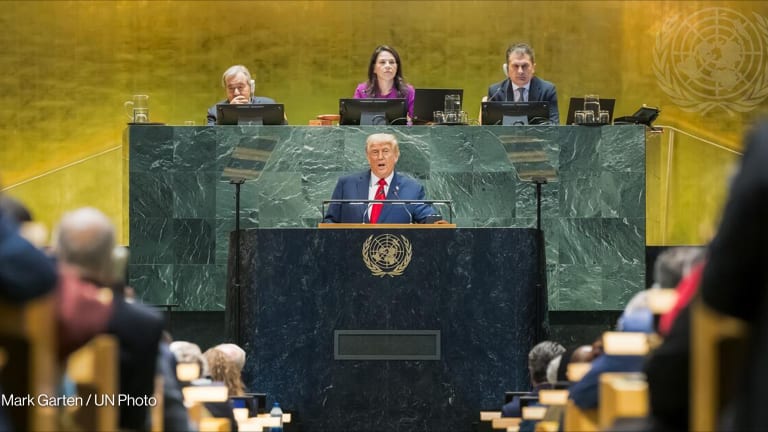
The effects of that could be seen on Monday, with the grand hall of the U.N. General Assembly — where the CSW’s opening session was staged — two-thirds full.
“Obviously, it’s really complicated this year, and the CSW is really important,” Harper says. “But still, there will be a lot of organizations that aren’t able to attend.”
It’s a blow for a sector that, even before the USAID cuts, was already struggling to grab the limelight. Even in 2022, just 4% of total bilateral aid went to programs focused primarily on gender equality, according to data from the Organisation for Economic Co-operation and Development. Today, funding cuts have made the situation even starker — and at the same time, women’s needs have continued to rise.
Related op-ed: Aid cuts for women and girls lead to instability that reaches us all
Dividing forces
Last week, UN Women warned that women’s rights are regressing worldwide, the result of democratic backsliding, a rising number of global conflicts, and an “increasingly organized pushback” on gender equality across the globe.
In Afghanistan, girls can no longer go to secondary school. In Iraq, girls as young as 9 years old are now allowed to get married. And in Gambia, the country’s high court is considering whether a law protecting girls from female genital mutilation is constitutional.
“It will be a very different environment than five years ago, where the attention was very much about pushing forward women’s rights,” Harper says. “Now, the atmosphere is about trying to hold back regression.”
Still, what exactly counts as “regression” is a topic charged with complexity. While many activists, nonprofit organizations, and progressive nations will spend the next two weeks pushing for reproductive rights, access to justice, and gender-based violence, countries such as the U.S. will be spending much of their time at the Conference on the State of Women and Family, a two-day “pro-family, pro-life” side event that runs parallel to CSW.
Critics see many of the CSWF’s sessions, such as those focused on “combatting gender ideology,” as antithetical to gender equality — and over the years, advocacy groups have tagged organizations promoting “family values” as those that threaten women’s rights. But increasingly, such language has become emblematic of the Trump administration’s broader push to reframe women’s issues around conservative politics.
“CSWF is the place to come and find a unique approach to meeting the needs of women and the families they love,” states the conference’s website. “The empowerment of women, the eradication of poverty and, in fact, all of the [Sustainable Development Goals] can best be achieved by recognizing and strengthening the family.”
It’s a difference that has bled into the official negotiations of CSW too. After most of the U.S. recommendations didn’t make it into the latest outcome document, Fos Feminista’s Rauch expects the country to call for a vote.
“We know that when the U.S. engages, it has the potential to bring others along with it, and with the votes to advance a conservative worldview that seeks to undermine women’s and girls’ rights and gender equality globally,” Jessica Stern, the former U.S. special envoy to advance LGBTQ+ human rights under President Joe Biden, tells Devex.
Elephant in the merger
Those lines are being drawn while the organization at the center of it all — UN Women — faces perhaps the most uncertainty of all.
As part of UN80, a U.N.-wide reform initiative, the multilateral institution is exploring whether UN Women should merge with the much larger UNFPA. It’s been a rough year for both agencies, which lost millions in the wake of USAID’s shuttering, and were two of 31 international organizations deemed “contrary to the interests of the United States.” As a result, President Donald Trump withdrew from both organizations earlier this year.
“The entities are already experiencing funding levels that are not sufficient to support the achievement of their respective mandates,” stated a recent document on the merger, which was published by the U.N. last month. “Continued fragmentation … may further weaken the entities’ ability to support countries’ priorities and needs.”
The potential merger is still being assessed, with early road maps of the process stating that findings will be presented by the end of March. But if member states can’t come to an agreement on the CSW outcome document, it won’t be a good look for an agency standing on the precipice of change, explains Rauch.
“UN Women is the technical secretariat and supports this process,” Rauch says. “So what does that signal to the efficiency of UN Women if there’s no outcome [document at CSW]? It’s a potential ‘frame’ that certain conservative countries could take in wanting to streamline UN Women.”
There hasn’t yet been a decision made on the merger, and a presentation on the assessment’s findings is expected by the end of this month. But according to a Fòs Feminista analysis, the merger could weaken the work of both agencies.
“We’ve already been seeing this global backlash on gender equality, and feminist organizations are worried that UN80, especially with this UN Women, UNFPA merger proposal, places the gender equality architecture at risk,” Rauch said.
+ In a year defined by shifting aid priorities and tightening budgets, where does the agenda for women’s and girls’ rights stand? At Devex, we’ve centralized our deep-dive reporting, expert analysis, and latest news on the push for gender equality. Visit the page.
About the author

Elissa Miolene
Elissa Miolene covers U.S. foreign assistance from Washington, D.C. She previously covered education at The San Jose Mercury News, and has written for The Wall Street Journal, the San Francisco Chronicle, and other news outlets across the world. Before shifting to journalism, Elissa led communications for aid agencies in the United States, East Africa, and South Asia.
Search for articles


Most Read
- 1
- 2
- 3
- 4
- 5