


“We are lost between frameworks — for a decade now.”
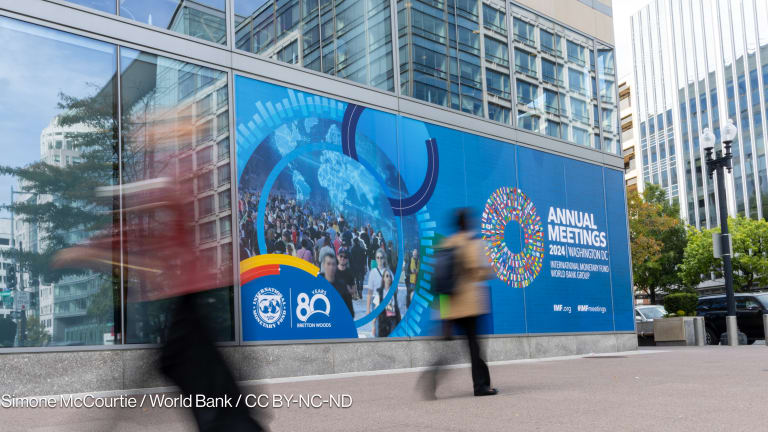
That’s the line that has hung with me since the World Bank and International Monetary Fund’s annual meetings wrapped up over the weekend. It’s often the offhand, unscripted comments that capture a feeling that doesn’t quite fit within the polished plenary speeches or carefully chosen talking points. In this case, it was from Rémy Rioux, CEO of the French Development Agency, or AFD, who was chatting with me in the green room before our interview onstage at the Devex Impact House held on the sidelines of the World Bank-IMF annual meetings.
It probably helps that Rioux — in addition to running AFD for the last nine years — is a historian by training. Maybe that allows him to put this moment of global development tumult and uncertainty in context.
In Rioux’s telling, it’s a story of missed opportunity and poor planning.
In Addis Ababa in 2015, global leaders were supposed to hammer out a new framework for financing global development. The problem? They didn’t really know yet what they were supposed to be financing. The U.N. Sustainable Development Goals hadn’t yet been adopted in New York. The Paris Climate Agreement was still several months away. In the end, the world never quite built a new architecture for financing its collective climate and development ambitions — and development finance stayed trapped in a paradigm from the 1990s, Rioux said.
Now we’re seeing large parts of that old architecture fall away.
“It’s important to go back to previous forms of international cooperation to invent the new one, especially when it comes to finance, which is the glue behind the narratives and the architecture,” he said during our panel discussion on stage.
That’s my takeaway from a week that put development finance front and center at a moment when the old foundations continue to crumble.
Many who gathered in Washington, D.C., for the meetings seemed to believe this is less the end of an era than it is the long-delayed start of a new one. The question is whether there is the political will to forge that new framework this time, or if the development finance agenda will drift while the rest of the world chases critical mineral supply chains and artificial intelligence, and the gap between ambition and resources becomes insurmountable.
“I’m optimistic, so I think we will succeed,” Rioux said. “It’s a transition and not a retreat.”
Read: Did the world get the development paradigm backward in 2015?
Related reading: Head of France's AFD reflects on development finance's uneven evolution (Pro)
+ Unlock a world of development expertise. Start your 15-day free Devex Pro trial today and gain immediate access to in-depth analyses, insider insights, crucial funding data, exclusive event access, and much more. Discover all the exclusive content available to Pro members here.
More with less?
A pair of African health leaders speaking at the Devex Impact House @ WB/IMF painted an unflattering portrait of U.S. global health assistance in recent years.
“Let me also shock you: We don’t need more than 40% of [the] money we were receiving before,” said Dr. Jean Kaseya, director-general of the Africa Centres for Disease Control and Prevention. His explanation: Major portions of traditional foreign health aid were wasted or inefficiently deployed.
Kaseya leveled some familiar criticisms against health aid, such as fragmentation, inefficiencies, and cases where foreign aid didn’t align with government priorities, and called for integrated national plans that outline how much health care programming costs and for donors to align under that plan.
Under its new “America First Global Health Strategy,” the Trump administration is rolling out bilateral compacts with aid recipient governments that will outline how those countries will assume responsibility for financing health programs over a two- to five-year span.
Dr. Lia Tadesse Gebremedhin, former Ethiopian health minister, agreed with Kaseya’s assessment of the amount of wasted funding — and pointed to her own country’s efforts to align aid funding with national priorities.
Read: Africa CDC chief says 60% of foreign health aid was effectively wasted
See also: Trump administration releases long-awaited global health strategy
+ For more content like this, sign up to Devex CheckUp, our free weekly newsletter that provides front-line and behind-the-scenes reporting on global health.
Let it flow
The collapse of official development assistance — illustrated most dramatically by USAID’s dismantling this year — was an elephant in many of the rooms of the annual meetings. I heard two things repeated about ODA in particular, and concessional finance in general.
First: These public resources remain critical — particularly for people and places that the private sector won’t easily reach — and advocates should continue to fight for them. Second: The center of gravity for development has definitively shifted to private capital mobilization.
That second point may be why it’s worth your time to dig into the first transaction by the International Finance Corporation — the World Bank’s private sector arm — that was two years in the making.
My colleague Adva Saldinger has the details on the IFC’s first collateralized loan obligation, or CLO, which bundled together a bunch of loans and sold them to private sector investors. It’s a major entry in the institution’s new “originate to distribute” approach.
The IFC transaction serves as a blueprint: structuring development-finance flows in ways that attract institutional investors, hedge risk, and expand the pool of available resources beyond traditional grant or concessional aid.
“The ultimate objective is to really create a new asset class for emerging markets so that institutional investors can really get into that space as well,” Mahfuza Afroz, the securitization project lead at IFC, tells Adva.
Read: Unpacking the World Bank Group’s first securitization deal and what’s next
Cooler heads
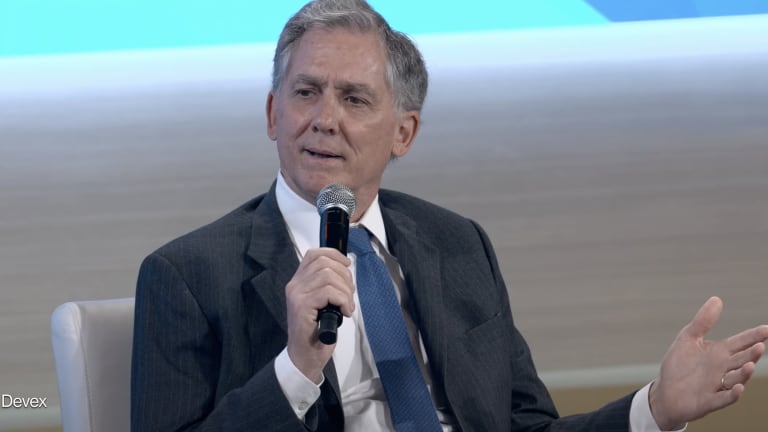
“I think certainly the United States should maintain its shareholding in the institutions. We should meet our quota or capital requirements.”
— U.S. Rep. French Hill, chair of the House Financial Services CommitteeWill the U.S. withdraw from the World Bank? Will Trump defund the Bretton Woods Institutions? Does ‘America First’ mean ‘America alone’?
It has often felt like anything is on the table when it comes to the Trump administration’s rejection of the global development status quo. But according to Hill, who chairs the House Financial Services Committee, some of the rhetoric about the White House and the World Bank might have outpaced the reality.
Hill told Devex Editor-in-Chief Raj Kumar at Devex Impact House that he believes the U.S. government should remain engaged and meet its commitments to the international financial institutions.
“I think the administration does as well, because American leadership in the multilaterals is the only way we will get the reforms we’re talking about,” he said.
Read: The US ‘is here to be your partner’ on development goals, says Rep. French Hill
+ Devex is officially on Telegram and WhatsApp! Join our channels to receive updates on the latest globaldev news directly to your mobile device.
Can you dig it?
I mentioned critical mineral supply chains at the top because this seems like one of those economic growth arenas where the development community’s ability to adapt — or not — will be on full display. With an estimated 30% of the world’s critical minerals located in Africa, the stakes are set for either a major economic boost or another era of extractive capitalism.
The balance many governments will have to strike is between speed and planning, said Aubrey Hruby of Tofino Capital and Palladium.
“African governments, in particular, need to make sure they don’t miss out on this moment,” she said at the Devex Impact House.
At a time when critical minerals are a hotly competitive — and geopolitically charged — economic contest, Hruby advised countries to “get the investment in and improve it as you go,” rather than waiting for the perfect policy plan.
World Bank President Ajay Banga said Friday that as part of his effort to laser-focus on job creation, the institution is trying to help countries get ahead of the critical minerals curve.
“We have identified five sectors with the potential to create these jobs in these countries — infrastructure and energy, agribusiness, health care, tourism, and value-added manufacturing, including the crucial minerals we all need for our energy and digital transitions,” he said in his plenary speech.
“And just recently, with our board’s help, we are finalizing a minerals and mining strategy to help countries move beyond raw extraction into processing and one day regional manufacturing, so that more value and more jobs stay local,” he said. “We expect to share this strategy in the coming months and move forward with that as one of the next big initiatives.”
Read: How to turn the critical minerals boom into a development win
+ Enjoyed this special edition of the Newswire? To continue exploring topics in this depth, Devex Invested — our free weekly newsletter on how business, social enterprise, and development finance leaders are tackling global challenges — is your go-to resource. Sign up today.
Sign up to Newswire for an inside look at the biggest stories in global development.
About the author

Michael Igoe@AlterIgoe
Michael Igoe is a Senior Reporter with Devex, based in Washington, D.C. He covers U.S. foreign aid, global health, climate change, and development finance. Prior to joining Devex, Michael researched water management and climate change adaptation in post-Soviet Central Asia, where he also wrote for EurasiaNet. Michael earned his bachelor's degree from Bowdoin College, where he majored in Russian, and his master’s degree from the University of Montana, where he studied international conservation and development.
Search for articles

Most Read
- 1
- 2
- 3
- 4
- 5