



Despite the remarkable health gains made over the past few decades, 5 billion people around the world still lack access to safe surgical care. And in low- and middle-income countries — where common barriers include geographic distance to hospitals, limited infrastructure, and a lack of trained surgical professionals — an additional 143 million surgeries per year and 2.2 million more surgeons, anesthesiologists, and obstetricians are needed to save lives and prevent disabilities.
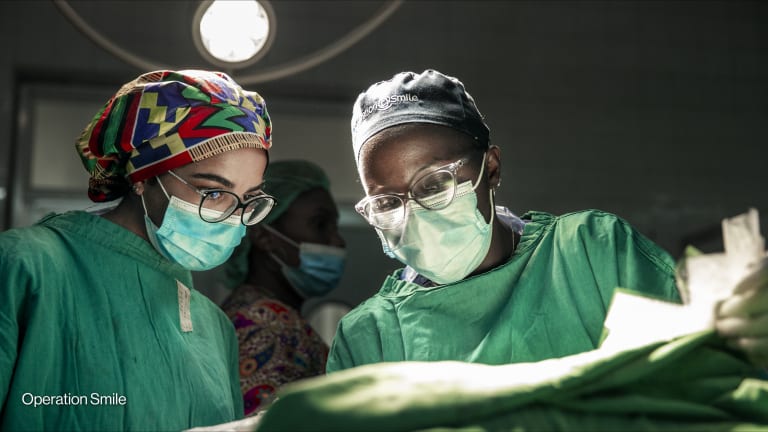
For children born with cleft conditions — a gap in the mouth that doesn’t close during the early stage of pregnancy — this disparity can mean years of pain, stigma, and isolation. One in every 700 children is born with cleft conditions globally. But this isn’t an aesthetic issue. Left untreated, cleft conditions can cause medical complications that impact children’s daily lives, including feeding difficulties leading to malnutrition, recurring ear infections, hindered speech development, and impaired dental development. Cleft surgery is a crucial part of their treatment journey and overall well-being.
It's the stories of those who have accessed this essential care that drive Operation Smile’s new We Build Hope creative campaign, which aims to leverage the power of storytelling to demonstrate how transformational safe surgery can be and that expanding access to it is possible.
“My hope is that we shift perceptions — that scars are no longer seen as something to hide but as badges of courage and proof of access,” Kristie Magee Porcaro, chief strategy officer at Operation Smile, told Devex. “A scar means someone received surgery, a barrier was broken, and hope arrived.”
The creative campaign is the latest initiative fueling the NGO’s Operation 100 strategy, which will start by training 100 cleft operative teams across 100 hospitals. Porcaro said Operation Smile is on track to launch surgical training programs at 60 district hospitals across Latin America and the Caribbean, sub-Saharan Africa, the Middle East and North Africa, and Asia by the end of 2025.
Speaking to Devex, she shared more about the inspiration behind the campaign, the early impact of Operation 100, and how storytelling is helping shift perceptions around safe surgery.
This conversation has been edited for length and clarity.
What inspired the launch of the We Build Hope campaign, and how does it tie into Operation Smile’s focus on making access to safe surgery a basic human right through Operation 100?
Operation Smile is deeply personal to me. My parents started Operation Smile close to 43 years ago, and for us — even in our family's home — every day we felt like children deserved more.
I think that has led us to where we are today, which is really exciting. We Build Hope came from a simple observation we’ve seen time and time again: When a child receives safe, timely, quality surgery, their entire future opens up — yet millions of children still can’t access that care.
When we had to choose what campaign we were going to do and began talking about scars, I also thought about my personal experience. Twenty-four years ago, I had open-heart surgery, and I started to recognize that my scar is my journey. If I didn’t have access to care, I think about where I would be [today].
We like to think everyone has scars — inside or outside — that maybe they don't recognize, but they are all part of their journey. So we wanted to recognize what our patients with cleft conditions face and the journey they’ve been on.
Operation 100 aims to train 100 cleft operative teams across 100 hospitals. Can you tell us about the progress made so far and the impacts you are seeing in communities?
Too many patients face barriers: long travel, pooling resources within their communities. Operation 100 tackles those barriers head-on, building long-term capacity where there is the greatest need.
We’ve already trained 649 cleft operative and comprehensive care providers. I like to think about it as: if we train the operative teams — the surgeon, anesthesiologist, biomedical tech, nurse, and pediatrician — then when we're not doing cleft surgery, the access and better care provided for all surgeries increases across these communities. Through these services, these hubs will open the doors to more than 70,000 additional surgeries annually that simply wouldn’t be possible without this training.
After 43 years, we understand these communities. We understand partnership. We understand collaboration and how we lift these communities together — but really leaning on our partners and letting them drive the change as we support them on a global scale.
Operation 100 is just the start. This strategy is about creating lasting impact — not just for patients, but for families, communities, and entire health care systems.
Is there a particular story that illustrates the campaign’s effort to reframe scars as symbols of strength and access?
One of the stories you’ll see is Reginaldo’s. He’s from Guatemala [and] grew up in a remote village nearly 14 hours from Guatemala City. Because his community was so isolated, he spent his life believing nothing could be done [about his cleft lip]. But through our work, care became closer. In February 2024, at 21 years old, he had surgery.
For the first time ever, he was able to travel outside his village. He was quiet, withdrawn, carrying years of shame — and we see that a lot. After surgery, something shifted. His confidence grew. He started speaking up. He allowed himself to imagine a different life. Today, he has a girlfriend and is planning a wedding.
He represents countless patients left behind. Operation Smile is trying to go closer into communities, so patients like Reginaldo have access. Building hope — that’s why we chose this campaign. It is transformational care, provided to patients who need it most.
Philanthropy relies on data and metrics, but stories move people. How do you see creative storytelling reshaping how donors and partners connect with access to safe surgery?
We've always been a data-driven organization — data tells us what's at stake. Stories tell us who’s at stake. Having a balance of both is important.
Through data, we learn where the need is. But through film, photography, and conversations like this, we bring issues out of policy reports and into everyday digital spaces.
In the world we live in, empathy is important. Donors and partners witness the reality when they visit our programs — they see the empathy we give to patients, the transformation behind scars, the dignity, the equity, and the long-term solutions Operation Smile focuses on.
Yes, data is important. Stories are important. But how they come together helps us understand that our strategy is the right one.
Ultimately, what story do you hope the world will say about Operation 100 25 years from now?
My hope is that Operation Smile remains exactly what it has always been: a global family built on trust, dignity, and partnership. We will take care of more children, build hope, and expand access to surgery, but we’ll remain rooted in the same values that have guided us for 43 years.
My hope is that the first 100 hospitals become the foundation of something much bigger: a global ripple effect of training, mentorship, and stronger surgical systems that continue to expand access.
And 25 years from now, I hope the world sees Operation 100 as the moment we moved from “reaching people” to “ensuring people are never out of reach” — a future where locally led, patient-centered care is the norm everywhere. If that’s our legacy, then Operation Smile will have fulfilled its purpose.
We’ll continue evolving, but we want people to feel like they’re coming home to a community dedicated to hope and dignity. That’s the story I hope the world will tell.
To learn more about Operation Smile’s We Build Hope campaign, visit buildhope.operationsmile.org
About the author

Devex Partnerships
Thanks for reading and for your interest in Devex. In collaboration with our partners, Devex’s partnerships editorial team produces content to promote a partner’s work or perspectives on a particular issue. It gives actors across the global development sector — including nongovernmental organizations, private sector stakeholders, aid agencies and government institutions — the opportunity to go beyond traditional advertising and tell their stories in an impactful way. If you’d like to learn more about how you can shine a spotlight on a particular issue with Devex, please email partnerships@devex.com. We look forward to hearing from you.
Search for articles



Most Read
- 1
- 2
- 3
- 4
- 5