


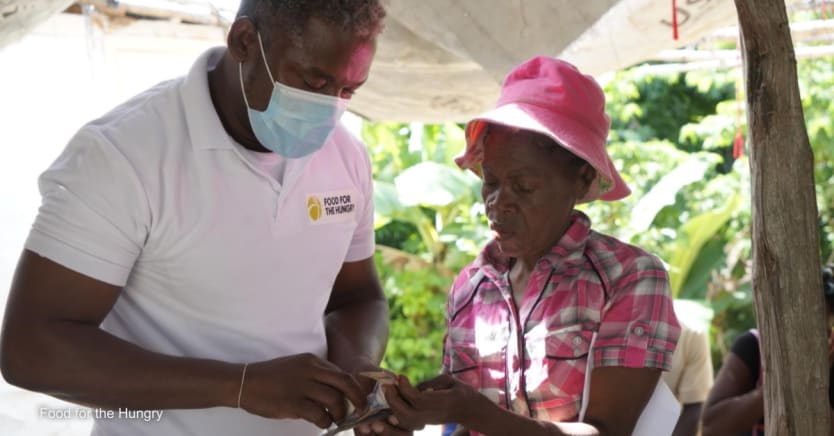
By 2030, a staggering 86% of the world’s extreme poor may live in settings afflicted by fragility, up from 73% now, according to new Organisation for Economic Co-operation and Development forecasts. As a major challenge to development progress, this appears to lend growing weight to calls for strategies to boost countries’ overall resilience to shocks.
And the last couple of years have seen multiple shocks — not only from the COVID-19 pandemic but also a whole series of events in fragile states, with coups in multiple countries, as well as the war in Ukraine. Those come alongside evergrowing shocks from climate change.
In this context, the concept of taking a long-term “fragility-to-resilience” approach to deal with compounding crises is taking hold, contrasting with aid delivered through siloed and short-term projects that focus on a single or narrow set of immediate issues.
“We’re not going to achieve the Sustainable Development Goals if we don’t bring that fragility lens to the work we do,” said Mamta Murthi, vice president for human development at the World Bank. “Working on this cusp between humanitarian response and development has become more important.”
And the global development community appears to widely back more joined-up strategies. In a survey conducted by Devex in partnership with Food for the Hungry, 87% of respondents said they think fragility-to-resilience strategies are the right approach for the development community to take. A similar proportion, 84%, agreed that collective platforms are needed to respond to crises.
“I think the first statistic really affirms that there is this movement towards more fragility-to-resilience strategies, which are crucial at this moment in time,” said Jonathan Papoulidis, global director for fragility and resilience at Food for the Hungry. He said this had only been made more evident by COVID-19, which exposed how fragile our health, economic, food, and energy systems are.
“Addressing fragility and building resilience is going to be central to anything that development agencies try to do.”
— Mamta Murthi, vice president for human development, World BankCountry platforms
Collective platforms are important for avoiding the fragmentation that often occurs when implementing strategies on the ground, said Papoulidis, adding that there have been steps in the right direction. “There are these really positive signs that have emerged over the last couple of years with what we call country platforms.”
These comprise government-led coordination bodies via which different groups in society can agree on shared priorities, mutual accountability, and collective action in a range of complex political, social, and economic areas. They have been harnessed in countries including Haiti, Rwanda, Sierra Leone, and Somalia.
However, according to Papoulidis, these need to go further and the results properly analyzed, refined, and incorporated into subsequent agendas. “Such approaches have been happening for 20 years, but there’s been no guiding doctrine or learning agenda around them,” he said. “I think the moment has come that we need to come together and be much more strategic on the ground.”
Papoulidis referred to a need to take on board lessons from the past, citing the example of Haiti. After the 2010 earthquake there, he said, it became clear that the country platform had an active high-level steering committee and secretariat, but lacked “middle-level” ministerial-led committees in sectors such as education, employment, the environment, and justice. This was corrected in the establishment of Haiti’s subsequent platform, the Coordination Framework for External Development Assistance or CAED.
Meanwhile, he said one of the “biggest moments” that has highlighted the fragility-to-resilience shift has been the recent establishment of the U.S. Strategy to Prevent Conflict and Promote Stability, focusing on 10-year plans to help countries exit fragility.
Fragility at the heart
Murthi said the World Bank has recognized for some time that fragility and conflict will be “at the heart” of development challenges going forward. From her organization’s perspective, she said addressing this involves both supporting government institutions to aid long-term development and building human resilience by ensuring that services — whether education, employment programs, or agriculture — are delivered.
“Addressing fragility and building resilience is going to be central to anything that development agencies try to do,” she added. Via the World Bank’s own Development Policy Financing Budget, for example, the average commitment for operations in countries affected by fragility, conflict, and violence tripled from $43 million between 2010 and 2015 to $127 million in the subsequent years to 2022.
As an initiative that has had an impact on boosting resilience, Murthi pointed to Wadata Talaka, a social safety net program run by Niger’s government that supports the poorest households with regular cash-transfer payments. It is estimated to have benefited more than 3 million people and can be scaled during shocks — expanding from the usual 28,000 households to 400,000 for a one-off emergency payment during COVID-19.
“This is a program that’s been rigorously evaluated and is shown to have impact,” said Murthi. “For women who benefit, there’s a lower level of food insecurity and a higher resilience of their families.”
In addition, under the program, the Niger government has been piloting the use of satellite early warning data to identify drought-affected areas and intervene with early cash transfers. “It has the scope to be scaled up, so there’s some institutional development that has occurred as a consequence of this program,” said Murthi. “I see it as an example of the kind of thing that can be used to build resilience in populations.”
She added that developing better analytics on the impact of fragility-to-resilience strategies will also be crucial to measure their outcome effectively. Given the differing approaches that different organizations take, there’s also a lot of learning that can be done both within and across institutions on “what works in which context,” she said.
Capacity-building
Marcia Wong, deputy assistant to the administrator at the U.S. Agency for International Development’s Bureau for Humanitarian Assistance, expanded on the importance of building capacity in different segments of society to resolve “compounding crises.” It’s important to work at the micro as well as the macro level, she said, “because sometimes you have that wonderful creativity on the ground.”
“It’s recognizing that if we don’t look to build the capacity of local communities and organizations to be able to analyze and understand and respond to these highly complex and multisectoral challenges, we’re kind of defeating ourselves,” Wong said.
USAID’s ER4 program — standing for early recovery, risk reduction, and resilience — is “focused squarely” on the need for joined-up programming in its range of initiatives globally, with community and local stakeholders forming key parts of that, said Wong. She said that the idea is not just to provide the money, but to be there at the front end of conversations on opportunities and challenges.
USAID is also involved in specific resilience initiatives that seek to achieve collective impact through partnerships between its own implementing partners, as well as governments, local institutions, NGOs, and development practitioners from other donors. These include the Partnership for Resilience and Economic Growth in Kenya, and the Partnership for Recovery and Resilience in South Sudan.
Wong said these approaches allow multiple stakeholders to join to discuss “what is the collective shared problem set? And how do you bring about collective action into work plans and the results framework?”
Measures to enhance resilience should also be coordinated in an intentional way, said Wong. “All these things have to come together in that big blender of dialogue, design, strategic thinking, and analytics,” she said.
But aside from partnerships at national and international levels, separate silos also need to be connected within organizations themselves, said Wong. “If we’re going to try to talk to and influence and shape the humanitarian-development-peace nexus, we have to be able to do it comfortably in our own thinking, strategic analysis, design, and implementation.”
About the author

Devex Partnerships
Thanks for reading and for your interest in Devex. In collaboration with our partners, Devex’s partnerships editorial team produces content to promote a partner’s work or perspectives on a particular issue. It gives actors across the global development sector — including nongovernmental organizations, private sector stakeholders, aid agencies and government institutions — the opportunity to go beyond traditional advertising and tell their stories in an impactful way. If you’d like to learn more about how you can shine a spotlight on a particular issue with Devex, please email partnerships@devex.com. We look forward to hearing from you.
Search for articles


Most Read
- 1
- 2
- 3
- 4
- 5