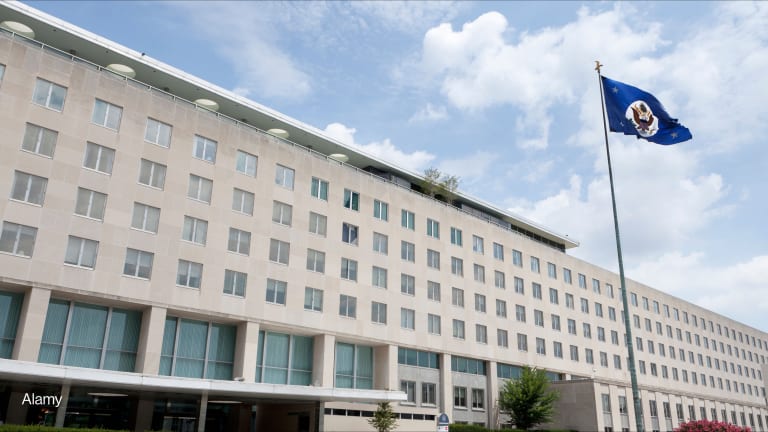
State Department scrambles to rebuild foreign aid workforce
“What we’re seeing anecdotally is a recreation of the things that we just tore down,” says Rohit Nepal, the Department of State vice president at the American Foreign Service Association.
The State Department is rebuilding its workforce — and across the world, positions are opening up to fill the gaps created by the obliteration of the U.S. Agency for International Development. “Oh look the job I was RIFed from,” one former USAID employee wrote on a LinkedIn post advertising those new positions, which went live in early December. It’s all part of a messy, ongoing scramble to reassemble the staff needed to oversee billions in foreign aid — and the first visible sign of a system trying to piece itself back together. For months, the aid sector has been asking how the State Department will continue to deliver assistance without the thousands of staff who worked at USAID. Even with the U.S. aid machinery running at a fraction of its previous capacity, money is still flowing faster than many teams can manage. But it’s something that the State Department — almost eleven months after the collapse of USAID — finally seems to have begun to address. Roles have quietly opened up, mirroring those once housed at the now-shuttered aid agency, and the department seems intent on staffing up even while its structure remains in flux. That’s meant utilizing several recruitment agencies who served as long-time USAID partners to source roles across the globe, with the department now hiring for positions at regional bureaus, embassies, and the offices beneath the Under Secretary for Foreign Assistance. “It’s almost like they walked into a giant factory, just started ripping out parts, saying ‘who needs this, who needs this?’ and then they tried to make the factory run,” said a former USAID staffer, speaking to Devex on the condition of anonymity. “And are slowly, slowly realizing, but never admitting aloud, that maybe they shouldn’t have destroyed something before they understood what it did.” It’s not clear exactly how many roles are being hired for, given the number of contracting agencies involved. Devex was able to identify nearly 20 open roles, but some others put the potential number much higher — on top of dozens of foreign service officers, embassy staffers, and others that were hired in recent months. The hollowing out USAID’s operations came to a halt on July 1. The majority of the agency’s 10,000 staff members were severed from their posts — and while nearly all remaining employees were terminated by Sept. 2, initial proposals suggest that some 600 were transferred to the State Department. That’s less than 6% of the agency’s former workforce — and for teams such as the Bureau of Humanitarian Assistance, it meant a drop from 1,000 staffers to roughly 50. “The U.S. had unsurpassed capability on the global stage to respond rapidly to crises,” said Noam Unger, the vice president of the Global Development Department at the Center for Strategic and International Studies, a Washington, D.C.-based think tank. “As a result of the changes to foreign assistance of this past year, it clearly has a reduced capacity — far reduced.” Around the same time, the State Department saw deep cuts of its own. In July, the department announced it would be laying off 1,300 of its own staff, nearly 250 of whom were foreign service officers. While an ongoing legal battle has paused the layoffs of FSOs, the remaining 1,100 civil servants — those who kept operations running in Washington — have been gone from the State Department for months. Together, the two agencies’ cuts wiped out a quarter of the country’s foreign service officers — and today, the State Department’s workforce is largely a black box. The agency did not answer a request for comment about how many staff are currently coordinating aid, and since March, it has severed ties with the American Foreign Service Association, the union representing such officials across the federal government. “In the past, I would have been able to pick up the phone and call someone, and get you actual numbers — but we don’t get those numbers now,” said Rohit Nepal, the Department of State vice president at the American Foreign Service Association, or AFSA. “The numbers here are very, very difficult until the Department is willing to provide them.” The hollowing-out came despite Congress appropriating $60 billion in previously agreed-upon foreign assistance in March of 2025. While the Trump administration has since clawed back some money through two rescission packages, the government is still on the hook to deliver billions of dollars in foreign assistance next year. “This has been everyone’s critique from the beginning,” said Conor Savoy, a visiting fellow at the Center for Global Development and a former senior employee at USAID. “Even if you slashed half of what we were doing last year, we’re still probably talking about them managing a $20-30 billion portfolio. I don’t really see how they’re going to be able to do that.” A recent report from AFSA laid many of those pain points bare. Ninety-eight percent of surveyed foreign service workers reported poor morale, while 86% said that the year’s upheaval had undermined their ability to advance U.S. diplomatic priorities. That was also the result of reduced budgets, delayed or suspended initiatives, and significantly heavier workloads — pushing 1 in 10 to try to leave their roles by the end of the year. “Folks have talked to me about taking on the work of an office that has been eliminated, but not being given any additional personnel to do it,” Nepal said. “So when there’s discussion of efficiencies, those efficiencies are being borne on the back of whoever’s still in place.” The new blueprint It’s not just the staff count that’s shifted at the State Department, but the structure of the agency itself. Since April, U.S. Secretary of State Marco Rubio has shuttered bureaus and offices, downsized staff, and “consolidated” aid in regional bureaus across Africa, Asia, Europe, and the Western Hemisphere. The goal, Rubio said, was on draining “the bloated, bureaucratic swamp” — and on empowering the department “from the ground up.” “If something concerns Africa, the bureau of African Affairs will handle it,” Rubio wrote in a State Department blog post, which was published on April 22. By July, a Washington-based foreign assistance arm had emerged — and Jeremy Lewin, who had previously been a part of the budget-slashing Department of Government Efficiency, was named under secretary for foreign assistance, Humanitarian Affairs, and Religious Freedom. Beneath Lewin were five more foreign aid-related offices, including one focused on global health and another centered on food security. Five months later, however, that structure is still hazy. For weeks, Congress has been expecting a notification about the merger of two bureaus beneath Lewin: the Office Of Global Food Security and the Bureau Population, Refugees, and Migration. For even longer, lawmakers have been expecting USAID’s flagship hunger program, Food for Peace, to shift over to the U.S. Department of Agriculture. Neither move has been officially announced to Capitol Hill to date, according to two congressional aides who spoke to Devex this week. “Everything is being tightly held in close leadership circles, and [it hasn’t been] an inclusive process, or one that asks folks who actually work on these issues day to day for their input as part of restructuring,” said one of those aides. At the same time, regional bureaus are establishing foreign assistance offices — and while those bureaus are slated to run foreign aid programs in their regions, they’re also expected to pull in significant input from embassies. Embassies in countries seen as strategic to the United States are also staffing up, and the State Department is pulling in former USAID foreign service officers and local staff to fill the gaps created earlier this year. “How that decision-making structure flows — and how that relates back to [the foreign assistance bureau] at the State Department is still pretty unclear to us,” said the aide. The effort to rebuild Amid the lingering chaos, the State Department is quietly working to rebuild the staff and systems it needs to deliver foreign aid. It’s a process that’s occurring at the same time the department is ramping up spending: earlier this month, the U.S. announced its biggest foreign aid award yet — a $2.5 billion bilateral health agreement with Kenya. “It’s still a lot of money that you’re asking a relatively small bureau at State to manage,” said Savoy. “They seem like they’re moving fairly quickly to fill the slots they have and put people in place, but they’re still really behind the eight ball in a lot of ways on this.” Over the last two weeks, contracting companies have discreetly flooded LinkedIn with job postings, with the State Department seeming to utilize many long-term professional service partners of USAID. There’s Koniag Government Services, an Alaska-based company that sources contractors for government agencies; Credence LLC, a long-time contracting partner of USAID’s, and many more — all of which are advertising for different foreign aid positions across different foreign aid bureaus. “What we’re seeing anecdotally is a recreation of the things that we just tore down,” said AFSA’s Nepal. “Will, over time, the State Department — even under this administration, or certainly in a future administration — end up creating another version of USAID?” The State Department’s Bureau of African Affairs, which is poised to oversee the U.S. government’s foreign assistance on the continent, is hiring for several different roles historically held by those at USAID, including humanitarian program analysts, grant management specialists, and financial analysts. Credence has posted similar positions in Colombia and the Dominican Republic, from a humanitarian and health advisor and food security and food assistance advisor in Colombia’s Bogota Foreign Assistance Hub, to health and development budget specialists in the U.S. Embassy in Santo Domingo. And Guidehouse and Dexis — two more professional services firms — have put up roles of their own, including a D.C.-based monitoring, evaluation, and learning specialist and a strategic consultant for the State Department’s global health security and diplomacy bureau. It’s a balancing act: while billions of dollars are being committed abroad, the department is simultaneously standing up the teams that will manage, monitor, and implement those programs, and many more. “There are still changes afoot, but at the same time — without question — the administration is starting to turn a corner,” said CSIS’s Unger.“They’re feeling pressure beyond the honeymoon phase of this administration to actually deliver, through the tools they have remaining, and deliver success against their goals.” The State Department did not respond to a request for information on this story.
The State Department is rebuilding its workforce — and across the world, positions are opening up to fill the gaps created by the obliteration of the U.S. Agency for International Development.
“Oh look the job I was RIFed from,” one former USAID employee wrote on a LinkedIn post advertising those new positions, which went live in early December.
It’s all part of a messy, ongoing scramble to reassemble the staff needed to oversee billions in foreign aid — and the first visible sign of a system trying to piece itself back together. For months, the aid sector has been asking how the State Department will continue to deliver assistance without the thousands of staff who worked at USAID. Even with the U.S. aid machinery running at a fraction of its previous capacity, money is still flowing faster than many teams can manage.
This story is forDevex Promembers
Unlock this story now with a 15-day free trial of Devex Pro.
With a Devex Pro subscription you'll get access to deeper analysis and exclusive insights from our reporters and analysts.
Start my free trialRequest a group subscription Printing articles to share with others is a breach of our terms and conditions and copyright policy. Please use the sharing options on the left side of the article. Devex Pro members may share up to 10 articles per month using the Pro share tool ( ).
Elissa Miolene covers U.S. foreign assistance from Washington, D.C. She previously covered education at The San Jose Mercury News, and has written for The Wall Street Journal, the San Francisco Chronicle, and other news outlets across the world. Before shifting to journalism, Elissa led communications for aid agencies in the United States, East Africa, and South Asia.