Stephen Hadley and Madeleine Albright team up to ask Congress not to cut foreign aid
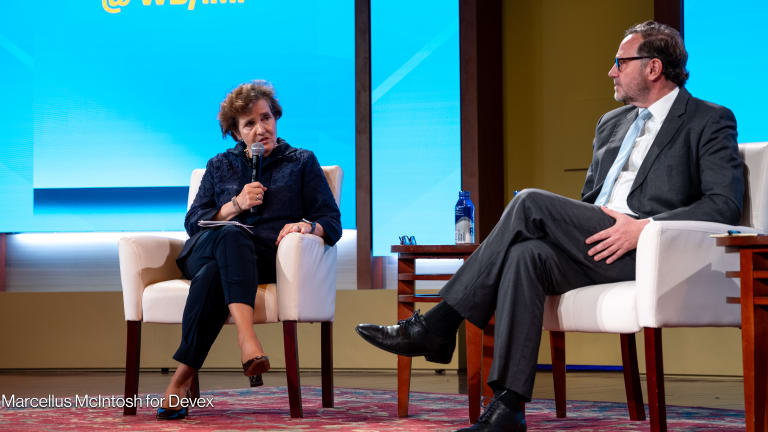
Former Secretary of State Madeleine Albright and former National Security Advisor Stephen Hadley may seem an unlikely pairing politically, but they called on Congress together to convene a national debate about America's role in the world, warned against isolationism and asked Congress to reject the foreign aid cuts recommended in President Donald Trump's budget.
Former Secretary of State Madeleine Albright and former National Security Advisor Stephen Hadley called on Congress together to convene a national debate about America’s role in the world, warned against isolationism and rejected deep foreign aid cuts recommended in President Donald Trump’s budget. The budget recommended a 28 percent cut to foreign aid funding, which Albright, who served under former President Bill Clinton, and Hadley, who served under former President George W. Bush, rejected repeatedly during a House Armed Services Committee hearing Tuesday. At the same time, Trump is pushing a hefty jump in military spending. Hadley said they both believed in a need to upgrade and enhance U.S. military capabilities, but that the other parts of the “national security toolkit: diplomacy, trade and investment, development assistance, reconciliation and peacebuilding skills and sound political advice” are also required — particularly in the Middle East. The administration has stated that destroying the violent extremist group the Islamic State is a top priority, Hadley said. But he pointed out that military action alone was not enough to secure that objective. “ISIS will return in an even more vicious and virulent form if those liberated lands to do not enjoy some measure of political stability, societal reconciliation, and economic progress. And such progress requires the very nonmilitary elements of national power targeted by the recent budget guidance,” he stated. “Gutting these institutions will make America less safe, undermine the success of our military and open the door to terrorists,” Hadley said. The Trump administration has said that its budget is focused on the U.S. and on hard power, rather than soft power, which will create a more robust military and fulfill campaign promises. “There's no question this is a hard power budget … that was done intentionally,” Mick Mulvaney, the director of the Office of Management and Budget, told reporters in a briefing last week, adding the next day that the president had said throughout the campaign “‘I’m going to spend less money on people overseas and more money on people back home.’ And that’s exactly what we’re doing with this budget.” But Albright said the cuts — which include reduced funding to the United Nations — will only damage the U.S. national security interests and position in the world. “I think they are so stunningly damaging to America's position that I find it hard to believe that somebody that is in the U.S. government could even suggest them, if I could put it bluntly,” she told the committee. While there is room for reform in international organizations, including the U.N., the U.S. needs to be engaged if it wants to have influence in dictating those changes, Albright said. “It is very hard for us to have influence in reforming if we are the ones that are creating a financial crisis there,” she said. Hadley said he took issue with the whole distinction between hard power and soft power because “a lot of our soft power converts into hard power.” The U.S. must have tools in place to help mitigate the risk of violence in flash points around the world. This often means using the tools that the State Department and the U.S. Agency for International Development have to quell conflicts before the military is needed, particularly in Africa, Hadley said. “Those preventive tools avoid our need to use the military instrument down the road when a fragile state becomes a conflict state,” he said. “We underinvest in those at our peril.” He gave the example of the U.S. Institute of Peace, an organization slated for elimination in the budget proposal. It has been working in Iraq since 2003, training local people to negotiate peace deals between different tribes and factions. In 2007, USIP helped broker a deal to accept the U.S. presence, which resulted in a dramatic decrease in violence and in reducing American military presence in the area by 80 percent. That agreement is still in place today, and USIP’s work has saved both lives and money, said Hadley, who chairs the board of USIP. Albright brought up another one of the agencies slated to be defunded — the Overseas Private Investment Corporation — in her response to a question about the need for Palestinian economic growth. OPIC provided a $110 million guaranty to the Middle East Investment Initiative to support lending to small and medium sized enterprises, in an effort to bolster job creation in the West Bank. They called on Congress to ensure that all instruments of national security, including diplomacy and development, are properly funded, and they thanked members of the committee, including chairman Rep. Mac Thornberry, a Republican from Texas, and the ranking member Rep. Adam Smith, a Democrat from Washington, who had already spoken out against the cuts in the budget proposal. They also called on the committee to help start a national debate about America’s role in the changing world, to be more involved in the policy process and to let policy drive the budget rather than the opposite. “In this pivotal moment there must be a national debate about how and why America engages in the world. Congress has a vital role to play in convening that debate,” Albright said. That strategy cannot be a retreat from engagement with the world, Albright cautioned, saying she has seen what happens when the U.S. is absent from international diplomacy, especially in the face of multiple current crises and a rapidly changing world order. The conversations about policy and America’s role in the world may well be complex, but the U.S. should be involved in creating a new framework or international system that will have to present a role for emerging powers such as China and India. There are ways for the U.S. to send the right signals, and one would have been to join the Asian Infrastructure Investment Bank, Hadley said. Not only to show China that the U.S. wants to engage, but also to ensure that it actually encourages development and is not just a vehicle for China to assert its influence, he added. Stay tuned to Devex for more news and analysis of what the Trump administration means for global development. Read more coverage here and subscribe to The Development Newswire.
Former Secretary of State Madeleine Albright and former National Security Advisor Stephen Hadley called on Congress together to convene a national debate about America’s role in the world, warned against isolationism and rejected deep foreign aid cuts recommended in President Donald Trump’s budget.
The budget recommended a 28 percent cut to foreign aid funding, which Albright, who served under former President Bill Clinton, and Hadley, who served under former President George W. Bush, rejected repeatedly during a House Armed Services Committee hearing Tuesday. At the same time, Trump is pushing a hefty jump in military spending.
Hadley said they both believed in a need to upgrade and enhance U.S. military capabilities, but that the other parts of the “national security toolkit: diplomacy, trade and investment, development assistance, reconciliation and peacebuilding skills and sound political advice” are also required — particularly in the Middle East.
This article is free to read - just register or sign in
Access news, newsletters, events and more.
Join usSign inPrinting articles to share with others is a breach of our terms and conditions and copyright policy. Please use the sharing options on the left side of the article. Devex Pro members may share up to 10 articles per month using the Pro share tool ( ).
Adva Saldinger is a Senior Reporter at Devex where she covers development finance, as well as U.S. foreign aid policy. Adva explores the role the private sector and private capital play in development and authors the weekly Devex Invested newsletter bringing the latest news on the role of business and finance in addressing global challenges. A journalist with more than 10 years of experience, she has worked at several newspapers in the U.S. and lived in both Ghana and South Africa.