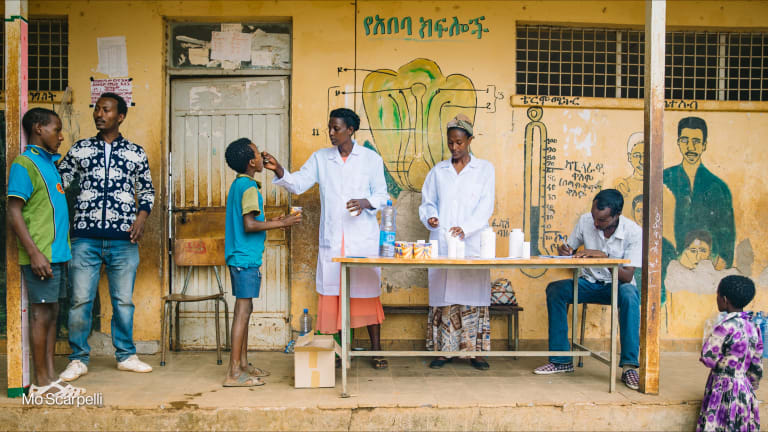
The END Fund: A collaborative fund approach to health integration
In the wake of mass foreign aid cuts, the global health sector can learn lessons from The END Fund’s private sector, collaborative approach.
Neglected tropical diseases threaten 1.5 billion people globally with conditions such as blindness, stunted growth, swollen limbs, and chronic pain — yet they remain chronically underfunded. The END Fund is trying to change that through a collaborative fund model. The fund raises private capital from individuals, corporations, foundations, activist-philanthropists, and institutions — and channels it to national programs, nonprofits, and other organizations, cocreating grants with them. It also provides technical support to country partners who work in areas such as providing treatments, performing surgeries, and expanding access to clean water. The END Fund is among a coalition of stakeholders in the NTD space working toward helping at least 100 countries reach the goal of eliminating one or more neglected tropical diseases by 2030. “We’re very confident that we’ll reach that goal,” Dr. Solomon Zewdu, the fund’s chief executive officer, told Devex. The sector is more than halfway: As of October, 58 countries have eliminated at least one NTD. The organization says that private capital brings speed, agility, and flexibility, allowing it to respond quickly to crises and seize new opportunities — unlike public or multilateral funds, which are often slowed by bureaucracy. Zewdu took over the helm of the organization at a tumultuous time in international development, as the United States abruptly pulled out of its long-held commitments to global health, including on NTDs — creating seismic ripples. “I started working in January, and then all hell broke loose,” he said. But these disruptions have also led to increased calls for efficiencies, more equitable global cooperation, and external funds integrating more into national health systems. These calls were recently articulated in the “Accra Reset,” and working more directly with governments, and increasingly the private sector, through new overarching bilateral agreements is a hallmark of the Trump administration’s new “America First Global Health Strategy.” “We started way before that, but it’s great that the trend is catching up,” Zewdu said. And so, the sector can learn lessons from The END Fund’s private sector, collaborative approach because those are goals the organization has strived for over a decade. Zewdu said it has long worked within existing government systems off of one budget, one plan, and one monitoring and evaluation framework — cocreated with governments, but led by them. A collaborative fund The fund started in New York in 2012, but it is also registered in London and Nairobi. The nonprofit fundraised $56.9 million for programs this year. In 2024, the organization had active grants in 32 countries. There are over 20 NTDs, but the fund has focused on six — working to control and eliminate intestinal worms, schistosomiasis, lymphatic filariasis, river blindness, trachoma, and visceral leishmaniasis. The END Fund uses the approach called a “collaborative fund,” which strategically channels resources from multiple donors to nonprofits and community-based organizations. According to the Bridgespan Group, this model delivers “outsized impact” yet remains “a largely underutilized segment of the global philanthropic landscape.” The group found that “collaborative funds working in the Global South are experts in channeling resources to ‘proximate’ leaders — those with lived experience and local knowledge — and to local communities.” “By pooling funds, by engaging governments, we are able to make much more smart investments to really squeeze every penny out of the dollar to make sure that it goes towards impact,” Zewdu said, adding that about 90% of what they fundraise goes into programming. One plan In Zewdu’s previous philanthropic work, he said, oftentimes health ministers would say they want donors to work in more organized ways. Since its founding, The END Fund has worked to do this. It’s not effective to come into a country with preconceived grants replicating another system, as opposed to coming in and assessing what exists, he said. Their model from the beginning has focused on saying “there’s no value in duplicating,” he said. Country leadership is the core of their work, according to the nonprofit, so that NTD programming is integrated into public health systems: from national strategies, budgets, and delivery through primary care services. Zewdu said they use available community health workers and existing supply chains, for example, and programs come with strict requirements around avoiding data duplication. “We won’t go in and say: Here’s our cadre of individuals that are going to end up doing the mass drug administration. We go to the country and say: Who do you have available in your community health structure, in your calendar, to be able to absorb this?” he said. In 2024, the fund awarded $55 million in grants to implementing partners and governments, with a focus on growing the percentage of grants to local, regional, and government partners. This figure stood at 48% last year, compared to 29% in 2018. There are others in the health sector with knee-jerk reactions to quickly pour money in, becoming duplicative, Zewdu said. “We’re not in a hurry. We want to make sure that we strategically place the finance and the funds into spaces that need it the most,” he said. The NTD community — not lush with resources — may have been driven to work more collaboratively out of necessity — with a fair amount of division of labor without too much overlap, he said. “We work from the scraps,” he said. “You learn to play well in the sandbox with the piece that you have.” He added it’s encouraging to see some countries cofinancing programs. For example, The END Fund initiated a cofinancing agreement with Oromia, Ethiopia’s most populous region. It’s a two-year cofinancing agreement where each side commits $1 million yearly toward fighting intestinal worms and trachoma. Donated drugs The END Fund’s success is in many ways linked to getting drugs for free, Zewdu said, adding that this keeps costs low, at about $0.50 annually to deworm a child. For example, in 1987, Merck committed to donate the drug Mectizan for as long as needed, and in whatever quantity, until river blindness was eliminated. It has since donated over 5 billion treatments. In late October, The END Fund supported Merck KGaA on a Kenya visit where there were discussions with the Ministry of Health about the results of a national survey about the prevalence of schistosomiasis in hyper-endemic hot spots. According to The END Fund, data-driven deliberations are critical in sizing drug donation impacts and informing accurate procurement quantities for future campaigns. Zewdu said one of his priorities is to “really create that security and stability for pharma companies to lean in even more.” This includes ensuring predictable markets for donated drugs, which in turn support steady levels of manufacturing. It also includes ensuring drugs are moved in a timely fashion so they don’t expire, and helping create conducive environments for companies to move manufacturing to the continent. “When you think about some of these drugs, we’re the only market,” he said. A ‘renaissance’ The END Fund hasn’t been directly impacted by foreign aid cuts in overseas development assistance, or ODA, as its funding comes from the private sector, but it does work alongside these projects. The U.S. was a major donor to NTDs. Over the past two decades, the U.S. Agency for International Development — which the Trump administration dismantled this year — supported the delivery of 3.3 billion treatments to more than 1.7 billion people in 26 countries. But the U.S. State Department’s ‘America First’ global health strategy excludes NTDs. “The recent withdrawal of funding by the United States from NTD projects jeopardizes the success of 19 years of investment in the global effort to eliminate NTDs,” the World Health Organization wrote in June. According to The END Fund, its programmatic plans were based on the assumption of continued ODA support, and without this funding, The fund’s available resources alone will be insufficient to bridge the gap and ensure success. But collaborative philanthropic funds do give the organization flexibility to shift its approach. This includes a bigger push to integrate NTD treatment with other essential services and expand domestic resource mobilization and innovative financing, according to the organization. And the fund also has experience of leaning in when others pull out. For example, in 2012, one of the nonprofit’s first initiatives was mobilizing support for Mali’s national NTD program to replace foreign aid funding that was suspended after a coup. As fiscal spaces narrow, Zewdu said there’s a need to use resources more catalytically in areas such as blended financing and cofinancing, as well as improving cross-sector coordination. And amid program interruptions, there’s a need for more surveys and mapping of areas so resources are placed in “a very scientifically savvy way,” he said. In the wake of the aid cuts, The END Fund signed an agreement with the African Union Commission in May to ensure efforts to tackle NTDs leverage regional strengths. “Folks have called this unfortunate situation a wake-up call, a renaissance, or an opportunity for the continent to really step forward and start making tougher and stronger decisions,” Zewdu said. This includes costing out the remaining problem and allocating responsibility to different players — such as countries, the AU, and donors. In June 2025, the Africa Centres for Disease Control and Prevention, with support from The END Fund, gathered 49 African countries to develop costed country microplans for NTD elimination for the first time. In the longer term, the ultimate success is ending the organization itself, Zewdu said. “It’s the end of the disease. It’s the end of our existence. The end of this fund, unless it is repurposed into something else,” he said. But to reach this, he said it’s crucial they have a good understanding of where they are on the journey — and that means stronger data collection, analytics, predictions, and collaborations. “We’ve had plenty of success, but the entire ecosystem around us has changed. How do we evolve? How we adapt to this is basically what I look forward to introducing into the organization,” he said. Update, Dec. 3, 2025: This article has been updated to clarify that The END Fund fundraised $56.9 million this year.
Neglected tropical diseases threaten 1.5 billion people globally with conditions such as blindness, stunted growth, swollen limbs, and chronic pain — yet they remain chronically underfunded. The END Fund is trying to change that through a collaborative fund model.
The fund raises private capital from individuals, corporations, foundations, activist-philanthropists, and institutions — and channels it to national programs, nonprofits, and other organizations, cocreating grants with them. It also provides technical support to country partners who work in areas such as providing treatments, performing surgeries, and expanding access to clean water.
The END Fund is among a coalition of stakeholders in the NTD space working toward helping at least 100 countries reach the goal of eliminating one or more neglected tropical diseases by 2030.
This story is forDevex Promembers
Unlock this story now with a 15-day free trial of Devex Pro.
With a Devex Pro subscription you'll get access to deeper analysis and exclusive insights from our reporters and analysts.
Start my free trialRequest a group subscription Printing articles to share with others is a breach of our terms and conditions and copyright policy. Please use the sharing options on the left side of the article. Devex Pro members may share up to 10 articles per month using the Pro share tool ( ).
Sara Jerving is a Senior Reporter at Devex, where she covers global health. Her work has appeared in The New York Times, the Los Angeles Times, The Wall Street Journal, VICE News, and Bloomberg News among others. Sara holds a master's degree from Columbia University Graduate School of Journalism where she was a Lorana Sullivan fellow. She was a finalist for One World Media's Digital Media Award in 2021; a finalist for the Livingston Award for Young Journalists in 2018; and she was part of a VICE News Tonight on HBO team that received an Emmy nomination in 2018. She received the Philip Greer Memorial Award from Columbia University Graduate School of Journalism in 2014.