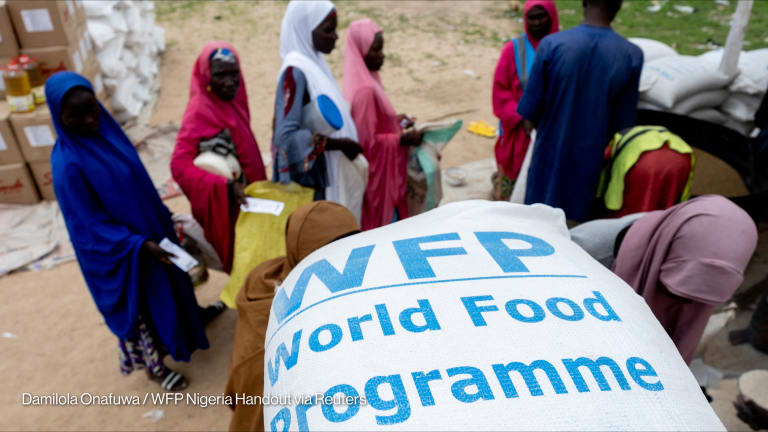


Buried in the spending package that recently reopened the U.S. government is a bipartisan commitment of $1.2 billion for the Food for Peace initiative. For more than seven decades, Food for Peace has purchased crops from American farmers to feed people in dire need around the world. Given the recent draconian cuts to foreign aid, the new investment is welcome — but only if the State Department maintains strategic control of the program and the money is actually spent to save lives.
Since the U.S. Agency for International Development was shuttered, the once steady flow of U.S. lifesaving food aid has dramatically slowed. Last year, the State Department — now responsible for running the program — spent just half of last year’s $1.8 billion Food for Peace budget, according to sources familiar with budget plans. And this year it has issued no new awards at all, even as needs have risen for six straight years and a record 295 million people are facing acute hunger.
While the State Department has much work to do to effectively manage its new foreign aid duties, this slowdown is not about a lack of know-how or systems. It’s on pause largely because of ongoing negotiations to shift Food for Peace to the U.S. Department of Agriculture through a backdoor agreement designed to bypass Congress, according to sources familiar with the draft interagency agreement.
On paper, the move may sound logical — USDA works with farmers, after all. In practice, it would be disastrous for the world’s hungry and offer little benefit to American farmers.
USDA has no humanitarian mandate, no expertise in targeting countries most in need, and no incentive to choose foods that most effectively address hunger and malnutrition. I’ve seen the consequences before when U.S. agricultural priorities override humanitarian imperatives.
In the 1990s, U.S. rice shipments flooded Haiti, devastating local farmers. Former President Bill Clinton later apologized. “It may have been good for some of my farmers in Arkansas,” he noted, “but … it was a mistake. I have to live every day with the consequences.”
As a long-time leader of Food for Peace, I saw similar dynamics again and again. USDA and agricultural lobbyists regularly pushed for commodities regardless of local needs: wheat for people whose diet relied on cheaper sorghum; rice for populations that did not eat it; lentils when yellow peas were cheaper and equally nutritious. When domestic markets fluctuated, I received wish lists to ship everything from walnuts to dates to canned salmon — even flying carp — regardless of cost, shelf life, or whether anyone in the receiving country ate those foods.
Humanitarians choose commodities that stretch every taxpayer dollar and save as many lives as possible. Standards require that food be culturally appropriate, because unfamiliar or undesirable foods are often traded away, wasting scarce resources and leaving people in crisis hungrier than before.
A USDA commodities-first approach will fuel other perverse outcomes, such as sending food where it’s cheapest to ship rather than where hunger is worst; and cutting back on the essential activities that make food aid work, from secure storage to monitoring and nutrition screening. Even the U.S. purchase of lifesaving ready-to-use therapeutic foods could be in jeopardy because the higher costs of RUTFs reduce the total tonnage of less-costly bulk commodities, such as wheat and corn, that the USDA could buy.
Worse, USDA could strip the program of its humanitarian purpose altogether and revert to the long-abandoned practice of buying up abundant U.S commodities and dumping them wherever they can be offloaded. And for what gain? The $1.2 billion in annual food aid purchases is a tiny fraction of the $175 billion in U.S. agricultural exports last year.
Even if USDA could marginally increase commodity purchases by cutting corners on program quality, it would not meaningfully affect commodity prices or shield American farmers from market volatility. USDA has far better tools to support farmers than sacrificing a program designed to prevent starvation.
Because of bipartisan resolve in Congress, Food for Peace survived the recent budget showdown, signalling lawmakers’ clear intent that it be put to work. And the law is clear: Food for Peace exists “to address famine and food crises, and respond to emergency food needs arising from man-made and natural disasters.”
If Secretary of State Marco Rubio is serious about ensuring fewer children die on his watch, he should immediately reactivate Food for Peace and keep it where it belongs, in the hands of humanitarian experts battling starvation.
If he will not act, Congress must. Lawmakers should set firm guardrails that guarantee Food for Peace continues its lifesaving mission, reaching as many people as possible and delivering the best outcomes for families struggling to survive. That is how American farmers can remain justifiably proud: knowing their harvests are saving lives, not undermining those they aim to help.
About the author

Dina Esposito
Dina Esposito served as assistant administrator of the USAID Bureau for Resilience, Environment, and Food Security and as deputy coordinator of Feed the Future from 2022 to 2024. Her government service also included serving as director of Food for Peace from 2010 to 2016. Dina also previously served as vice president for technical leadership at Mercy Corps.