
As aid is being pulled apart, Germany needs to fight back


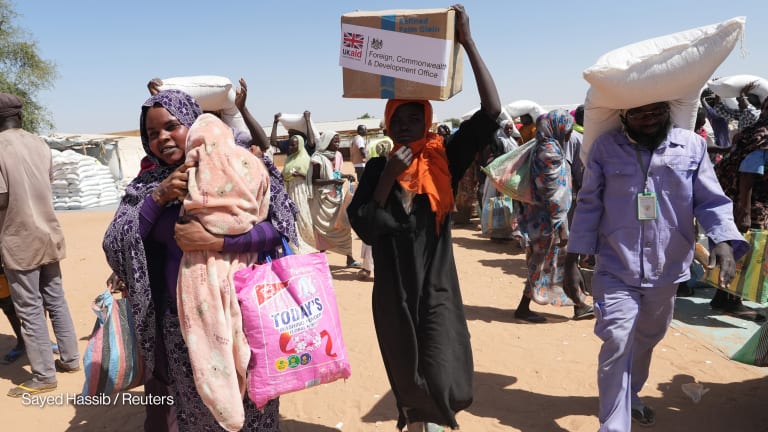
For the first time in nearly three decades, the world’s major aid donors are all cutting their development budgets simultaneously. The United States has dismantled the U.S. Agency for International Development. The United Kingdom has slashed spending, and France has pulled back. Germany’s core development budget has fallen from €12.4 billion in 2021 to €9.9 billion. The real crisis isn’t the budget cuts, severe as they are. It’s that the political case for aid is collapsing from both sides.
Progressives have loaded every global challenge onto development budgets — climate, migration, health, conflict, gender — demanding that aid address all of them simultaneously. As the historian Adam Tooze has written, the Sustainable Development Goals represent an attempt to organize the world around a spreadsheet of universal values rather than politics. In Germany, for example, projects targeting four or more SDGs have increased nearly tenfold in a decade. The result: Aid tries to do everything and achieves less.
Conservatives have rebranded aid as a means of achieving domestic goals, such as curbing migration, promoting national firms, and securing geopolitical leverage. While these goals serve the national interest, it is far less certain that development aid is the most appropriate means of achieving them. The mutual benefit framing sounds pragmatic on the surface. A study by Public First exposes its limits: In France, National Rally voters identified reducing migration as a key benefit of aid — yet most also believed aid fails to reduce migration, and may even increase it. The pitch designed to win over skeptics does not actually convince them.
About the authors

Benedikt Erforth
Benedikt Erforth is a senior researcher at the German Institute of Development and Sustainability, or IDOS. He also co-leads the Megatrends Afrika research and advisory project. His research focuses on European-African relations and Africa’s international relations. He has published widely on the Africa-Europe partnership, authored “Contemporary French Security Policy in Africa,” and coedited “Africa-Europe Cooperation and Digital Transformation.”
Heiner Janus
Heiner Janus is a project lead and senior researcher at the German Institute of Development and Sustainability, or IDOS, in Bonn, Germany, where he leads the institute’s research project on the effectiveness of development policy. His research focuses on bureaucratic politics in development, international development cooperation, and development effectiveness.
Tim Hailer-Röthel
Tim Röthel is a researcher and economist in the Department of Inter- and Transnational Cooperation at the German Institute of Development and Sustainability, or IDOS. His work focuses on economic development, with a particular emphasis on development effectiveness and institutional economics. He holds a Ph.D. in Economics from the University of Bayreuth, where his dissertation examined long-run institutional dynamics. Röthel has published in leading peer-reviewed journals on topics including foreign aid transparency, institutions, education, and economic growth.
Search for articles


Most Read
- 1
- 2
- 3
- 4
- 5