
While the United States withdrawal from Indonesia's $20 billion Just Energy Transition Partnership, or JETP, may seem alarming, Japan, which co-leads the partnership with the U.S., has quietly been stepping into the void — but not just to maintain the status quo. Japanese agencies have been advancing their own vision for Indonesia’s energy future, one that favors Japanese-developed technologies over the rapid coal phaseout originally envisioned. The shift has the potential to mark a fundamental change in how the world's sixth-largest greenhouse gas emitter approaches its energy transition, with competing Japanese initiatives now offering Indonesia different — and possibly conflicting — pathways away from coal. The uncertainty comes as Japan-led institutions play an even greater role in financing and policy planning around Indonesia’s energy transition. Energy experts and climate advocates warn that while Japan’s expanded influence could accelerate decarbonization efforts, it may also promote technologies that could actually prolong Indonesia’s dependence on fossil fuels rather than achieve the rapid coal phaseout originally envisioned. The role of the US, Japan, and Germany in Indonesia’s JETP Launched in November 2022, Indonesia’s JETP was the world’s second G7-led coal and energy transition finance mechanism, after South Africa’s. Aimed at catalyzing funding to speed up the transition from coal, the most polluting energy source, to clean energy, JETPs have been beset by slow progress and lack of enthusiasm from private investors. When the U.S. first announced its withdrawal from the JETP, there were fears it could end a program seen as central to Indonesia’s shift from coal to renewables. Indonesia's special envoy for climate change and energy even suggested the country might follow the U.S. and withdraw from the Paris Agreement. So far however, the impact has been limited. JETPs are led by the Group of Seven advanced economies with one or more countries designated as leads, which provide public financing. With the U.S. withdrawal, Germany became co-lead with Japan, and took over the U.S. financing commitment. Germany has announced its continued support for “Indonesia’s energy transition and its path to net-zero emissions.” Energy experts now see Japan’s expanded role as both an opportunity and a potential concern for Indonesia’s climate goals. “The U.S. has clearly shown that it is now anti-climate change, so a U.S. role in the JETP would have been more of a hindrance than a help,” said Grant Hauber, an energy finance adviser for Asia at the Institute for Energy Economics and Financial Analysis. “It would behoove the Japanese government to look at a diversified portfolio and assist Indonesia to advance their renewable energy program.” As JETP struggles, other Japanese-led initiatives are gaining momentum Agencies such as the Japan International Cooperative Agency, or JICA, have long been active in Indonesia. In 2023, Indonesia was the fifth-largest recipient of aid from Japan, with $983 million in bilateral official development assistance going to the country. Recent years have also seen a greater focus from Japan on energy and climate finance initiatives in Asia. Today, besides JETP, there are two Japan-led multistakeholder initiatives, the Asia Energy Transition Initiative, or AETI, and Asia Zero Emissions Community, AZEC, which promise to invest in net-zero and low-carbon technologies, primarily in Southeast Asia. “AZEC and AETI are where you’re seeing Japan holding out the promise to Indonesia and other Southeast Asian governments of receiving Japanese largesse through state-backed loans,” said Hauber. “This is where Japan is pushing its more aspirational agenda for energy transition solutions.” AZEC was proposed by Japan’s then-Prime Minister Fumio Kishida, and launched in early 2023 as a “platform for cooperation towards carbon neutrality … in the Asia region” with the aim of “simultaneously achieving ‘decarbonization, economic growth, and energy security.’” It is closely linked to AETI, which was launched in 2021 with a pledge of $10 billion from Japan to support decarbonization in Asia. As the largest country in the region, Indonesia is an important focus of these efforts, with a Zero Carbon Analytics analysis finding that 43% of AZEC projects are in Indonesia. Through AZEC, AETI, and bilateral partnerships with JICA, Japan is providing the country with substantial aid, loans, and technical assistance. This has only grown this year, as Indonesia and Japan signed a mutual recognition agreement on carbon credit trading in May, linking Japan’s world-leading market with Indonesia’s burgeoning one. Indonesia is also a focus of Asia GX, a multilateral consortium of financial institutions, including the Asian Development Bank, which seeks to promote energy transition finance in Asia. “Collaboration with other relevant initiatives, including but not limited to AZEC and JETP, as well as the setting and management of consortium goals, would be important elements in advancing the implementation of [energy] transition finance in this region,” a spokesperson from the Japanese Financial Services Agency, told Devex. Competing visions and ‘false solutions’ These initiatives have different mandates due to the roles of different Japanese ministries and agencies. While JETP is managed by the Ministry of Finance, the more pro-fossil fuels Ministry of Economy, Trade, and Industry, or METI, is central in AZEC and AETI. And while JETP’s focus is on retiring coal-fired power plants and expanding renewables like wind, solar, and geothermal, the goals of AZEC and AETI are focused on promoting technologies being pushed by Japanese companies. “Through JICA and AZEC, the Japanese government is recommending co-firing liquefied natural gas as a transition fuel, carbon capture and sequestration (CCS), and, in the long term, hydrogen and ammonia,” Hozue Hatae, a campaigner with Friends of the Earth Japan, said. These fossil-fuel related technologies, heavily promoted by major Japanese companies such as Mitsubishi and JERA, are excluded from JETP financing, Hatae explained. “We are concerned about Japan pushing what we consider false solutions to Indonesia,” she said. Of the current projects funded under AZEC, many support liquefied natural gas, or LNG, or fossil-fuel-linked technologies. Of the 68 partnership projects between Indonesia and AZEC, just 15 are for renewables, compared to 36 for fossil-fuel-related LNG, CCS, or ammonia/biomass co-firing. For example, one project aims to retrofit a coal-fired power plant in Paiton to burn biomass. But expanding biomass or ammonia co-firing — in which wood or ammonia is mixed with coal — could, in fact, prolong the use of coal, and science shows that the technology is costly and has little climate benefit. Similarly, LNG’s benefits as a transition fuel between coal and renewables are likely limited, and CCS remains both expensive and ineffective as a decarbonization technology. To some, it seems like JETP and AZEC have opposing goals. “It’s almost like JETP is competing with AZEC,” said Hauber. “One is looking at sustainable, economic, low-cost, zero carbon approaches, and the other is pinning hope on solutions that will be high cost and high risk.” “One side of the Japanese government admits that co-firing, etc., will only prolong the life of fossil fuels, but under AZEC, they are pushing those false solutions, backed by METI,” Hatae said. Uncertain future Indonesia’s latest electricity supply plan, released in June, includes no mention of the JETP coal transition targets and reduces the ambition for renewable energy. Also concerning is that the updated JETP Comprehensive Investment and Policy Plan, or CIPP, plan has yet to be released. For Dinita Setyawati, a Jakarta-based senior energy analyst at the think tank Ember, it seems that the new Prabowo Subianto administration is deprioritizing JETP. “Indonesia lacks strong leadership that could reduce all this bureaucracy and make renewable energy projects become a national priority, like what [Prime Minister Narendra] Modi did for India,” said Dinita. Japan’s focus on promoting AZEC and AETI, rather than JETP, hasn’t helped make the case for the partnership’s importance in Indonesia. “In the last year, Japan’s role in JETP has been quiet; I don’t see much Japanese representation in the JETP working groups,” said Dinita. “It’s in contrast to AZEC, which is their golden child and gets a lot of attention.” Nearly three years after its historic signing, Indonesia’s JETP has yet to become, as many hoped, a model for how international aid can support a large, diversifying economy’s transition away from coal. But Dinita believes there is still hope for progress. “I think JETP has made progress,” said Dinita. “The infrastructure is there, the work is there, and the investment is focused on the whole-system change we need, expanding the grid, a coal phaseout, and renewable energy. We just need the Indonesian government, Japan, and Germany to take the lead and catalyze it as a financing mechanism.”



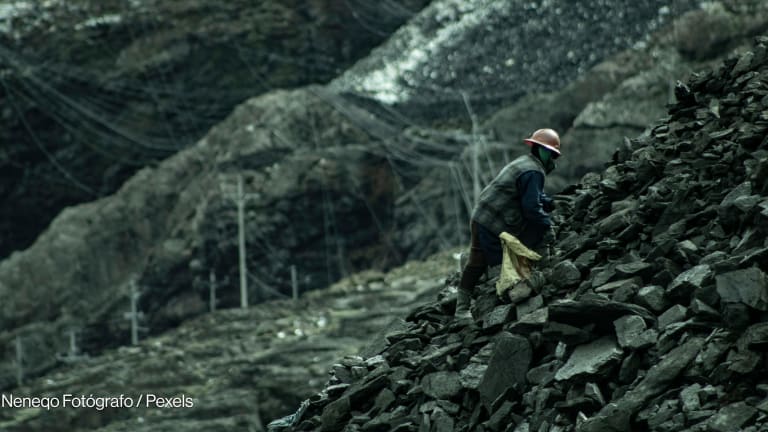
While the United States withdrawal from Indonesia's $20 billion Just Energy Transition Partnership, or JETP, may seem alarming, Japan, which co-leads the partnership with the U.S., has quietly been stepping into the void — but not just to maintain the status quo.
Japanese agencies have been advancing their own vision for Indonesia’s energy future, one that favors Japanese-developed technologies over the rapid coal phaseout originally envisioned.
The shift has the potential to mark a fundamental change in how the world's sixth-largest greenhouse gas emitter approaches its energy transition, with competing Japanese initiatives now offering Indonesia different — and possibly conflicting — pathways away from coal.
Printing articles to share with others is a breach of our terms and conditions and copyright policy. Please use the sharing options on the left side of the article. Devex Pro members may share up to 10 articles per month using the Pro share tool ( ).
About the author

Nithin Cocaexcinit
Nithin Coca is a Devex contributing reporter who focuses on social, economic, and environmental issues in developing countries, and has specific expertise in Southeast Asia.
Search for articles



Most Read
- 1
- 2
- 3
- 4
- 5