


Presented by RADIAN
“We wish them well.”
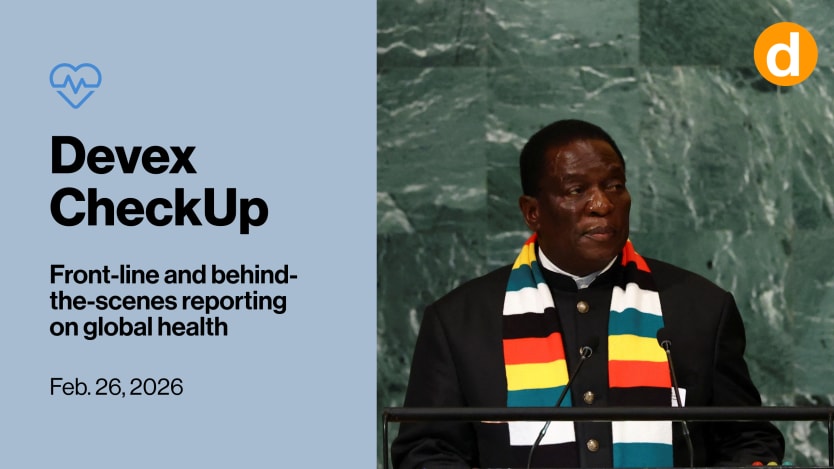
This wasn’t a message scribbled in a farewell card. It was the parting line from U.S. Ambassador to Zimbabwe Pamela Tremont after she announced that Washington will wind down its health assistance to the country. The announcement came a day after news broke that President Emmerson Dambudzo Mnangagwa’s government had rejected a $367 million U.S. health framework, citing sovereignty concerns.
Mnangagwa — nicknamed “the crocodile” for his political shrewdness — has been unapologetic about his Zimbabwe-first stance. “We don’t need to please the West or please the East; we please ourselves," he said during the World Governments Summit this month. “Zimbabwe is a sovereign state.” But that assertion of sovereignty comes against a more complicated backdrop: his administration has faced persistent corruption allegations, alongside mounting criticism that the country’s public health system is crumbling.
Tremont said the deal “would have delivered extraordinary benefits” for people in Zimbabwe, including the 1.2 million people currently receiving HIV treatment with U.S. support. However, she said she was assured by the Zimbabwe government that “it is prepared to sustain” the fight against HIV and AIDS.
Zimbabwe’s reasons for pulling out of the negotiations reflect concerns raised in other countries — issues around U.S. access to health data and, according to some reports, the country’s mineral resources. In Kenya, the high court has suspended the deal that the government signed over data privacy concerns. In Zambia, negotiations over U.S. access to minerals have delayed the signing of a $1.5 billion health deal.
Several health experts have warned that these “America First” health deals feel increasingly transactional — though others point out that aid has always involved strategic interests, and the U.S. is hardly the only country eyeing Africa’s mineral wealth.
The response to Zimbabwe’s decision is mixed.
Global health expert Fifa Rahman, who has consulted for several African governments, welcomed Zimbabwe’s refusal to sign a deal that comes with conditionalities — including potential access to pathogen data without clear benefit-sharing guarantees. But she tells me that the government now needs to start the process to protect its health data through domestic legislation and find ways to boost its domestic resources.
She supports African countries’ ambitions to achieve health independence from donors. But like many observers, Rahman is concerned about what happens next: the functioning of laboratories, uninterrupted supplies of antiretroviral treatments, and the broader continuity of services once U.S. assistance winds down.
The U.S. withdrawal also raises questions about the rollout of the HIV prevention injectable lenacapavir, which began this week with U.S. support. A spokesperson for the Global Fund to Fight AIDS, Tuberculosis and Malaria told me its financing for lenacapavir “is not tied to, nor contingent upon” the U.S.-Zimbabwe health deal.
The Zimbabwe National Network of People Living with HIV, which represents more than 1.3 million people in the country, said international partnerships — including through PEPFAR and USAID — “have been the backbone of Zimbabwe’s successful HIV response.” While acknowledging the government’s right to assert sovereignty, the group warned of the health consequences.
Their appeal: reengage in negotiations — or spell out how the government plans to replace the lost U.S. funding.
ICYMI: Kenya limits US access to disease outbreak data in new bilateral deal
Background reading: Will African nations lose their leverage in an ‘America First’ health plan?
+ Catch up on our reporting on The future of global health — a new series that explores the consequences of cuts to foreign aid and the search for a new path forward.
Big plans
While laying out the country’s reasons for swiping left, Zimbabwe’s government spokesperson Nick Mangwana said the U.S. withdrawal from the World Health Organization and pivot to bilateral health agreements undermines multilateral systems meant to ensure equitable pandemic preparedness and response. And now it looks like the U.S. is planning a parallel WHO.
The Washington Post reports that the Trump administration wants to spend $2 billion a year to replicate the agency’s global disease surveillance and outbreak functions. That’s two to three times more than what the U.S. was giving WHO annually.
It’s unclear how exactly this parallel system will work. The Washington Post reported that U.S. global health efforts will rely on federal health agencies abroad, along with bilateral agreements with partner countries — which now includes Panama. The Latin American country signed a $22.5 million bilateral health agreement with the U.S. State Department on Wednesday, the first in the Western Hemisphere.
But as my colleague Andrew Green reported over a year ago, WHO’s work can’t be easily replicated — if it can be reproduced at all. One of the agency’s superpowers is its ability to draw information from every country in the world, including China and Russia.
Several U.S. states have, in fact, joined WHO’s Global Outbreak Alert and Response Network, recognizing how valuable and massive this network is, and how critical it is to protecting their citizens — even after the federal government exited the agency.
Read: US State Department signs first Western Hemisphere bilateral health deal
From our archives: Can the US replace the World Health Organization?
Plus: What’s behind US states joining WHO’s outbreak response system
Over in Geneva
Is Mark Dybul returning to the Global Fund?
The American diplomat — one of PEPFAR’s chief architects and a former head of the Global Fund — is among the names circulating as a potential candidate after the multilateral financier launched a search for its next executive director.
Mark passed the baton to current ED Peter Sands, but has remained a vocal supporter of the multilateral institution, and has been actively involved in discussions on the future of PEPFAR and the importance of responsible HIV programming transitions in countries.
I asked Mark if he’s considering returning to the Geneva-based institution.
“Too early in the process. We'll see what happens,” he said.
I told him that’s not a no, to which he responded: "Never say never. But nowhere near a yes."
Show me the money
Meanwhile, UNAIDS — which is cutting more than half its staff and scaling back its country presence amid donor funding shortfalls — is cautiously hopeful that the $45 million allocated by the U.S. Congress for fiscal year 2026 will come through.
If it does, the funding could ease some of the program’s financial strain this year. At a town hall earlier this month, a UNAIDS official told staff the secretariat has secured $21 million from the Netherlands for 2026, but other donors — including the U.S. — have yet to disburse their contributions.
A major unknown is whether U.S. funding will come with conditions. UNAIDS told me this week it does not yet know “what conditions, if any, are specified.” Still, during the town hall, Executive Director Winnie Byanyima reassured staff that the agency is not backing away from supporting communities’ access to HIV services. If U.S. funds cannot be used for certain programs, she said, UNAIDS would draw on other resources to continue that work.
The U.S. funding could also allow UNAIDS to retain some staff for longer and rehire select consultants — but that check needs to clear first.
“As we have not yet received the US funds we cannot plan on allocating resources which are not yet available to us,” a UNAIDS spokesperson told me.
Background reading: UNAIDS will lose more than 50% of staff in restructuring
FINDing donorland
The Foundation for Innovative New Diagnostics, or FIND, is another organization that could use a big check.
Over the past four months, I’ve engaged in a back-and-forth with FIND and several of its donors. I wanted to know what has happened to this organization, known for its important work in improving access to health diagnostics.
A little back story: FIND suffered a series of grant terminations and suspensions as donors await the results of an independent governance and forensic review launched by the Swiss Agency for Development and Cooperation, after some of FIND’s former board members raised concerns on alleged mismanagement of the organization.
Your next job?
Specialist — Primary Health Care Supply Chain Readiness
UNOPS
Denmark
CEO Dr. Ifedayo Adetifa tells me that all of that is now in the rearview mirror and insisted that 2026 is a “recovery year for FIND.” But several of its top donors haven’t resumed funding for the organization. And in late January, the organization suffered another round of layoffs and contract nonrenewals.
Adetifa tells me that when we spoke in December, he was “hopeful that cuts would not be needed but like many organisations in global health, while working on increasing income, we have had to also cut down on Geneva HQ related costs, which is very painful but unfortunately necessary based on the current headwinds we all face and to align with the current portfolio.”
Read: Can FIND regain donor trust after a wave of setbacks? (Pro)
+ Not yet a Devex Pro member? Start your 15-day free trial today to access all our expert analyses, insider insights, funding data, events, and more. Check out all the exclusive content available to Pro members.
Your opinion matters
Global development is shaped by negotiations, incentives, institutional politics, and financial flows — but too little of that story gets told by the sector itself.
In order to help bring these insights to Devex readers, we’ve updated our guidelines for opinion articles. We are inviting development movers and shapers to submit sharp, analytical, behind-the-scenes perspectives on how power and money move in the sector — and what that means for real-world outcomes.
If you’ve seen how decisions are made inside agencies, donor capitals, multilateral development banks, or funding mechanisms, this is your invitation to unpack what’s really going on.
Catch up on the new guidelines and how to submit.
From our newsroom
The Demographic and Health Surveys are back — with the Gates Foundation as the largest donor and a leaner structure. [Pro]
As bilateral aid shrinks and health systems strain, the Global Fund’s fundraising shortfall has hit country allocations.
WHO's Africa chief outlines his vision for advancing health sovereignty for countries across the continent. [Pro]
About the author

Jenny Lei Ravelo@JennyLeiRavelo
Jenny Lei Ravelo is a Devex Senior Reporter based in Manila. She covers global health, with a particular focus on the World Health Organization, and other development and humanitarian aid trends in Asia Pacific. Prior to Devex, she wrote for ABS-CBN, one of the largest broadcasting networks in the Philippines, and was a copy editor for various international scientific journals. She received her journalism degree from the University of Santo Tomas.


