




Presented by International Monetary Fund
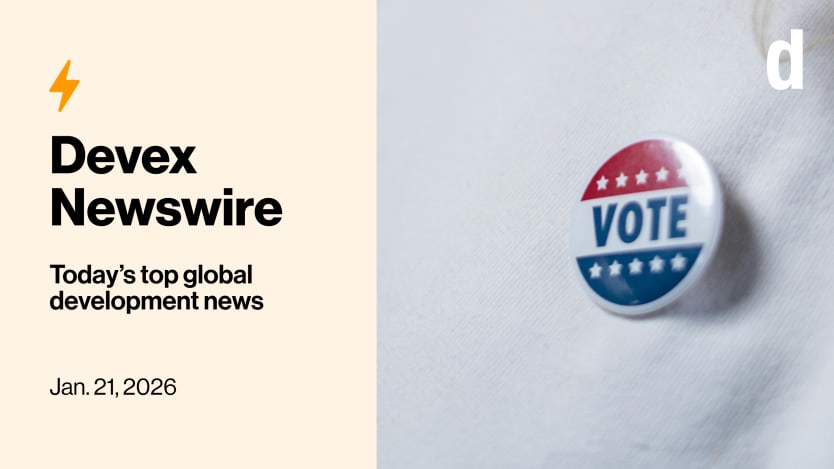
As U.S. foreign aid was dismantled, thousands of development professionals lost their jobs. Some former USAID insiders responded by entering politics, saying skills honed abroad are now urgently needed to defend democracy at home.
Also in today’s edition: What a leadership change at Davos really means.
+ What happens if the $50 billion U.S. foreign aid bill passes? Join us today for a Devex Pro Briefing with global development experts to understand the U.S. Congress’ $50 billion foreign aid proposal and explore a potential path forward for the country’s foreign aid. Can’t attend live? Register anyway, and we’ll send you a recording.
Run and tell that
When U.S. foreign aid began to unravel almost exactly one year ago, the dominant reaction across the development world was grief — and a flood of #opentowork posts on LinkedIn. But a smaller group of former USAID insiders responded differently: They decided to run for office.
The dismantling of USAID and the broader gutting of the global development sector under the Trump administration was widely lamented as a historic brain drain. At USAID alone, roughly 10,000 people lost their jobs, with cuts also rippling through contractors and NGOs.
It made little sense to suddenly sideline people whose careers focused on stabilizing economies and strengthening democratic systems, said Amanda Green, a Democratic Party candidate for Florida’s 2nd Congressional District, who previously worked at Chemonics International. It was “a stupid thing for them to have done.”
Devex Senior Reporter Michael Igoe spoke with four development professionals-turned-political candidates, running from city council to the U.S. Congress. Their paths differ, but their motivations rhyme: alarm about the state of American democracy, disappointment with political leadership, and a sense that their international experience now belongs at home.
For Allison Eriksen, who spent eight years in USAID’s Bureau for Humanitarian Assistance, the breaking point came after watching colleagues abruptly cut off and programs dismantled. “What I really took away from doing that was that no one at the national government level really seemed to understand what was going on and how devastating it was,” she said.
Green’s decision was more visceral. “I sat under a tree in my front yard one day, and I thought about what was the most audacious way I could ensure these men never were comfortable ignoring me again,” she said. “I realized I could take the weakest one’s job.”
Others reached similar conclusions from different paths. Kyle Beaulieu, a former USAID official now serving on a Colorado city council, said senior leaders once assured staff “there’s nothing we needed to worry about,” adding: “All of those people are now without jobs.” And Brit Steiner, who rose from intern to acting director of the agency’s policy office, said returning home to Ohio pushed her to act. “I couldn’t help but think about being that local leader,” she said.
The common thread? A belief that the skills honed abroad — navigating complexity, listening first, and acting under pressure — may now be most needed closer to home.
Read: Trump dismantled USAID. Now these aid workers are running for office (Pro)
+ Not a Pro member yet? Start your 15-day free Devex Pro trial and gain immediate access to in-depth analyses, insider intelligence, crucial funding data, exclusive event access, and much more. Discover the advantage of having Devex Pro.
Schwab mentality
The World Economic Forum is entering a new — and uncertain — phase now that Klaus Schwab has stepped aside after more than five decades. And for the development community, the stakes go well beyond the ski town optics, as nearly 3,000 leaders gather in Davos under the theme “A Spirit of Dialogue.” In an opinion piece for Devex by Benbella Dektar, he writes that the real question is whether Davos 2026 becomes a platform for meaningful action or simply a cleaner stage for entrenched power.
Schwab’s April 2025 resignation, following whistleblower allegations and an internal investigation, forced a reckoning for an institution that long positioned itself as the conscience of global capitalism. While investigators later cleared him of “material wrongdoing,” the episode exposed governance weaknesses that could no longer be ignored.
Interim cochairs Larry Fink of BlackRock and André Hoffmann of Roche signal a move away from Schwab-era grand narratives toward a cooler pragmatism, Dektar writes. Their promise of “long-term, sustainable growth for all, within planetary boundaries,” sounds right — but Dektar warns that delivery, not rhetoric, will determine whether this reset matters.
Opinion: Davos post-Schwab — can new leadership restore trust, or just rebrand the club?
+ Direct from the Alps: My colleague Elissa Miolene is on the ground at Davos 2026. Keep an eye on your inbox today for a special edition of the Newswire, featuring insights from this year’s gathering.
The funding trap
After more than 20 years building digital health systems in dozens of countries, BroadReach Group cofounder Ernest Darkoh — a Time magazine “global health hero” and former Obama administration HIV/AIDS adviser — has watched the same pattern play out: A nurse uses a slick donor-funded HIV app for one patient, then pulls out paper files for a diabetes patient.
“You end up with these disjunctions and discontinuities,” Darkoh tells Devex President and Editor-in-Chief Raj Kumar at WEF.
The culprit? Vertical donor funding that only covers specific diseases or districts for three-year stints. Then the money moves, and so does the software.
Aid cuts might actually flip the script on this problem. Without donors footing the bill, governments may have to pay for what they actually need. “If you pay for something, the vendor can focus on what you need,” Darkoh says. But it’s not happening yet — BroadReach still runs on the donor treadmill.
And cheap AI tools won’t be a shortcut. Darkoh warns governments can’t skip the hard work of fixing broken systems — such as building cultures where managers actually hold staff accountable for results. “You cannot short-circuit the learning curve,” he says.
Translation: You can’t build a health system three years and one disease at a time — someone needs to pay for the whole thing, not just the parts donors like.
Who controls AI
AI investment is surging — but who actually gets to control it is fast becoming the real question. For low- and middle-income countries, “AI sovereignty” — the ability to govern how artificial intelligence systems are built, deployed, and regulated at home — may determine whether this boom delivers benefits or just new dependencies, writes Devex Senior Editor Catherine Cheney.
That’s why the WEF is working on a new Digital Embassy Framework, designed to help governments move faster on digital infrastructure without giving up control over data, compute, or security. A briefing at this week’s WEF annual meetings made the stakes clear: Countries can host foreign-owned AI infrastructure, but only if the rules are set before the money arrives.
“Time would be of the essence,” Gobind Singh Deo, Malaysia’s digital minister, said of decisions around data centers and AI infrastructure. Investors, he warned, won’t wait around for governments to figure it out.
“You want to try and build that framework at the outset,” he said, “so people immediately know that if they want to actually invest in a particular country, this framework exists.”
+ Check out our coverage on how AI is getting integrated into globaldev work.
UNintrusive
Every week, it seems the United Nations’ footprint in New York City shrinks a bit more, Devex Senior Global Reporter Colum Lynch tells me. Over the weekend, the U.N. Development Programme announced it is relocating some 400 posts from its midtown Manhattan headquarters to Bonn, Germany, and Madrid, Spain.
The announcement follows moves by several other New York-based U.N. humanitarian agencies, including UNICEF, UN Women, and the U.N. Population Fund, to shrink their headquarters staff, sending workers to Nairobi, Kenya, and other overseas duty stations.
About 300 of the new posts will move to Germany, which is the largest government donor to UNDP, providing nearly $100 million in funding in 2024. Germany, however, has more recently been imposing steep cuts in its foreign aid budget, reflecting a shift in priorities to defense.
The rest of the posts, about 100, will relocate to Spain, which, while not a top 10 contributor, has increased its funding to UNDP’s core budget tenfold over the last three years.
ICYMI: UN staffers depart Manhattan's urban canyons for Kenya’s leafy capital
In other news
A leaked email from Nick Checker, the new head of the U.S. State Department’s Africa bureau, telling diplomats to stress American “generosity” despite sharp aid cuts, has drawn criticism. [The Guardian]
A new U.N. report says the world is no longer facing a temporary water crisis but a state of “global water bankruptcy,” and calls for long-term solutions rather than quick fixes. [UN News]
The Gates Foundation and OpenAI are investing $50 million to deploy AI tools in health clinics across Rwanda and other African countries, to help reduce pressure from chronic staffing shortages. [Financial Times]
Sign up to Newswire for an inside look at the biggest stories in global development.
About the author

Helen Murphy
Helen is an award-winning journalist and Senior Editor at Devex, where she edits coverage on global development in the Americas. Based in Colombia, she previously covered war, politics, financial markets, and general news for Reuters, where she headed the bureau, and for Bloomberg in Colombia and Argentina, where she witnessed the financial meltdown. She started her career in London as a reporter for Euromoney Publications before moving to Hong Kong to work for a daily newspaper.
Search for articles


Most Read
- 1
- 2
- 3
- 4
- 5