
Devex Newswire: USAID challenged deadly gender norms in Nepal. No more




Presented by RADIAN
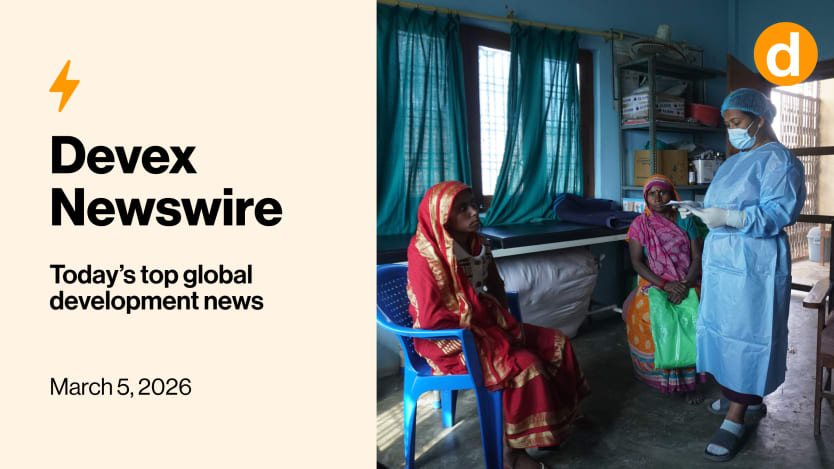
Breaking deeply entrenched societal norms around gender takes an enormous amount of effort and time. USAID made strides in Nepal, until its closure last year.
Also in today’s edition: A scourge that costs the world $175 billion every year.
🗓️ Happening today: Can philanthropy fill the USAID gap? Join us later today at 10 a.m. ET for a Pro Funding Briefing to unpack new data from our latest special report on the world’s largest philanthropic funders and their top grantees, the acceleration of philanthropic spending, and changes in foundation strategies. Register now. If you can’t attend live, we’ll send you a recording.
Deadly consequences
After 25 years of marriage, Anita Yadav and her husband Khushiram were excited to welcome their first child. But after pregnancy complications, Anita delivered a stillborn baby. Hours later, after heavy bleeding, she lost consciousness and never woke up.
A week before her death, Anita experienced severe abdominal pains but had to wait for days for her husband and father-in-law’s permission to go to the health clinic as they insisted she deliver at home, as others in their Nepalese community had traditionally done.
Health workers say the delays that proved fatal for Anita are not anomalies but harmful patterns that community-based maternal and reproductive health programs are designed to prevent, writes Sunita Neupane for Devex.
One of those programs was funded by USAID. Launched in 2022, the Adolescent Reproductive Health, or ARH, program worked across homes, schools, and villages to shift behaviors around pregnancy, childbirth, child marriage, and adolescent health, tackling taboos such as attending school while menstruating.
After the Trump administration’s dismantling of USAID, however, ARH was terminated last April.
“When I got the letter saying the program was closing, I was terrified,” says Mona Sherpa, country director at CARE Nepal, which implemented ARH with the Nepalese government. “All I could think was, ‘What will happen to those girls now? Will they have to go through the same suffering their mothers endured?’ We had truly given hope to those mothers and girls.”
“Home deliveries and women being rushed to hospitals in their final stages had been causing mothers to die,” says Bishnu Shrestha, a public health nurse. “In situations where families could not understand the rationale for a mother's death, these programs had ultimately done what the government had failed to do: Break gender norms that undervalued women’s lives.”
Kiran Kumari Bari, a female community health volunteer, was more blunt, lamenting that old patterns quickly resurfaced following the program’s demise.
“Only continuous programs over at least 10 years can shift attitudes; otherwise, women here are treated no better than cows and buffaloes,” she says.
As for Khushiram, Anita’s husband, he plans to remarry. “I was not able to fulfill the dream about my first child,” he says. “And I still have dreams for the children I might have in the future.”
Read: In Nepal, US ends effort to help women make life-or-death choices
📍 This story is part of The Aid Report, a Gates Foundation-funded, editorially independent initiative to track and document the on-the-ground impacts of the U.S. aid cuts with firsthand reporting and a verified, contributor-based data collection system. For more information and to read the stories, go to https://www.theaidreport.us.
Letting children be children
One of the areas ARH covered was child marriage, a stubborn practice that forces 12 million girls out of school every year.
“Child marriage takes away every bit of autonomy that a girl has,” Sheryl Sandberg tells my colleague Elissa Miolene. “It doesn’t just take away her present, but her future.”
The billionaire philanthropist — who served as Facebook’s first chief operating officer for over a decade — has poured millions of dollars toward cultivating women leaders via the Sandberg Goldberg Bernthal Family Foundation. Recently, she set her sights on child marriage, commissioning a report that outlines the human and economic costs of child marriage.
Those economic costs are key, with Sandberg hoping to reframe the case against child marriage beyond the human rights lens. The economic costs are also staggering: The report found that child marriage costs the world $175 billion every year because of elevated health risks, lost education, and reduced earnings that take their toll on child brides.
By contrast, the report estimates that it would cost $1.3 billion to reduce child marriage by 30% over the next five years.
“This is not just a social issue or a human rights issue, but an economic issue,” Sandberg says. “If you care about humanity, if you care about basic human rights, if you care about education, if you care about the economy, you’ve got to care that 12 million girls are married before they turn 18.”
And the timing is urgent. “We’re at this pivotal moment in the fight against child marriage that will really determine whether we continue to make progress or whether we go backwards,” says Rachel Vogelstein, one of the study’s authors. “And so what this report aims to do is to put a spotlight on this moment for that reason, and to explain what the cost will be if we fail to address this sufficiently.”
Read: Sheryl Sandberg pushes a $175 billion case for ending child marriage
Who didn’t make the list?
The Trump administration didn’t cut aid in one big batch last year. It’s an ongoing process — and for some countries, it’s a complete cutoff.
Across Somalia, organizations are receiving notice that their grants will expire once their award period ends, delivering yet another blow to a nation estimated to have lost nearly 70% of its global humanitarian funding in a single year, Elissa writes.
One of those organizations is Alight, whose nutrition center has shut down, leaving care for over 200,000 Somalis hanging by a thread.
“Somalia is experiencing a drought, and already, there are massive humanitarian needs,” says Jocelyn Wyatt, Alight’s CEO. “We’ll see newborns that will miss vaccines that they will otherwise be getting, pregnant women that will be left without any sort of maternal or postnatal care, and likely, higher rates of maternal or neonatal mortality.”
The closure tracks with reporting from The Atlantic, which named Somalia as one of seven African nations slated to no longer receive U.S. aid. It also follows other U.S. pullbacks, from Somalia being left off a new, still-in-limbo agreement between the U.S. and the U.N. Office for the Coordination of Humanitarian Assistance, or OCHA, to the country being absent from a recent deal with the World Food Programme.
The OCHA deal — which several sources have told Devex has been solidified for up to 18 countries — would channel roughly $2 billion into pooled funds for nations aligned with “American interests and priorities.”
Somalia didn’t make the cut — likely alongside other countries on the African continent, raising concerns that large swaths of need could soon fall outside the bounds of the U.S.-OCHA agreement.
“It’s concerning that U.S. humanitarian assistance, if it’s only through these pooled funding mechanisms in Africa, is only going to certain countries,” says Kate Phillips-Barrasso of Mercy Corps. “That means there will be no U.S. response in Somalia — and in any other countries that are left off that list.”
Read: Somalia faces ‘food crisis’ after lifesaving US aid left to expire
The vault in our stars
American interests and priorities — that’s the ethos driving the Trump administration’s approach to development, for better or worse. Critical minerals are key to that strategy, and that has injected new energy and relevance into the U.S. Export-Import Bank, which is financing Project Vault.
The Hollywood-like name belies its real-life importance: to stockpile critical minerals and insulate the U.S. from supply chain volatility (hint: China).
The Export-Import Bank is the official export credit agency of the U.S., designed to bolster domestic jobs by financing the export of American goods and services. EXIM head John Jovanovic, speaking at a Council on Foreign Relations discussion moderated by Devex President and Editor-in-Chief Raj Kumar, said Project Vault fits in neatly with the administration’s focus on energy dominance and American manufacturing.
While those are administration priorities, Jovanovic said they should appeal to people of all political stripes.
EXIM’s mission “day-in and day-out, is how do we help mobilize the best that America has and put us in a position to win?” he said. “And what I’ve realized is, Democrat, Republican, independent, Martian, whatever you are, everybody likes to win, right?”
Read: US Export-Import Bank chief details what's in Trump's Project Vault
Further reading: Does the development world need to worry about critical minerals? (Pro)
And don’t miss: Inside Africa’s high-stakes push for mineral sovereignty (Pro)
💰 Dig deeper into the new normal of U.S. aid with our limited-edition Devex Pro Insider’s special newsletter, led by Senior Reporter Michael Igoe, who delivers exclusive insights, analyses, and behind-the-scenes commentaries on the power brokers, key players, and influencers of the new U.S. foreign aid policy.
Not yet gone Pro? Start your 15-day free trial now to receive this week’s edition straight in your inbox today and also access all our exclusive content and events.
In other news
In a 2-1 ruling, a U.S. appeals court spared Elon Musk from a deposition in a case examining his role in dismantling USAID while heading the Trump administration’s Department of Government Efficiency. [Reuters]
The head of the U.N. migration agency urged Europe to prepare early as prolonged conflict in the Middle East could trigger a new wave of migration flows. [Financial Times]
Médecins Sans Frontiéres reports 26 staff members missing following attacks on its medical facilities in South Sudan, highlighting growing threats to humanitarian workers in the country. [The Independent]
Australia has joined the G7 minerals alliance through a new agreement with Canada, as Western nations move to secure critical mineral supply chains and reduce reliance on China. [Reuters]
Ace the test
Test your knowledge of global development affairs with our monthly news quiz!
About the author

Anna Gawel
Anna Gawel is the Managing Editor of Devex. She previously worked as the managing editor of The Washington Diplomat, the flagship publication of D.C.’s diplomatic community. She’s had hundreds of articles published on world affairs, U.S. foreign policy, politics, security, trade, travel and the arts on topics ranging from the impact of State Department budget cuts to Caribbean efforts to fight climate change. She was also a broadcast producer and digital editor at WTOP News and host of the Global 360 podcast. She holds a journalism degree from the University of Maryland in College Park.
Search for articles


Most Read
- 1
- 2
- 3
- 4
- 5