




Presented by Operation Smile
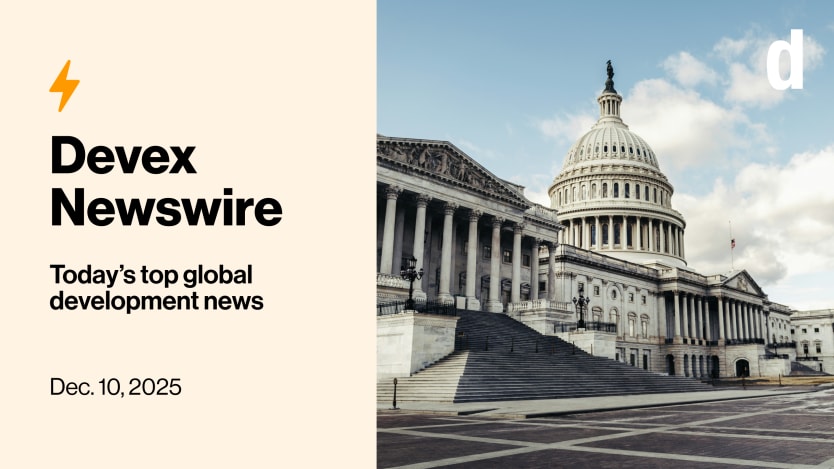
The U.S. International Development Finance Corporation has been stuck in legal limbo, in large part because of fierce debate over how much DFC should focus on the “development” part of its name.
Also in today’s edition: Artificial intelligence tools often speak the same language. That’s not good for students in lower-income countries.
+ Searching for your next development job or seeking recruiter insights for the year ahead? See you soon at 9 a.m. ET today for our expert-led event on how to navigate the job market in 2026. Can’t attend live? Register anyway, and we’ll send you a recording.
One step forward
With USAID gone, attention has shifted to America’s other engines of international development, especially DFC, which, with its private-sector focus, appears likely to survive the Trump administration gauntlet.
But first, it needs reauthorization from Congress — and it just took an important step in that direction.
Lawmakers attached the DFC Modernization and Reauthorization Act of 2025 to the National Defense Authorization Act, which will be voted on this week — possibly even today. That’s a good sign because the defense bill is often seen as must-pass legislation.
If passed, the reauthorization would change DFC in fairly substantial ways, my colleague Adva Saldinger reports. For one thing, it would beef up the agency — boosting its total spending cap from $60 billion to $205 billion — and allow it to work in high-income countries, but with limitations. That’s key because many were concerned that DFC would eschew its core mandate of alleviating poverty in lower-income countries in favor of investing in wealthier countries for strategic self-gain.
The result? A compromise that neither side is particularly thrilled with — welcome to the world of politics — but one that might pass muster.
The bill requires that projects advance national security or economic interests, but should be designed to produce development impacts for the poorest in those countries. It also says DFC cannot fork over more than 25% of the total investment in any individual project in high-income countries, and all of its investments in these countries cannot exceed 10% of the agency’s total spending cap.
“There is evidence of a fair amount of horse-trading going back and forth on different things,” says Rob Mosbacher, former head of the defunct Overseas Private Investment Corporation, which was DFC’s predecessor. “Folks worried about this process veering too much in pursuit of strategic interests — critical minerals, key infrastructure — should be mollified by, I think, a very concerted effort to reiterate the importance of development and this agency doing deals in middle- and low-income countries.”
Read: Reauthorization of the US development finance corporation gains traction
The language of learning
The promise of artificial intelligence in lower-income countries is vast. So are the pitfalls.
They include overburdened teachers, limited funding, unreliable connectivity, and shifting data-protection rules. Another more basic but often-overlooked limitation is language, writes Devex contributor Sophie Edwards.
Most AI systems cannot understand the languages that millions of children speak. Africa alone is home to roughly a third of the world’s languages. However, less than 40% of children in many low- and middle-income countries are taught in their mother tongue; in some regions, the figure rises to 90%.
“Children learn best in their mother tongue, yet most LLMs [large language models] struggle with low-resource languages, and particularly with deciphering children’s voices,” says Ben Piper, head of global education at the Gates Foundation.
This linguistic mismatch is not just academic, Sophie writes. If children cannot read or understand — in any language — they cannot meaningfully use AI-based learning tools, locking them out of the very innovations designed to support them.
A big hurdle is the lack of financial incentives to invest in generating dozens of languages, many spoken in poorer, rural settings. But some tech innovators are taking notice of the problem.
In Uganda, Crane AI Labs is developing local-language apps and models, including a version of Google’s open-source model Gemma that is fine-tuned for Swahili and Luganda. Critically, it is designed to function entirely offline, making it usable in areas with low or no connectivity.
Crane AI Labs co-founder Kato Steven Mubiru says the mission is to ensure the AI revolution doesn’t leave African youth behind.
“A lot of people face literacy challenges, and that won’t change soon. The education system is very weak,” he says. “If you want to engage people in villages and connect them to technology, it has to be through local languages.”
Read: Why AI can’t transform classrooms until it learns local languages (Pro)
+ Devex Pro members can access all our coverage on how AI is getting integrated into globaldev work. Not yet gone Pro? Experience unlimited access to expert analyses, hidden funding opportunities and career resources with recruiters’ insights, and connect with key sector players and influencers at exclusive events when you start your 15-day free trial of Pro today.
Lead, or be led
In a conversation on his new “AI for America” road map, Democratic Sen. Mark Kelly of Arizona argues the U.S. must not cede leadership on artificial intelligence — at home or abroad.
The plan proposes an AI Horizon Fund, financed by major tech companies, to strengthen U.S. workers, community infrastructure, and national research and development.
My colleague Catherine Cheney asked how the U.S. should think about AI leadership globally, particularly in Africa, where U.S. development engagement has declined even as other players expand AI infrastructure and seek to set the terms for governance.
“Not only do we have a role, we should be taking steps to make sure that the standards of this industry are based on our standards and our values,” he says.
Kelly adds that by scaling back or cutting programs that have brought the U.S. goodwill, from the President's Emergency Plan for AIDS Relief to food assistance, the U.S. has diminished its global leadership, creating an opening for China.
“We need to partner with other nations so we're the ones that build the framework for how this industry is going to exist across the globe, because if we don’t do it, we know who is, and that’s not going to be beneficial to us.”
+ How do we successfully build the AI for Good ecosystem? On Monday, Dec. 15, Catherine will sit down with Kanika Bahl, CEO of Evidence Action and a founding member of Anthropic’s Long-Term Benefit Trust, to dive into how the global ecosystem must reorganize to ensure the benefits of AI reach the people who need them most. Secure your spot now.
The value of materialism
The current story of foreign aid isn’t just one of decline; it’s one of evolution, argue Kusi Hornberger and Ben Schatz of Dalberg in a Devex opinion piece. And in a way, that evolution means going back to the basics — roads, bridges, ports — that materially benefit people’s lives.
Instead, in recent years, as aid budgets shot up, the sector “drifted toward ‘post-material’ priorities — projects emphasizing rights, governance, and process over tangible, growth-oriented investments,” Hornberger and Schatz write. “While these are important, they can seem detached from the visible progress citizens expect: jobs, incomes, infrastructure, and upward mobility.”
“This drift is a choice we can change. As Kevin Starr, CEO of the Mulago Foundation, recently argued in his article, ‘Big Aid Is Over,’ the sharp decline in traditional aid presents a forcing moment — and an opportunity — to design interventions that national governments can and will pay for,” they add. “Development assistance must once again be seen as materially beneficial to people’s lives. That means prioritizing infrastructure, job creation, and support for economic growth strategies that credibly deliver material prosperity.”
Opinion: Rethinking development funding means making it matter to the median voter
Setting the record straight
The bilateral health compact that the U.S. State Department recently inked with Kenya was quickly followed by deals with Rwanda and Liberia, signs that the “America First” global health strategy is gaining steam.
But the Kenyan government has clarified that it didn’t sign a specimen-sharing agreement with the U.S., although it will share data on request if regulators sign off and the data relates to U.S.-supported work.
A template bilateral agreement showed the U.S. was seeking a 25-year lock on the sharing of specimen data that could help companies develop vaccines and other countermeasures to thwart disease outbreaks. That prompted criticism from those who say countries should benefit from any countermeasures designed with data they provide.
“We did not negotiate a specimen-sharing agreement,” said Dr. Ouma Oluga of the Kenyan Ministry of Health on national TV. “This is something that they really wanted but we said: ‘Wait a minute, we will not do it.’”
But Oluga said Kenya did agree to jointly test outbreak specimens — as they have existing partnerships, such as with the U.S. Centers for Disease Control and Prevention. He said if Kenya halted joint testing, the Americans would “close shop.”
Read: Kenya limits US access to disease outbreak data in new bilateral deal
ICYMI: The US signs first bilateral health deal with Kenya for $1.6 billion
In other news
Climate change is pushing mosquitoes and other disease-carrying insects into temperate high-income countries while funding cuts weaken control efforts in low-income regions, increasing the global threat of vector-borne diseases despite new tools to fight them. [Financial Times]
A new report warns that widespread synthetic chemicals used across the global food system are driving major health and environmental harms costing up to $2.2 trillion a year and contributing to rising rates of cancer, infertility, and other diseases. [The Guardian]
About 200,000 people have fled escalating M23 rebel attacks in the eastern Democratic Republic of Congo, only days after a U.S.-brokered peace deal was announced. [Reuters]
Sign up to Newswire for an inside look at the biggest stories in global development.
About the author

Anna Gawel
Anna Gawel is the Managing Editor of Devex. She previously worked as the managing editor of The Washington Diplomat, the flagship publication of D.C.’s diplomatic community. She’s had hundreds of articles published on world affairs, U.S. foreign policy, politics, security, trade, travel and the arts on topics ranging from the impact of State Department budget cuts to Caribbean efforts to fight climate change. She was also a broadcast producer and digital editor at WTOP News and host of the Global 360 podcast. She holds a journalism degree from the University of Maryland in College Park.
Search for articles

Most Read
- 1
- 2
- 3
- 4
- 5