


Presented by RADIAN

U.S. funding cuts have shuttered clinics, reduced staff, and disrupted care for hundreds of thousands in South Africa’s HIV response. As the country’s government vows the program won’t collapse, front-line workers warn the fragile thread holding patients together is fraying fast.
Also in today’s edition: A new job for DFC, and the U.S. seeks innovations to cure tuberculosis.
+ The dismantling of USAID and deep bilateral aid cuts have forced development organizations to rethink their funding strategies. Many are looking to philanthropy. But how realistic is that pivot? Join us on March 5 for a Devex Pro Funding Briefing, where we’ll unpack where the big foundations fund. Save your spot now.
Clinics close, lives unravel
South Africa bears the world’s largest HIV burden, and U.S. foreign aid cuts have ripped through its response to the disease, forcing clinics to close and leaving thousands of vulnerable patients scrambling for care.
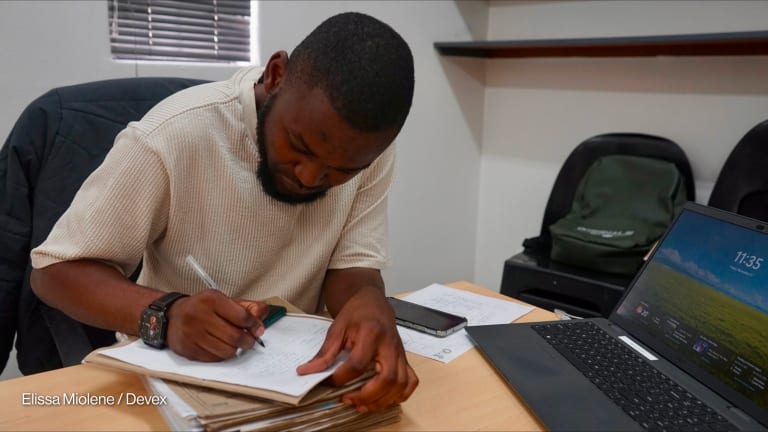
At ground level, that crisis now plays out one phone call at a time. By mid-morning, Lungani Sithole has already made dozens of calls — checking whether former patients are still on treatment, and sometimes whether they’re still alive.
“Any wrong move I do now, or any wrong attitude that I portray, could unleash the mental thread that’s keeping that person together,” says Sithole, who has been a peer educator at South African HIV clinic OUT LGBT Well-Being since 2019.
U.S. aid cuts and a standoff with the Trump administration have halted all subsidies to the country, which got $450 million from USAID for its HIV response in 2024. The impact was immediate: OUT LGBT Well-Being was forced to shutter services for 10,000 patients. Nationwide, more than 15,000 HIV workers were affected, and services for over 222,000 people were disrupted, writes my colleague Elissa Miolene.
Now, government facilities are trying to absorb the shock. Last summer, South Africa announced a stopgap payment of $47 million to address the funding shortfalls left by USAID, with more contributed by various philanthropies and China.
“There is no way we are going to allow the world’s biggest HIV/AIDS program to collapse,” said the country’s health minister, Aaron Motsoaledi, in July. “Never.”
Read: After US aid cuts, South Africa’s HIV response strains to hold the line
TB determined
With USAID’s closure, the Trump administration abruptly cut off many HIV/AIDS treatments last year, although it has since put out an “America First” global health strategy that has preserved some money for fighting the disease.
But the administration has also set its eyes on another killer: tuberculosis. In fact, it’s vowing to find “the next lenacapavir” — but this time, for TB instead of HIV. As you may recall, lenacapavir is the breakthrough twice-yearly injectable HIV prevention drug.
At a congressional hearing yesterday, the State Department’s top health official suggested that TB will continue to top the agency’s health agenda in the years ahead, especially as part of the bilateral health compacts that the U.S. has signed with over 20 countries, most of them in Africa.
“We’re thinking, alongside these [memorandums of understanding] that we’re signing with governments, how do we set aside [money] for innovations?” said Jeffrey Graham, the senior bureau official for the State Department’s Bureau of Global Health Security and Diplomacy. “A scalable, innovative invention that not only can change the course of an epidemic, but also for us, as stewards of taxpayer dollars in the U.S., that can help us move away from being forever donors.”
On that note, Graham said U.S. contributions come with caveats — specifically that recipient governments need to invest in their own health systems.
“Countries need to take the lead,” Graham said, arguing that this should include nations with a high burden of TB, which the World Health Organization estimates kills 1.2 million people every year.
“Donor support has been very effective over the decades, but at some point, governments whose citizens these are have to take responsibility for the lives in their own countries,” Graham added. “We are trying to accelerate that transition in a responsible way.”
Read: State Department eyes tuberculosis breakthroughs
+ For more content like this, sign up to Devex CheckUp — our free weekly newsletter that provides front-line and behind-the-scenes reporting on global health.
Nordisk model
The Novo Nordisk Foundation is flexing. Flush with profits from obesity and diabetes treatments Ozempic and Wegovy, the Danish enterprise foundation has ramped up grantmaking from almost 3.9 billion Danish krone in 2018 to nearly DKK 10.1 billion in 2024 — and kicked off 2026 with an eye-popping $860 million pledge to Denmark’s BioInnovation Institute, its largest donation so far. As bilateral aid shrinks and the Gates Foundation plans its 2045 sunset, NNF is moving fast to fill space on the global stage.
“They are internationalizing rapidly, but part of this internationalization is the realization that if you want to have an impact, you need to bring things to scale,” says Adam Moe Fejerskov, an expert on sustainable development and governance at the Danish Institute for International Studies.
But NNF is no ordinary philanthropy, writes Devex contributing reporter Andrew Green. It controls Novo Nordisk A/S through Novo Holdings — and when drug revenues soar, so does giving. And critics say the lines can blur. “It can be difficult to know where the foundation starts and ends,” Fejerskov says — especially as advocates push the company to lower insulin prices.
Read: How Novo Nordisk’s profits are reshaping global health funding (Pro)
+ Not yet a Devex Pro member? Start your 15-day free trial today for expert analyses, insider insights, funding data, events, and more exclusive content. Discover all the exclusive content available to Pro members.
Shipping news
U.S. President Donald Trump posted on his Truth Social account yesterday that he ordered the U.S. International Development Finance Corporation “to provide, at a very reasonable price, political risk insurance and guarantees for the Financial Security of ALL Maritime Trade, especially Energy, traveling through the Gulf.”
It’s a reflection of the administration’s push to keep oil and natural gas tankers sailing through the all-important Strait of Hormuz despite the current hostilities with Iran.
DFC said it was ready to provide political risk insurance and guarantees to stabilize international commerce and support American and allied businesses operating in the Middle East. The agency will offer support to commercial shipping charters, shipowners, and maritime insurance providers.
"DFC is here to provide support and stability in order to ensure there are minimal disruptions to operations and markets," said DFC CEO Ben Black in a statement. The statement went on to say that DFC’s involvement is part of a strategy to align American commercial tools with Trump’s foreign policy.
This is an unprecedented use of the DFC and raises several questions, my colleague Adva Saldinger tells me.
First is whether it’s even possible. DFC political risk insurance deals typically take many months to finalize, even when moving quickly. It’s also unclear what Trump means by a “reasonable price,” because pricing is based on individual coverage issues and the level of risk — likely quite high in this case.
DFC’s insurance program is self-funded, uses no appropriated funds to pay claims, and did not borrow any funds from the Treasury for fiscal year 2025, according to the DFC’s annual management report for FY2025. Providing a lot of new risky insurance policies would likely mean that DFC has to pay out more claims, and change that.
There is also a bigger question about what exactly DFC’s role will be in this administration and moving forward. The president’s announcement may further raise concerns from some that it will turn into a political vehicle for foreign policy priorities and lose its development focus.
ICYMI: Senior DFC official details agency's plans, new vision (Pro)
Data mining
Is artificial intelligence actually changing lives — or just generating buzz? That was the question hanging over the India AI Impact Summit last month, where Dean Karlan, professor of economics and finance at Northwestern University and former chief economist at USAID, urged donors to slow down and demand proof. Instead of funding flashy pilots, he said, donors should fund the evaluations that tell governments what’s actually worth scaling.
Right now, “there’s more hype, there’s more excitement, than actual evidence” that AI tools work, Karlan told Devex contributor Catherine Davison.
Donors seem to agree. The Gates Foundation, Novo Nordisk Foundation, and Wellcome pledged $60 million to launch the Evidence for AI in Health initiative, aimed at closing the proof gap in low- and middle-income countries.
The sector needs to shift from thinking about responsible AI to verifiable AI, said Alain Labrique, director of digital health and innovation at WHO. He said, in health, it would “just take one or two catastrophic failures to degrade the trust that people have in these systems.”
Read: AI tools that actually do something — beyond the hype and ‘sales pitch’
+ Devex has centralized our deep-dive reporting, expert analysis, and latest news on how AI is being used in global development. Explore our AI focus page.
In other news
Close to 90 global shipping and logistics firms are backing the U.N.’s net zero shipping framework and pressing governments to move forward, even as the U.S. pushes to derail it. [Financial Times]
At least 30,000 people have been displaced in Lebanon amid intensifying cross-border strikes between Israel and Hezbollah, with the UN Refugee Agency warning of further displacement. [Reuters]
Ireland has nominated former EU commissioner Phil Hogan to be the next Food and Agriculture Organization director-general, facing Italy’s Maurizio Martina. [Politico]
Sign up to Newswire for an inside look at the biggest stories in global development.
About the author

Helen Murphy
Helen is an award-winning journalist and Senior Editor at Devex, where she edits coverage on global development in the Americas. Based in Colombia, she previously covered war, politics, financial markets, and general news for Reuters, where she headed the bureau, and for Bloomberg in Colombia and Argentina, where she witnessed the financial meltdown. She started her career in London as a reporter for Euromoney Publications before moving to Hong Kong to work for a daily newspaper.
Search for articles

Most Read
- 1
- 2
- 3
- 4
- 5