


Presented by Tetra Pak
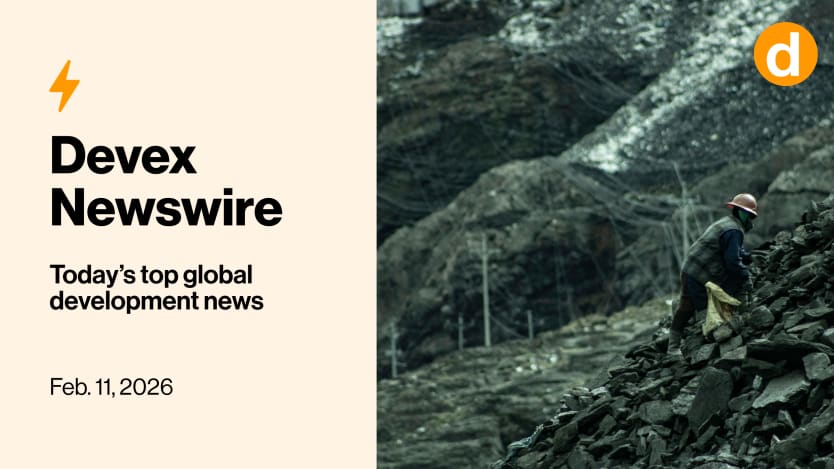
We have answers to all your questions on critical minerals — and how development professionals need to be thinking about them.
Also in today’s edition: Sexy farmers are a staple of romance novels, but now African crop influencers are, well, cropping up on TikTok.
The mineral power shift
Critical minerals are quickly becoming a 21st-century gold rush — and one of the most consequential development stories of the clean energy transition. My colleague Jesse Chase-Lubitz dived into questions both big, such as what this means for geopolitics and the climate crisis, and small, such as what even makes a mineral critical?
“From a development perspective, critical minerals are an even better prospect than oil and gas,” Ibrahima Aidara, deputy Africa director for the Natural Resource Governance Institute, tells Jesse. But he warns that without the right foundations, the boom could repeat old mistakes, particularly for African countries rich in minerals but vulnerable to exploitation and corruption. “For Africa, we need strong institutions and regulations, and resources to maximize the value addition. Otherwise, it’s going to be just as extractive as before.”
That challenge is colliding with geopolitics, Jesse writes. China still dominates global processing, while the U.S. and EU race to secure alternative supply chains for clean energy and defense. Having the majority of certain minerals controlled by one country is “just not healthy for the global economy,” says U.S. Secretary of State Marco Rubio — though who knows, he might think differently if the U.S. controlled that majority.
One key factor will be African countries’ race to add processing power to their arsenal — and potentially extract far more value from the raw materials beneath their soil.
Read: Does the development world need to worry about critical minerals? (Pro)
+ Start your 15-day free Devex Pro trial today and gain immediate access to in-depth analyses, insider intelligence, crucial funding data, exclusive events, and much more. Discover the advantage of having Devex Pro by checking out all our exclusive content.
Aid’s aftershocks
One year after the abrupt dismantling of large parts of U.S. foreign assistance, the real impacts are finally coming into view — often far from the headlines. The latest special publication from The Aid Report documents how those cuts are reshaping lives, services, and systems long after programs ended.
Drawing on an aggregated dataset covering health, food and farming, education, governance, and displacement — alongside original on-the-ground reporting cross-published on Devex — the report tracks 348 documented impacts across dozens of countries. The picture that emerges is less about isolated program closures and more about cascading system failures.
Some of the most consequential damage is happening behind the scenes, writes Devex Editor Kelli Rogers. National systems used to track hunger, disease, and service delivery have been destabilized, forcing governments and aid players to make critical decisions with partial or outdated data. As Ajay Kumar Yadav, program manager at Aasaman Nepal, puts it: “All our efforts have sunk into oblivion after the stoppage. We built deep community trust, only for it to vanish in moments.”
When programs close, the effects rarely stay in one lane. School feeding and education initiatives doubled as income sources, safety nets, and protection pathways — especially for girls. “With these programs ending, dropout rates will soar, irregular attendance will rise, and child marriage will become an even bigger threat,” warns Deepak Majhi, equity and inclusive education officer at local implementing organization Center for Education and Human Resource Development.
The report also shows how care hasn’t always disappeared — but has quietly become unreachable. Fees, travel costs, and lost outreach have pushed patients and health workers into impossible choices. “I don’t want them to be worried. I can’t just leave them,” says Paul Ochieng, a 52-year-old community health worker in Kisumu, Kenya. “They depended on me like their parents.”
The Aid Report isn’t a full accounting — it’s a signal flare. By pulling together fragmented evidence and front-line testimony, it makes visible the longer-term, second-order impacts of U.S. aid cuts — and the blind spots that still demand attention.
Read: US aid cut impacts, one year later
+ The Aid Report is a Gates Foundation-funded, editorially independent initiative to track and document the on-the-ground impacts of the U.S. aid cuts with firsthand reporting and a verified, contributor-based data collection system. For more information and to read the stories, go to https://www.theaidreport.us.
The donor hangover
Malawi is getting a brutal lesson in what life after U.S. aid really looks like. Programs once backed by more than $350 million a year from USAID are frozen, the Millennium Challenge Corporation has shut down operations, and a $350 million transport and land compact has collapsed.
The ripple effects are everywhere — from a weaker currency and rising prices to stalled schools, clinics, and infrastructure projects. Economist Gilbert Kachamba says the cuts have magnified existing pressures and argues that “the important thing is the self-sustainability of the country after aid,” not just emergency belt-tightening.
Health is where the pain is sharpest, writes Devex contributing reporter Madalitso Wills Kateta. Six projects by the U.S. global AIDS initiative PEPFAR worth $176.5 million have been terminated, forcing Malawi to scale back HIV prevention and treatment and putting years of progress at risk. Clinics are scrambling to cope, and sources tell Madalitso that services are being bundled so patients can get HIV care alongside family planning and chronic disease checks.
The government has responded by injecting more than $13 million into the Ministry of Health and promising to recruit some 6,000 new workers in the sector. It’s also raising taxes — though that alone can’t make up the monetary shortfall; Bertha Bangara-Chikadza, president of the Economics Association of Malawi, says taxation alone can’t fix fiscal issues, but the reforms signal renewed fiscal discipline.
Read: Malawi struggles to fill development gaps after US aid cuts (Pro)
+ Enjoyed this content? Devex CheckUp — our free weekly newsletter — delivers more insights on global health straight to your inbox. Sign up today.
Crop influencer
Farming is going viral in Africa — and it’s changing who makes money. Ghanaian agronomist Alex Afari posts daily from his farm, sharing tips and market know-how with a growing online audience. “There is no easy crop ... only well-planned farming,” he wrote on Facebook, while his TikTok pitch is simpler: “My TikTok platform is there to promote sexy agriculture.”
Afari is part of a wave of young African farmers using social media to boost yields, find customers, and bypass systems that rarely work for them. Platforms such as WhatsApp, TikTok, and Facebook are now filling gaps left by traditional extension services. Many of the farmers targeted by digital agriculture platforms simply don’t have the money to pay for those services, according to Abbie Phatty-Jobe, manager for research and engagement at Caribou.
In Uganda, agri-influencer Sandra Nabasirye turned posts into sales under the brand “SlayFarmer,” with the tagline: “sexy from my head to-ma-toes.” “I collect orders from Monday to Friday, then I do deliveries on Friday,” she says.
The upside is real, writes Devex contributing reporter David Njagi. So are the risks — from scarce finance to tighter controls on online speech. But for a generation shut out of capital markets, social media is doing something donors and governments haven’t: making farming visible, viable, and — yes — sexy.
Read: Meet the agri-influencers drawing African youth to farming
+ For more content like this, sign up to Devex Dish — our free weekly newsletter on the transformation of the global food system.
In other news
The U.S. and U.K. have fallen to new lows on Transparency International’s corruption index, with the U.S. decline driven by multiple factors, including growing concerns over the use of public office to target NGOs. [The Guardian]
The Trump administration may carve out an exception for CORSIA, the U.N.-led carbon offset scheme for airlines, signaling limited U.S. engagement with market-based climate measures for aviation even as it retreats from broader international climate commitments. [The Wall Street Journal]
The Islamic Development Bank committed to supporting Uzbekistan at the second AlUla Conference on Emerging Market Economies, allocating $192 million for infrastructure development and $160.25 million for education facilities. [Arab News]
Sign up to Newswire for an inside look at the biggest stories in global development.
Printing articles to share with others is a breach of our terms and conditions and copyright policy. Please use the sharing options on the left side of the article. Devex Pro members may share up to 10 articles per month using the Pro share tool ( ).
About the author

Helen Murphy
Helen is an award-winning journalist and Senior Editor at Devex, where she edits coverage on global development in the Americas. Based in Colombia, she previously covered war, politics, financial markets, and general news for Reuters, where she headed the bureau, and for Bloomberg in Colombia and Argentina, where she witnessed the financial meltdown. She started her career in London as a reporter for Euromoney Publications before moving to Hong Kong to work for a daily newspaper.


