How to create a portfolio career playbook for long-term consulting stability
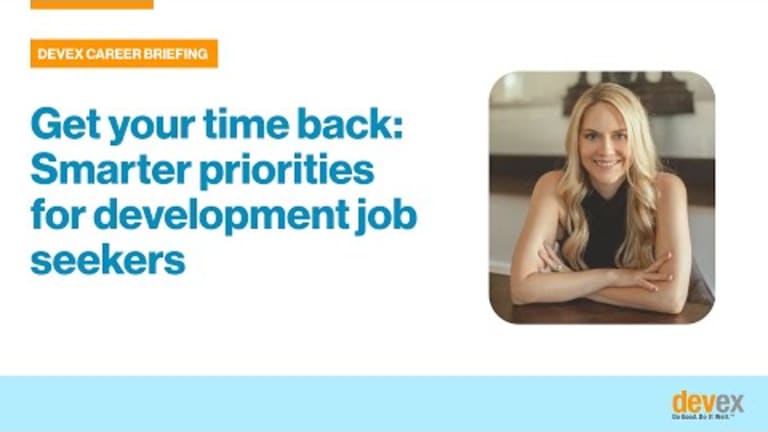
During a recent digital event, social impact career coach Kelsi Kriitmaa outlined a practical framework for moving from ad hoc consulting to a structured portfolio career.
In the fiercely competitive post-USAID job market, many global development professionals are turning to consulting as a new career path. But building a sustainable consulting career requires more than picking up short-term gigs. It demands an intentional approach — one that balances income stability, visibility, and long-term optionality, alongside a fundamental shift in mindset. “When you're building a portfolio career, we need you to shift from being a job seeker to a consultant, independent mindset. This is very different. This is not like you're between gigs. You are building a business, and this is a real job,” said Kelsi Kriitmaa, a social impact career coach who has built her own portfolio career, during a recent Devex digital event. Drawing on her own experience, Kriitmaa outlined a practical framework for moving from ad hoc consulting to a structured portfolio career, one built on clarity, strategic positioning, and deliberate growth. Here are three key takeaways to help development professionals build a more sustainable path. Start with constraints, not ambition According to Kriitmaa, one of the most common mistakes professionals make when transitioning into consulting is focusing on income targets rather than lifestyle design. Many default to replicating their previous salary, but that approach can miss the point of a portfolio career. Instead, she urged participants to begin by identifying their nonnegotiables. For many in global development, the shift to consulting is driven by a desire for greater control over time, energy, and commitments, whether that’s reducing travel, managing caregiving responsibilities, or avoiding burnout. “Most people transition to a portfolio career because they want something different for their life,” Kriitmaa said. “They want more agency over their time, more flexibility, more energy.” That means rethinking long-held assumptions about work. The traditional five-day, nine-to-five structure no longer applies. Kriitmaa, for example, has a four-day workweek, a deliberate choice aligned with how she wants to spend her time and energy. From there, the focus shifts to defining a clear consulting niche. Kriitmaa recommended a simple formula to articulate this: I help X solve Y using Z. The goal is to create a concise, client-ready statement that communicates both expertise and value. To help participants refine this further, she introduced what she referred to as the “$10K framework”: identify a topic you could confidently speak about for 30 minutes — without notes or artificial intelligence — that someone would pay you for, and that you genuinely enjoy. That intersection of expertise and energy, she suggested, is often where a sustainable consulting niche begins. Establish your blueprint Once that clarity is in place, the next step is building a structure that can support a long-term consulting career. Kriitmaa emphasized that while many professionals are drawn to the idea of a “portfolio career,” jumping straight into multiple income streams can create instability. “To hedge your bets and de-risk this strategy of going from full-time work to a portfolio career, I suggest that you start with consulting at your core,” Kriitmaa said, who added that having an anchor client is ideal, especially in the beginning. In practice, this means prioritizing steady, repeatable consulting work, whether through project-based contracts, advisory roles, or fractional positions, while gradually experimenting with other opportunities on the side. These might include coaching, teaching, speaking engagements, or board work. While these additional streams can grow over time, Kriitmaa cautioned that they are often unpredictable and unlikely to replace a full salary immediately. Without a stable foundation, professionals risk creating a fragmented portfolio that lacks both focus and financial security. The goal, she explained, is to strategically layer diversification, not all at once. By maintaining a strong consulting base, professionals can test new ideas, build credibility, and expand their offerings without taking on unnecessary risk. Over time, this structure allows for greater flexibility — as secondary income streams mature, consultants may choose to reduce their reliance on client work, but only once the broader portfolio can support that shift. Embrace content as a client catalyst For many consultants, visibility is the most uncomfortable, and often the most overlooked, part of building a sustainable career. Kriitmaa acknowledged that content creation can feel intimidating, particularly for professionals who don’t identify as “influencers.” She reframed content not as self-promotion, but as a strategic tool for attracting clients. “What we’re talking about here is getting your products and services out there at the top of the funnel,” she said. Rather than trying to be everywhere or produce constant output, Kriitmaa advised focusing on a small number of consistent themes, or “swim lanes.” These are the core topics you want to be known for. Put another way, these are the ideas and perspectives that define your professional brand. From there, the goal is to build what she described as a content flywheel: taking one core insight and adapting it across multiple formats. A single idea might become a LinkedIn post, a newsletter, a workshop, a conference talk, or even a consulting offer. “Take one idea and package it in five different ways,” she suggested. This approach not only makes content creation more manageable but also reinforces your positioning over time. By consistently sharing insights in your area of expertise, you make it easier for potential clients to understand what you do and to think of you when relevant opportunities arise. Crucially, Kriitmaa emphasized that content should feel aligned and sustainable. The goal is not to force visibility, but to find a rhythm and format that feels natural — ones that allow you to share value without burning out.
In the fiercely competitive post-USAID job market, many global development professionals are turning to consulting as a new career path. But building a sustainable consulting career requires more than picking up short-term gigs. It demands an intentional approach — one that balances income stability, visibility, and long-term optionality, alongside a fundamental shift in mindset.
“When you're building a portfolio career, we need you to shift from being a job seeker to a consultant, independent mindset. This is very different. This is not like you're between gigs. You are building a business, and this is a real job,” said Kelsi Kriitmaa, a social impact career coach who has built her own portfolio career, during a recent Devex digital event.
Drawing on her own experience, Kriitmaa outlined a practical framework for moving from ad hoc consulting to a structured portfolio career, one built on clarity, strategic positioning, and deliberate growth. Here are three key takeaways to help development professionals build a more sustainable path.
This article is exclusively for Career Account members.
Unlock this article now with a 15-day free trial of a Devex Career Account. With a Career Account subscription you will get:
- Full access to our jobs board, including over 1,000 exclusive jobs
- Your Devex profile highlighted in recruiter search results
- Connections to recruiters and industry experts through online and live Devex events
Start my 15-day free trialAlready a user?
Printing articles to share with others is a breach of our terms and conditions and copyright policy. Please use the sharing options on the left side of the article. Devex Pro members may share up to 10 articles per month using the Pro share tool ( ).
Justin is a contributing writer and editor who previously led Devex’s careers content strategy. Before joining Devex, Justin served as the managing editor of Springwise, covering sustainable and climate-tech innovation across all business sectors. He also spent over 13 years as an editor and writer for the New York Times, specializing in digital content production and strategy while producing written and multimedia content on a range of topics, including travel, sports, and technology.