


Presented by Abt Global

The world’s most-subscribed YouTuber MrBeast has turned viral stunts into a massive philanthropic machine, reshaping how young audiences see aid. While the model’s reach is undeniable, critics warn it risks oversimplifying complex problems — and puts creators, not communities, at the center.
Also in today’s edition: A look at the collapse of global humanitarian aid by the numbers.
A note to our readers: This is the last edition of Devex Newswire for the year as the team takes a break for the holidays. The next edition will be sent on Jan. 5.
+ Join us on Jan. 5 for a Devex Pro Briefing that will unpack the Novo Nordisk Foundation’s approach to global development and funding priorities. Save your spot now!
The beast is yet to come
MrBeast probably isn’t the first name you’d expect in global development — but he’s fast becoming impossible to ignore. MrBeast, aka Jimmy Donaldson, still in his 20s and already the world’s richest YouTuber, has gone viral countless times via philanthropic stunts. Now he’s extended handing out money to more globally minded giving — and is shaping how young people understand humanitarian aid.
With 455 million subscribers on his main channel, as well as a Beast Philanthropy channel boasting 28.8 million followers, his model positions philanthropy itself as entertainment.
That model just went mainstream. Late last month, The Rockefeller Foundation announced a “strategic partnership” with Beast Philanthropy — a move that surprised some in the sector and signaled growing institutional interest in influencer-led aid.
Rhodri Davies, a Pears research fellow in the Centre for Philanthropy at the University of Kent and founder and director of Why Philanthropy Matters, says it’s easy to dismiss MrBeast because “it looks a bit crass and garish,” but the partnership suggests legacy institutions see real value in his reach. “He’s definitely not doing it perfectly,” Davies says, but adds that “philanthropy … a lot of it’s problematic for other reasons, it’s just that in the case of MrBeast, [it’s] sort of visceral and obvious because it’s so visual.”
Still, the approach raises sharp questions, writes my colleague Emma Smith. Critics warn of “white saviorism,” “commodifying compassion,” and a “creator-centric aid model” that risks turning communities into “props in their own survival story.”
Supporters counter that nonprofits can’t afford to ignore where attention — and younger audiences — actually are. As Matt Derby, partner of M+R, put it, if nonprofits don’t adapt, “they risk becoming less and less relevant.” Whether influencer-led philanthropy becomes a lasting force or a flashy sideshow may hinge on what happens next — starting with a joint Rockefeller-MrBeast trip to Ghana in 2026.
Read more: Is MrBeast a force for good in development — or a big problem? (Pro)
+ Elevate your development work. Begin your 15-day free trial of Devex Pro and instantly access our comprehensive suite of resources: expert analysis, insider briefings, an extensive funding database, curated event listings, and a library of exclusive content designed to keep you ahead.
How low can it go?
Humanitarian aid didn’t just dip in 2025 — it collapsed. A new report from the U.N. Office for the Coordination of Humanitarian Affairs shows funding fell to $20.5 billion, down from $37 billion in 2024 and more than $43 billion in 2022. The biggest hit came from the United States, long the world’s top humanitarian donor, whose funding plunged to just $2.5 billion from $11 billion in a single year. Other major donors, including France, Germany, Switzerland, and the United Kingdom, also pulled back, writes Devex Business Editor David Aisnworth.
The consequences are stark. While the official number of people in need has fallen to 239 million, conflict is at its highest level since World War II, and aid agencies warn this drop reflects accounting changes, not real relief. With less money to go around, funding per person has shrunk so sharply that UNOCHA has been forced to prioritize only the most urgent cases. Tom Fletcher, the under-secretary-general for humanitarian affairs and UNOCHA head, summed it up bluntly, calling 2025 “a time of brutality, impunity and indifference.” The worst pressures are in Sudan — where 40 million people are affected — alongside protracted crises in Palestine, Syria, Yemen, and Ukraine, leaving the global humanitarian system dangerously stretched.
Read: How humanitarian funding collapsed in 2025
Dollars and sense
U.S. President Donald Trump moved quickly to dismantle decades of bipartisan U.S. development policy, freezing foreign aid and shutting down USAID. Programs were abruptly halted, but the money didn’t disappear entirely.
According to foreignassistance.gov, the U.S. disbursed $32.5 billion in foreign aid in 2025 — less than half of $68 billion in 2024, but still enough to rank among the world’s largest donors. Because the fiscal year spans two administrations, much of that funding likely flowed before Trump took office.
Nearly all of that spending — $32.2 billion — went to development and humanitarian activities, with just $265.1 million directed to military aid, writes Devex analyst Miguel Antonio Tamonan. What remains of USAID still accounted for about 70% of development spending, while the State Department obligated less than $1 billion in new development funding, signaling a sharp pullback from launching new programs.
Read: What did the US spend on aid in 2025? (Pro)
ICYMI: How US aid obligations fell by 65% in 2025 (Pro)
Related: How aid has slowed under Trump (Pro)
A moral reset
As the Catholic Church marks another jubilee year — an every-25-years tradition marked by forgiveness, restoration, and social justice — the world should reclaim that moral logic to confront today’s deepening debt crisis, according to an opinion piece for Devex by Marina Zucker-Marques, Kevin Gallagher, and Marilou Uy, authors of a report published earlier this year by the Jubilee Commission, convened at the request of the late Pope Francis. They point to the 2000 jubilee, which delivered the largest debt relief in modern history and created fiscal space for health and education spending via the Highly Indebted Poor Countries initiative, or HIPC.
The current moment is even more urgent, they write. Scores of developing countries now spend more than 10% of government revenue on interest alone, while billions of people live in countries where debt service eclipses spending on health or education. High interest rates, climate shocks, war, and the lingering effects of the COVID-19 pandemic have combined into a “polycrisis” that is forcing governments to default not on debt, but on their people and long-term development.
The authors call for an HIPC 2.0 — a new, more optimistic debt relief framework suited to today’s creditor landscape, where private lenders and emerging economies play a much larger role. Without comprehensive, coordinated relief and reforms to the international financial architecture, they warn, the world will once again be relying on the pope’s moral authority in 25 years to press for another reset.
Opinion: This jubilee year must herald a new era of debt relief for the world
Background reading: New Vatican-backed push for debt cancellation gains steam (Pro)
Still standing
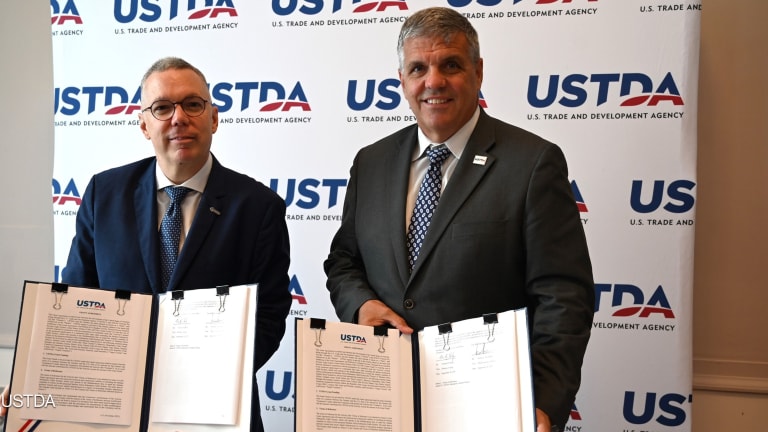
In a brutal year for U.S. development agencies, one small outfit has stood its ground. The U.S. Trade and Development Agency has navigated the year fairly unscathed, even as other agencies faced cuts, pauses, or dismantling.
That survival wasn’t automatic. USTDA, which funds early-stage infrastructure work while creating opportunities for U.S. companies, spent much of the Trump administration’s first year justifying its role.
“It’s been a year of recalibrating, reorganizing, reorienting our program,” says Thomas Hardy, USTDA’s deputy director and chief operating officer, who is also performing the duties of agency director. “There’s a lot of noise in Washington about the deconstruction of [USAID] and so forth, but if you look at the president’s executive orders, it’s kind of the signal that USTDA has been following.”
Those orders explicitly cite USTDA as an implementing agency for priorities ranging from energy dominance to artificial intelligence and critical minerals, Hardy tells Devex Senior Reporter Adva Saldinger.
The agency’s transactional model — backing overseas infrastructure projects that open doors for U.S. firms — has helped make the case. In fiscal year 2025, USTDA generated an average of $226 in U.S. exports for every dollar spent, and since its inception in 1992, it has facilitated more than $127 billion in exports.
Not everything survived the review. A “significant number of activities that weren’t aligned with the president’s agenda” were cut, Hardy says, including most climate-related projects, while aligned work moved ahead. With fewer than 60 staffers and a tighter focus that now includes an explicit national security lens, USTDA is positioning itself to play a larger role in U.S. economic engagement abroad.
Read: How the small US Trade and Development Agency navigated this year
In other news
Canada’s Liberal government has fast-tracked Bill C-12, a sweeping overhaul of border and asylum rules that critics warn borrows from U.S. hard-line policies and risks weakening refugee protections while fueling anti-migrant politics. [The Guardian]
Some 90,000 people who have fled the fighting in the Democratic Republic of Congo now face dire humanitarian conditions in Burundi. [BBC]
Cyclone Ditwah, which struck Sri Lanka in late November, left in its wake approximately $4.1 billion worth of physical damage, equivalent to 4% of the country’s gross domestic product, according to the World Bank. [Xinhua]
It’s quizmas!
Take on our 2025 year-end quiz, and you might win a free annual Devex Pro membership that’s worth $400!
Sign up to Newswire for an inside look at the biggest stories in global development.
About the author

Helen Murphy
Helen is an award-winning journalist and Senior Editor at Devex, where she edits coverage on global development in the Americas. Based in Colombia, she previously covered war, politics, financial markets, and general news for Reuters, where she headed the bureau, and for Bloomberg in Colombia and Argentina, where she witnessed the financial meltdown. She started her career in London as a reporter for Euromoney Publications before moving to Hong Kong to work for a daily newspaper.