

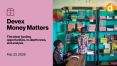


The United Nations had been experiencing two years of falling income even before the Trump administration returned to power in 2025 and implemented a sharp cut in funding to many agencies, according to recently released figures.
Also in today’s edition: Where donors spend their ODA, and the top 10 foundations funding development.
+ Are there topics you want to read more about in Money Matters? We want your feedback.
Taking the UN out of funding
The United Nations’ budget was already in trouble before Donald Trump came to power, recent figures show — leaving it poorly positioned when the U.S. president pulled the rug out from under its feet.
The latest financial statistics data from the U.N. System Chief Executives Board for Coordination reveals a 1.9% real-term reduction in the total income of the U.N. in 2024 — falling to $68.3 billion from $69.6 billion in the previous year. 2023, in turn, saw a steeper decline of 12.6%, down from $79.6 billion in 2022.
In part, this is down to a peak in income during the COVID-19 pandemic — many U.N. agencies received significant funding to tackle the disease. But it is also symptomatic of a growing reluctance among major donors to respond to humanitarian needs.
This is a problematic situation because humanitarian need during 2024 was at its highest since World War II, driven by war, pandemic, and economic hardship.
The biggest cuts in 2023 and 2024 hit the largest U.N. agency, the World Food Programme, which saw a 39% drop in income — around $6 billion — in 2023, followed by a slight rebound in 2024.
UNICEF, the second-largest agency, also saw significant dips over the two years — a drop of 16.9% in 2023 and another 6.4% in 2024, totaling around $2 billion altogether.
In both cases, the cuts were down to major reductions from the United States under the Biden administration.
For the U.N. it is worrying that the U.S. was cutting funding to the U.N. even before Trump. It suggests a bipartisan desire among politicians to step away from humanitarian aid — an area where the U.S. has traditionally been the mainstay.
It will be the next set of figures, however — those for 2025 — which reveal the true extent of the problem, with some agencies, including WFP, projecting that the cuts could be in the region of a further 40%.
Read: Inside the shrinking income of the United Nations (Pro)
Interested in more insights on the challenges facing the United Nations? Devex Senior Global Reporter Colum Lynch is hosting an event on that exact subject tomorrow at 10 a.m. ET. The event is free for Devex Pro and Pro Funding members. Register here to join.
Funding activity
We publish tenders, grants, and other funding announcements on our Funding Platform. Here are some of those viewed the most in the past 10 days.
The Asian Development Bank is seeking consultancy firms to design and implement a baseline study for a wetlands and fisheries project in India.
The Nordic Development Fund has announced grant financing for innovative clean-energy solutions in Africa.
The OPEC Fund for International Development has approved a $20 million loan to support SMEs' growth in the Democratic Republic of Congo.
The United Nations has launched a call for proposals to support farm-level adoption of gender-responsive, climate-resilient agriculture practices in Nepal.
The World Bank has approved $200 million in funding to create jobs, enhance food security, build climate resilience, and support vulnerable households in Ethiopia.
+ From daily funding opportunity alerts to exclusive intelligence on donor trends, Devex Pro Funding gives development professionals the edge they need to navigate today’s complex finance landscape — and win. Sign up with a five-day free trial now.
Aid in freefall
It wasn’t just U.N. funding that fell in 2024, though. For the first time, bilateral official development assistance also fell, by around $4.6 billion — a drop of just under 3%.
That’s indicative of a broader across-the-board shift to reduce official development assistance, or ODA, spending by the U.S. and Europe.
In 2024, the largest flows were to Ukraine, which dominated the spending of the major powers in the global north. The United States, for example, spent $9.5 billion in Ukraine — roughly 60% of its spending on the whole of Africa. Ukraine was also the country that received the most funding from the U.K. and Germany.
All of this raises interesting questions about the next set of ODA figures, which will cover 2025, which are due to be published within the next month. Based on our other analyses, it looks likely that U.S. funding in the year could fall by something like 80%, while there are also likely to be cuts from all other major donors. Who will bear the brunt of these reductions?
Read: Where did the top donors spend their bilateral ODA in 2024? (Pro)
Solid foundations
Devex publishes an annual report looking at the top 10 foundations funding development, with an analysis of how much funding each of them provided, and to whom.
It’s based on data from OECD, which collected figures from 32 funders, which between them spent $12.5 billion on development in 2023 — a rise of 8% on the previous year.
The Gates Foundation accounted for around 44% of that — just under $5.5 billion — but still well under the $10 billion that the foundation has targeted as its annual funding figure.
We previously brought you a brief preview of this report, but the full details are now available.
Read: The top 10 foundations funding development 2026 (Pro)
Last week, I spoke to my colleague, Pro Funding Editor Raquel Alcega, about what to take away from the report, and the state of philanthropy more widely. Our Pro and Pro Funding members can read the takeaways and watch the event recording for free.
Watch: Can philanthropy fill the aid gap? 5 reality checks (Pro)
+ Pro members can access all our content exploring how philanthropy and the private sector have been responding to the bilateral aid decline.
Skeletons in the closet
USAID might have been shut down, but it’s struggling to actually close.
Within the agency, a legacy team is still struggling to settle termination agreements with its former partners, who are still owed hundreds of millions of dollars. (One group of contractors said they were collectively owed $600 million.)
Those familiar with the team tell Devex that it is battling to overcome mistrust and suspicion from the White House Office of Management and Budget and that there is a lack of agreement over how they are supposed to shut down the agency without breaking the law.
Read: Inside the USAID closeout mess (Pro)
+ Dig deeper into the new normal of U.S. aid with our limited-edition Devex Pro Insider’s special Saturday newsletter, led by Senior Reporter Michael Igoe, who delivers exclusive insights, analyses, and behind-the-scenes commentaries on the power brokers, key players, and influencers of the new U.S. foreign aid policy.
Not yet gone Pro? Start your 15-day free trial today to receive the next edition straight in your inbox and also access all our exclusive content and events.
Sign up to Money Matters for an inside look at the biggest stories in development funding.
About the author

David Ainsworth@daveainsworth4
David Ainsworth is business editor at Devex, where he writes about finance and funding issues for development institutions. He was previously a senior writer and editor for magazines specializing in nonprofits in the U.K. and worked as a policy and communications specialist in the nonprofit sector for a number of years. His team specializes in understanding reports and data and what it teaches us about how development functions.
Search for articles

Most Read
- 1
- 2
- 3
- 4
- 5