Opinion: What Ajay Banga can learn from past World Bank presidents
Succeeding at an impossible job: leadership lessons for the next president of the World Bank.
By Shyam Sundaram // 04 April 2023If Ajay Banga is confirmed as the president of the World Bank — as it’s likely since he is the only candidate in the running — he will step into an impossible job: of the past four presidents, all but one resigned from the job before his term ended. Why is this job so hard? Because it's actually five jobs rolled into one. The tasks and requirements of a good World Bank president are to: • Manage a lending portfolio of over $200 billion, which requires finance executive skills. • Set the anti-poverty agenda globally, which needs forward-looking thought leadership. • Champion forgotten causes, which needs sustained advocacy skills. • Engage directly with finance ministers and heads of state from every country, which requires the workmanship of an adept politician. • Manage and lead an active and engaged workforce of 15,000 people spread across all five continents, which requires strong administrative skills. As keen observers of leadership at the World Bank for over 20 years, we have seen presidents come and go — some with greater success than others. And their collective track record points to five key lessons Banga should consider if he wants to be a transformational president. 1. Tackle at least one big unspoken challenge. The World Bank president has a platform from which to shine a light on issues that people do not want to address. This is difficult — but if done right, this can become a defining legacy. Jim Wolfensohn, the bank president from 1995-2005, made tackling systemic corruption a central part of his legacy. This was not a popular mantle to take up: He was actively going against many entrenched interests inside and outside the bank. But in shining a light on the “cancer of corruption” embedded in the World Bank, his legacy at the bank has been a sustained increase in anti-corruption efforts. For Banga, this clarion call likely should be around pushing the bank to make climate justice a central goal in all its efforts. Whatever the signature issue is, he should identify a key agenda and drive progress, even in the face of resistance. 2. Continually build the bank’s importance, especially amongst critics. The World Bank has many critics, and it is easy to dismiss those audiences and try to work around them. However, presidents such as Jim Kim, who was at the helm from 2012-2019, and Bob Zoellick, the bank president from 2007-2012, despite the criticism surrounding them, leaned into making allies out of traditional critics. Kim was particularly successful at increasing shareholder confidence in the bank, especially to audiences who are not traditional allies, such as the Trump administration of the United States. While this glad-handing and politicking were derided by some as cynical, it did result in an additional $13 billion in financing for the World Bank. For Banga, building partnerships with nontraditional allies will be critical, particularly given the possibility of a Republican administration in the U.S. in 2025, increasingly inward-focused governments in Europe, and China and India’s interests in setting up their own financing institutions such as the New Development Bank. 3. Challenge orthodoxy to meet crisis moments. While building consensus is critical for most of the president’s work, every so often, progress needs to be in large and bold leaps, not in incremental action. For Zoellick, this was launching billions of dollars in climate investment funds to demonstrate that investments in climate could be good for growth and for returns. For David Malpass, it was launching a new fund for pandemic preparedness and response due to the COVID-19 crisis. This is not easy and will ruffle feathers, so Banga should pick his moments carefully. But if we are to make progress on thorny issues such as unlocking financing for fragile and conflict-affected states or restructuring debt for emerging markets, leaps will sometimes be necessary. 4. Move only slightly faster than the “speed of trust” on any internal reform agenda. The World Bank staff are, in the words of the past four presidents, the greatest asset that the organization has. It is also true that these very same presidents never found a way to work effectively with their staff. The only exception in recent times is Kristalina Georgieva, who was the acting president in 2019, who made it a significant priority of hers to rebuild trust after Kim’s ill-fated reorganization package. This is not to say internal reform of the bank isn’t needed. In fact the opposite is true. But if Banga tries to reform the bank much faster than he is able to build and sustain trust with his staff, he is unlikely to achieve lasting success. 5. Bring joy and empathy to the role. Most people familiar with the World Bank would regard Wolfensohn as the most successful president in recent times. And in large part it was because of the attitude he brought with him to his role. He greeted everyone with bear hugs — from heads of state to the flower vendor on 19th and H streets in Washington, D.C. He consistently prioritized the human element of major decisions that the bank was taking. And even when staff and shareholders got frustrated with his leadership style and any half-baked ideas he would push on the institution, he made it a point to listen to them. His exuberance, energy, and enthusiasm for the potential of the institution he led inspired a generation of staff, clients, and shareholders to do better that has persisted for almost 20 years since the end of his term. Banga is coming into this role with an unenviable to-do list, sky-high expectations, and a difficult set of stakeholders to manage. But if he can heed some of the lessons former holders of his role have for him, he has the potential to be a truly transformative leader of the World Bank. Editor’s note: The opinions expressed in this article are those of the author and do not represent the opinions or views of Dalberg.
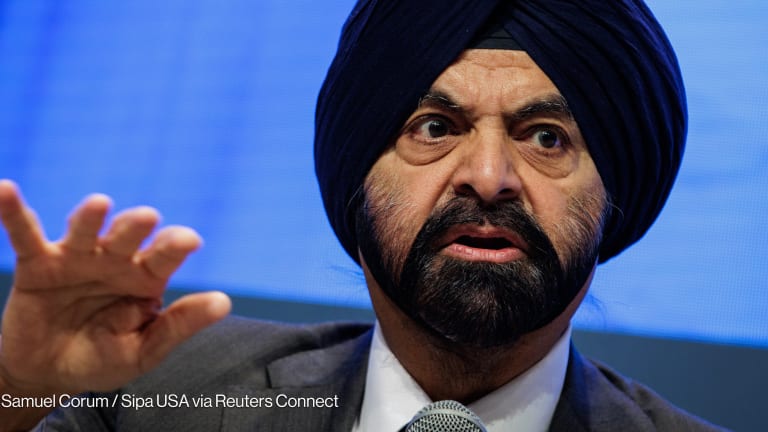
If Ajay Banga is confirmed as the president of the World Bank — as it’s likely since he is the only candidate in the running — he will step into an impossible job: of the past four presidents, all but one resigned from the job before his term ended.
Why is this job so hard? Because it's actually five jobs rolled into one. The tasks and requirements of a good World Bank president are to:
• Manage a lending portfolio of over $200 billion, which requires finance executive skills.
This article is free to read - just register or sign in
Access news, newsletters, events and more.
Join usSign inPrinting articles to share with others is a breach of our terms and conditions and copyright policy. Please use the sharing options on the left side of the article. Devex Pro members may share up to 10 articles per month using the Pro share tool ( ).
The views in this opinion piece do not necessarily reflect Devex's editorial views.
Shyam Sundaram is a partner at Dalberg Advisors and director of the Washington, D.C. office, where he leads the global talent & leadership practice area. Before joining Dalberg, Shyam worked with the World Bank Group, focusing on disaster risk management in the Middle East and North Africa region. He consulted for the Inter-American Development Bank and has worked with a number of NGOs in the conflict resolution sector, including the International Crisis Group.