
Q&A: Fighting for family-like environments over institutional care


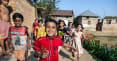


Where possible, donors and practitioners must ensure children live in a family or family-like environment rather than institutional care, said Sister Delvin Mukhwana, program manager for the Association of Sisterhoods of Kenya’s Catholic Care for Children in Kenya program, or AOSK-CCCK.
“If, as a donor, you tell me it's not the normal story [to have] children in institutions but you want to see us helping children from their family, we'll do that. But if you encourage us to see children [placed] in institutions, then it will be difficult,” she said.
An estimated 2.7 million children are thought to live in residential care across the world.
Part of our Focus on: Faith and Development
This series illuminates the role faith actors and their communities play in strengthening global development outcomes.
According to UNICEF, abuse, neglect, exploitation, lack of stimulation, poor nutrition, and toxic stress are more likely to be experienced by children who grow up outside a family environment. This can have repercussions into adulthood, affecting both physical and mental health.
“Children in an institution lack identity and suffer from identity crisis when they grow up,” Mukhwana said, adding that they can go on to find basic decisions as well as attachments hard to make. “Children [can] become irresponsible and … lack basic family values.”
The U.N. Convention on the Rights of the Child states that a family environment is far more beneficial for a child’s development.
Speaking to Devex, Mukhwana explained how AOSK-CCCK strives to support children in families and family-like environments — and the role of faith communities in safeguarding children.
This conversation has been edited for length and clarity.
Why is it so important to shift the care of children away from institutions to a family or family-like environment?
We know that there are developmental milestones that are usually delayed when children grow up in an institution because it's an automated life … in a family, you learn how to climb a tree, a child will steal sugar … you are told “not this way” or “you have to share.” But [in an] institution, you have your plate, your time to sleep, time to play, to go to school. You find that at the end of the day, these children don't know how to live their own lives because they are waiting to be directed. … The full developmental process only happens in a family, not in institutions. Realizing this, as consecrated women we feel it's important to ensure that children go back to their families.
[In] extreme cases, maybe abuse or violation, we rescue them, but still find an alternative family because we understand the importance of a child growing up in a family and we promote the development of a human person.
Is there enough support and resources to support a child staying in family environments versus an institution?
We know that the rain started beating us somewhere when we embraced the [idea of] institutional care. … Unfortunately, we’ve got so used to this model that now we don't know how to continue with the model that [was in place] before where a child belonged to the entire community, and everybody had the responsibility of caring and protecting the minors.
There is a need to educate people in the community that it's their sole responsibility to support children, even if [the] children are not theirs. In any given society, we value the family. I don't want to say it's the African way of doing it because it's all over the world. … The way we put it, a child belongs to the whole village. Therefore, the community has a responsibility to ensure that this vulnerable child is supported to grow like any other child.
Tell us about the work that you are doing with AOSK’s CCCK program?
First of all, [we] ensure that there's a legal framework in place because the government has its own laws when it comes to care and protection of children. As religious women, priests, or brothers, we need to follow the law of land and ensure that whatever we’re doing, we’re operating within the legal framework.
With that, we try to ensure that all institutions under Catholic care have a child protection policy in place that reflects the government’s laws and also the United Nations Convention on the Rights of a Child, African Charter on rights and responsibilities of children, and “Motu Proprio” by Pope Francis. Congregations also have … their missions so we incorporate all that to ensure that safeguarding is done fully.
We do a lot of training … [For sisters,] if you’re told you've got to be an administrator or a social worker in any given home of the congregation, having taken the vow of obedience, you have to go. But you may not have [experience or professionalism] in social work or the protection and the care of children. Instead of protecting and caring, not knowing it, you might be doing harm. We discovered that and feel there's a need to train sisters in social work and we’re doing that. Almost 39 sisters are in the Catholic University of Eastern Africa here in Nairobi.

With the support of the GHR Foundation, and in collaboration with the CUEA … we have [given] extra training to the sisters to ensure that, apart from just being social workers, there is what we call sustainable children rights, protection, and post institutional care which is a certificate course that is being offered at the CUEA. This covers components from the Scriptures, the Catholic social teaching on human dignity and family participation, culture, repurposing of resources, and theories of development for children among others.
“A child belongs to the whole village. Therefore, the community has a responsibility to ensure that this vulnerable child is supported to grow like any other child.”
— Delvin Mukhwana, program manager, Association of Sisterhoods of Kenya-Catholic Care for Children in KenyaWhat does it mean when it comes to culture? What are the theories science talks about when it comes to a child growing? What mechanisms or strategies should I use to ensure that these children are transitioning well without causing harm?
What role do faith communities and actors have in setting an example?
Remember, if it touches the family it is a pastoral issue. If all priests one Sunday across the whole world talk about family-positive parenting and the need to impress family and community-based care and not institutions of care, what impact would that have? Slowly, we are trying to see together as church members, sisters, brothers, priests, how we can work together using the church structure to ensure that family strengthening is done in collaboration — in isolation it is not possible.
We are sharing the information we are getting to ensure that we are collecting data for people to learn, to ensure that we bring about change. The problem is ignorance and the lack of information … We feel it's our responsibility to share, to speak out, to advocate for it. We are very aware that it's a process that might not happen in one or two or three years, but it will take effect for sure.
What is your call to action for those working in international development when it comes to a child’s development and upbringing?
We can move together when donors [and] practitioners in communities around the globe speak [as] one voice or stand for one purpose; that family is the best place for a child and restoring a family is possible. Of course, [I’m] not denying the challenges, because each country has its own challenges — legal, cultural, etc. — but it's possible because in some places it's already happening.
Devex, with support from our partner GHR Foundation, is exploring the intersection between faith and development. Visit the Focus on: Faith and Development page for more. Disclaimer: The views in this article do not necessarily represent the views of GHR Foundation.
About the author

Rebecca L. Root
Rebecca L. Root is a freelance reporter for Devex based in Bangkok. Previously senior associate & reporter, she produced news stories, video, and podcasts as well as partnership content. She has a background in finance, travel, and global development journalism and has written for a variety of publications while living and working in Bangkok, New York, London, and Barcelona.
Search for articles


Most Read
- 1
- 2
- 3
- 4
- 5