
Special edition: LatAm development takes center stage at IDB talks



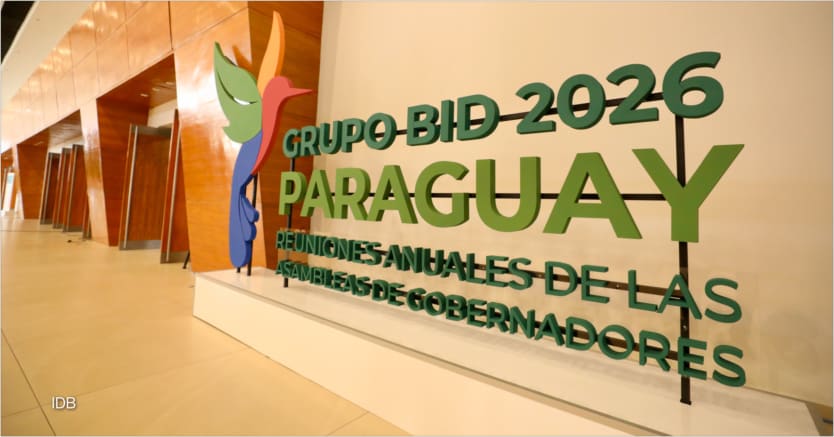
Government officials, financiers, and development leaders are gathering in Asunción, Paraguay, this week for the annual meetings of the Inter-American Development Bank — the main multilateral development bank for Latin America and the Caribbean.
The country welcomed me with stunning views of the winding Paraguay River and striking evidence of the country’s complex development journey. From my plane window, I saw mansion-like complexes with swimming pools positioned around dirt roads. On the drive into the city, I passed an enormous bridge that looked as yet untouched, sitting just across from a neighborhood of makeshift houses.
Hosting the IDB’s annual meetings in Paraguay feels apt. The country enjoys stable growth, abundant renewable energy, and growing investor interest — but still faces the infrastructure and inequality challenges that development banks aim to solve.
I’m on the ground in Asunción all week. Here’s what I’ll be watching.
Ascension ahead of Asunción
Finance first. Two years ago, shareholders agreed to increase the overall capital in IDB Invest, the bank’s private sector arm, by $3.5 billion. This week, that money is expected to be officially disbursed, sources requesting anonymity tell me. One source says that the IDB received a “letter of subscription” from the United States on Monday, which is a legally binding document that confirms the U.S. will participate in the capital increase — the most significant contribution considering the Trump administration’s move away from international development institutions.
The increase marks a major milestone for the institution as it seeks to scale up private sector lending at a time when traditional development finance is increasingly under pressure globally.
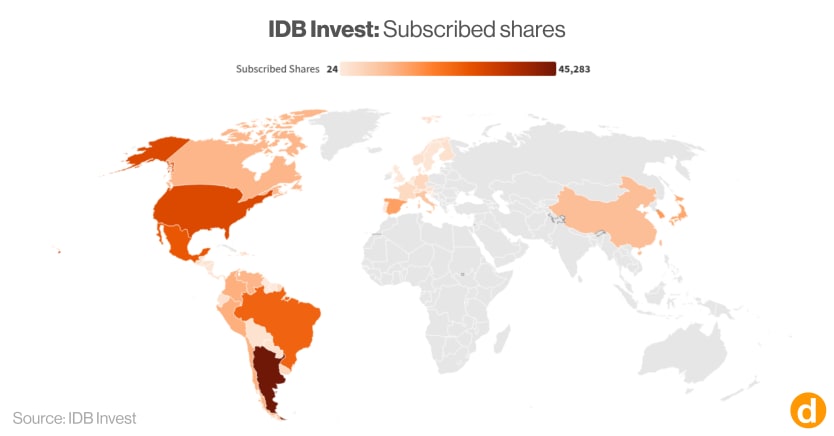
The increase would also allow IDB to take on more risk, expand its investments, and deploy financing in smaller or underserved markets — particularly in Central America and the Caribbean, regions that have historically received less attention compared with larger economies such as Brazil and Argentina.
For IDB, the push reflects a broader effort to rethink how multilateral development banks mobilize capital. In recent years, IDB Invest has rolled out a new “originate to share” strategy aimed at finding ways to structure deals with more private sector participation or in ways that enable it to offload risk to the private sector through securitizations.
“Last year, the IDB Group delivered $35 billion in financing, the highest level in our history and about 50% higher than in 2022 — achieved without a general capital increase,” IDB’s president, Ilan Goldfajn, told me in an email. “It shows we are finding ways to make our resources work better and deliver greater impact.”
Private sector investment is seen as especially critical in Latin America and the Caribbean. Despite being largely classified as middle-income, the region continues to struggle with weak productivity, persistent inequality, and limited job creation — challenges that development financiers increasingly believe require stronger private sector participation.
“We recognize that development cannot rely on the public sector alone,” Goldfajn said. “The scale of investment needed in infrastructure, energy, and productive sectors requires private capital involvement.”
Check out:
• A deep dive into the world’s biggest MDBs (Pro)
• Development finance trends to watch in 2026 (Pro)
+ Unlock the power of Devex Pro with a 15-day free trial. Discover the expert analyses and wealth of knowledge that drive global development. Connect with key players at exclusive events and uncover hidden funding opportunities you won't find elsewhere. Discover all the exclusive content available to Pro members.
Right place, not a great time
With war raging in the Middle East and Latin America still reeling from the U.S. capture of former Venezuelan President Nicolás Maduro, the meetings are taking place against an explosive geopolitical backdrop.
The United States remains IDB's largest shareholder, holding 30% of the bank's voting power and just under 15% in IDB Invest. As a result, Washington’s evolving — and often unpredictable — priorities could shape the bank’s agenda.
Despite its hefty shareholder status, sources tell Devex that the U.S. is expected to send a lower-level official from the Treasury Department to the meetings. The Treasury did not respond to a request for comment.
The current geopolitics could mean a meager showing from a few crucial sectors. Many representatives in the Persian Gulf states may not be able to attend. Despite the participant list indicating a strong showing from the Qatar Fund for Development, the fund tells me it is no longer participating due to flight restrictions. The group may still have representatives on the ground, but is refraining from making any public comments at the time.
Parallel to the discussions in Paraguay, Argentine President Javier Milei is in New York for Argentina Week, a three-day summit aimed at strengthening ties with investors.
China’s presence
For years, IDB has been subject to debates over how much China should participate in Latin American development finance, especially given China’s rivalry with the U.S. Beijing’s role as a small IDB shareholder and as a competitive contractor on infrastructure projects both expanded under the bank’s former president, Luis Alberto Moreno, including through a dedicated China fund.
That history has fed long-running suspicions in Washington that Chinese firms have benefited disproportionately from multilaterally financed projects in the region, even if their involvement has rarely translated into direct political influence at the bank.
While China is far from dominant in IDB operations, experts say there is growing informal pressure by Beijing critics to narrow its role in bank-financed projects. However, Chinese companies tend to be better equipped to carry out big infrastructure projects at a low cost. A shift away from that could carry implications for price, procurement choices, and how far existing capital can stretch in a region still facing large infrastructure and productivity gaps.
For now, experts are largely unclear on what the next move from the U.S. will be. “I don’t know that there’s a strategy,” Margaret Myers, director of the Asia and Latin America program at the Inter-American Dialogue, tells me. “A focus is not a strategy. What is and is not on the table in pursuit of a diminished Chinese role is unclear. And that lack of clarity is problematic for the region and regional institutions.”
But, she adds, “the IDB is the U.S.’s to lose, frankly. If they pull out, of course, China will step in.”
Punching on progress
In response to a question about whether the bank is feeling pressure to align itself with U.S. priorities, Goldfajn said in his email that “current common interests focus on private sector led development, resilience, security in all dimensions, among others.”
Despite shifting political winds on climate change, IDB has so far maintained ambitious climate targets. It has a broad institutional strategy that runs through 2030, committing 45% of its total approved financing volume to climate-related activities.
However, a specific Climate Change Action Plan that laid out steps the bank would take over a five-year period expired in 2025, and there is no publicly available plan for the next five years.
Some advocates are concerned about the climate direction the bank will take, especially under a Trump administration adamantly opposed to combating climate change. For example, IDB financed one of its largest gas-to-power projects in the Dominican Republic in 2025, which generated criticism from civil society organizations and locals who were hoping to see IDB leave gas in the past.
The bank is also one of several MDBs that recently received a letter from the watchdog organization Bank Climate Advocates, arguing that it may be violating international law by not aligning its projects with the 1.5 degrees Celsius limit outlined in the Paris Climate Agreement.
More generally, civil society organizations say that they have felt welcomed by the bank since Goldfajn came into his role.
“They have been opening up spaces for us,” Daniela Sepulveda, communications facilitator at The Coalition for Human Rights in Development, tells me. “They’ve been quite receptive, especially now with Goldfajn as president; it’s become much more open. For several years, we were actually excluded from any sort of discussion.”
ICYMI: Legal opinion warns development banks may violate climate law
What we’re watching
We’re keeping an eye out for conversations about infrastructure, connectivity across Latin America and the Caribbean, and critical minerals projects this week.
Several panels will focus on the bank’s South Connection plan — a regional program to improve physical, digital, and energy connectivity, streamlining trade and logistics, and strengthening regulatory and institutional frameworks across countries.
Latin American governments created the plan to tackle high transport costs and weak infrastructure. It aims to build strategic corridors — including roads, ports, waterways, and digital networks — that lower costs, boost competitiveness, and attract investment while supporting sustainable growth and regional cooperation. But that also comes at the expense of forests and Indigenous communities’ homes, critics say.
IDB is also increasingly positioning itself as a key financier in critical mineral value chains. Backed by grants and IDB‑led investments, the bank says it wants to strengthen governance around mining, fill geological data gaps, and support sustainable extraction practices — efforts aimed at boosting inclusive economic growth and environmental sustainability in countries such as Argentina, Bolivia, Brazil, Chile, and Ecuador.
This week, it will launch a program called LAC Minerals to help countries capitalize on their minerals. “The goal is to build responsible value-added supply chains that promote prosperity in Latin America and the Caribbean, while contributing to the global technological transformation by expanding its energy supply,” Goldfajn wrote in his email.
And, of course, today we’ll be at the IDB soccer game at the South American Confederation for Football stadium, where the meetings are being held. We’ve heard that Goldfajn will be playing.
Related: Does the development world need to worry about critical minerals? (Pro)
+ For more content like this, sign up to Devex Invested — our free weekly newsletter that tracks how capital, policy, and innovation are transforming global development.
About the author

Jesse Chase-Lubitz
Jesse Chase-Lubitz covers climate change and multilateral development banks for Devex. She previously worked at Nature Magazine, where she received a Pulitzer grant for an investigation into land reclamation. She has written for outlets such as Al Jazeera, Bloomberg, the Organized Crime and Corruption Reporting Project, and The Japan Times, among others. Jesse holds a master’s degree in Environmental Policy and Regulation from the London School of Economics.
Search for articles



Most Read
- 1
- 2
- 3
- 4
- 5