• News
    • Latest news
    • News search
    • Health
    • Finance
    • Food
    • Career news
    • Content series
    • Focus areas
    • Try Devex Pro
  • Jobs
    • Job search
    • Post a job
    • Employer search
    • CV Writing
    • Upcoming career events
    • Try Career Account
  • Funding
    • Funding search
    • Funding news
  • Talent
    • Candidate search
    • Devex Talent Solutions
  • Events
    • Upcoming and past events
    • Partner on an event
  • Post a job
  • About
      • About us
      • Membership
      • Newsletters
      • Advertising partnerships
      • Devex Talent Solutions
      • Contact us
Join DevexSign in
Join DevexSign in

News

  • Latest news
  • News search
  • Health
  • Finance
  • Food
  • Career news
  • Content series
  • Focus areas
  • Try Devex Pro

Jobs

  • Job search
  • Post a job
  • Employer search
  • CV Writing
  • Upcoming career events
  • Try Career Account

Funding

  • Funding search
  • Funding news

Talent

  • Candidate search
  • Devex Talent Solutions

Events

  • Upcoming and past events
  • Partner on an event
Post a job

About

  • About us
  • Membership
  • Newsletters
  • Advertising partnerships
  • Devex Talent Solutions
  • Contact us
  • My Devex
  • Update my profile % complete
  • Account & privacy settings
  • My saved jobs
  • Manage newsletters
  • Support
  • Sign out
Latest newsNews searchHealthFinanceFoodCareer newsContent seriesFocus areasTry Devex Pro
    • News
    • The Trump Effect

    USAID’s largest partners report furloughs for thousands of staff

    The dismantling of U.S. foreign assistance isn’t just affecting USAID — it’s scorching even the biggest aid organizations across the world.

    By Elissa Miolene // 11 February 2025
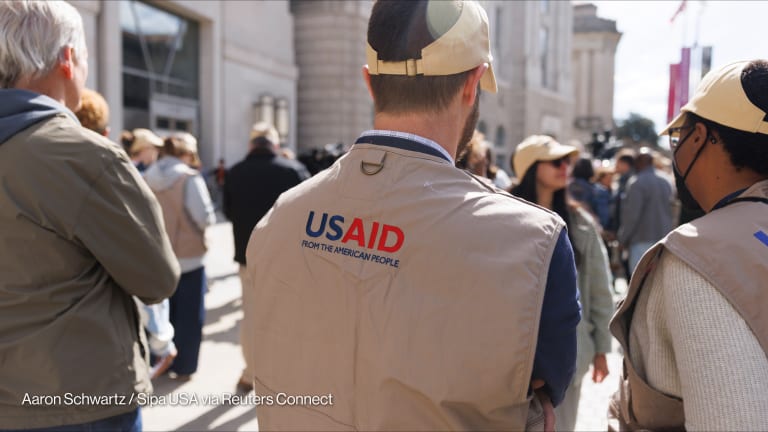
    For more than 50 years, FHI 360 has reached thousands across the world. In Ethiopia, that has meant treating children suffering from malnutrition; in Ukraine, that’s meant bringing mobile medical clinics to communities with bombed-out hospitals. Those programs were funded by USAID, the agency which, three weeks ago, was the largest bilateral donor in the world. But over the last three weeks, USAID has been brought to pieces. And day by day, its partners have gone down with it. FHI 360 is just one of countless organizations to be hit, furloughing 36% of its staff — including 200 in its North Carolina headquarters — last week alone. “Most leaders are in firefighting mode,” said Kim Kucinskas, a director at the nonprofit group Humentum. But at the same time, she said, organizations have had to continue to ensure they’re keeping on top of other programs not funded by the U.S. government. “It’s this balance between crisis management, and needing to keep the trains running on time.” Today, eight organizations — including some of USAID’s largest contracting partners, DAI and Chemonics International — sued President Donald Trump, USAID, the U.S. Department of State, and others for “irreparable harm” in the wake of USAID’s dismantling. In the lawsuit, the organizations laid out the damage: DAI, for example, has furloughed between 65% and 70% of its workforce — some 383 employees — and reduced salaries for senior staff members by 20%. Democracy International, a nonprofit focused on democratic governance, has furloughed 100% of its 95 U.S.-based employees and placed 163 staff members overseas — 92% of those abroad — on administrative leave. And Chemonics International, an organization that was once a USAID contracting powerhouse, has furloughed 750 of its U.S.-based staff — more than 63% of its American workforce — and reduced the hours of another 300. “These programs cannot simply be restarted on command,” the lawsuit states. “USAID’s partners are hemorrhaging resources and employees.” The list goes on. Management Sciences for Health, a Virginia-based nonprofit, has furloughed half its U.S. staff, with the court filing stating the organization may soon terminate another 1,000 employees abroad. HIAS, a nonprofit focused on refugee resettlement, has laid off 500 of its international staff. There are reports of deep cuts at Catholic Relief Services and Resonance, a Vermont-based contractor, has laid off all but a dozen of its 100-person workforce. The International Republican Institute, or IRI — a nonprofit focused on freedom and democracy — has also been forced to furlough two-thirds of its workforce, some 200 people. More are expected to follow, and IRI is now shutting down more than 20 of its offices overseas, according to someone with knowledge of the organization’s internal decision-making. USAID Stop-Work, a coalition of former, current, and affiliated USAID staff, has counted more than 11,300 American jobs lost across 43 states — and nearly 52,000 across the world. “Without having money in place, organizations have had to lay off staff and or stop procurement orders for essential products, and that is not something that can just be turned back on if money were to become available,” said one former USAID official, who spoke during a virtual press conference assembled by USAID staff last week. “This has resulted in consequences for every region in the world.” Smaller organizations often receive lines of credit from USAID, which they draw on to do the contracted work. Larger organizations often do that contracted work, and then invoice USAID for reimbursement. With USAID’s payment system frozen since last month, both systems have been broken. In Central America, that means shelters previously supporting young people fleeing gang recruitment are now closed; across the world, that means $150 million of health commodities, including antiretroviral medications, are stranded in warehouses. “It’s in the hundreds of millions of dollars owed for services already provided, and of course, some multiples of that when it comes to what is being asked to be floated during the 90-day review,” said Tom Hart, the president and chief executive officer of InterAction. “That’s why at least in the INGO sector, we’re seeing mass layoffs, country programs stopped, and some organizations looking at shutting their doors.” Organizations have been forced to shift money around to cover costs or lay off staff to save on program expenses. And for many of USAID’s largest partners, that means they’re out millions of dollars for work they’ve already done. The Professional Services Council, or PSC, a trade association of more than 400 government contractors, said federal agencies currently owe its members some $500 million in unpaid work. Humentum surveyed 100 organizations to ask the same, finding that nearly three-quarters of respondents said their organization had not been paid for work completed before Jan. 24. The court filing breaks things down further: DAI is owed $120 million for work completed before the stop-work order began while Chemonics is out $103.6 million for the same. “What happens when those invoices are not paid?” said PSC’s president, David Berteau, in a press release. “Without reimbursement for funds already disbursed, companies will run short of cash.” Earlier today, Kucinskas gathered human resource leaders for Humentum’s people and culture roundtable, a regular convening of those across the global development space. The mood was heavy as organizations compared how they were making their calculus, Kucinskas said. “Some said: I’ve been around for a while, and have been through crises before,” she added. “But this is a whole other level. It’s physically, emotionally, mentally exhausting.”

    Related Stories

    Inside the USAID closeout mess
    Inside the USAID closeout mess
    Where do the USAID legal battles stand?
    Where do the USAID legal battles stand?
    Fighting for billions: The legal battle to keep US foreign aid alive
    Fighting for billions: The legal battle to keep US foreign aid alive
    Forced into retirement, ex-USAID staffers face long pension delays
    Forced into retirement, ex-USAID staffers face long pension delays

    For more than 50 years, FHI 360 has reached thousands across the world. In Ethiopia, that has meant treating children suffering from malnutrition; in Ukraine, that’s meant bringing mobile medical clinics to communities with bombed-out hospitals.

    Those programs were funded by USAID, the agency which, three weeks ago, was the largest bilateral donor in the world. But over the last three weeks, USAID has been brought to pieces. And day by day, its partners have gone down with it.

    FHI 360 is just one of countless organizations to be hit, furloughing 36% of its staff — including 200 in its North Carolina headquarters — last week alone.

    This article is free to read - just register or sign in

    Access news, newsletters, events and more.

    Join usSign in
    • Funding
    • Democracy, Human Rights & Governance
    • Humanitarian Aid
    • Global Health
    • Project Management
    • Careers & Education
    • United States Agency for International Development (USAID)
    • Chemonics International Inc.
    Printing articles to share with others is a breach of our terms and conditions and copyright policy. Please use the sharing options on the left side of the article. Devex Pro members may share up to 10 articles per month using the Pro share tool ( ).

    About the author

    • Elissa Miolene

      Elissa Miolene

      Elissa Miolene covers U.S. foreign assistance from Washington, D.C. She previously covered education at The San Jose Mercury News, and has written for The Wall Street Journal, the San Francisco Chronicle, and other news outlets across the world. Before shifting to journalism, Elissa led communications for aid agencies in the United States, East Africa, and South Asia.

    Search for articles

    Related Stories

    The Trump EffectRelated Stories - Inside the USAID closeout mess

    Inside the USAID closeout mess

    The Trump EffectRelated Stories - Where do the USAID legal battles stand?

    Where do the USAID legal battles stand?

    The Trump EffectRelated Stories - Fighting for billions: The legal battle to keep US foreign aid alive

    Fighting for billions: The legal battle to keep US foreign aid alive

    The Trump EffectRelated Stories - Forced into retirement, ex-USAID staffers face long pension delays

    Forced into retirement, ex-USAID staffers face long pension delays

    Most Read

    • 1
      One year on: Is Africa’s surgical equity push delivering real change?
    • 2
      How to deliver results at scale for people and planet
    • 3
      Ending HIV globally requires action in Eastern Europe and Central Asia
    • 4
      US launches $4.5B platform inviting NGO support for bilateral health deals
    • 5
      What will it take to unlock private financing in a changing era?
    • News
    • Jobs
    • Funding
    • Talent
    • Events

    Devex is the media platform for the global development community.

    A social enterprise, we connect and inform over 1.3 million development, health, humanitarian, and sustainability professionals through news, business intelligence, and funding & career opportunities so you can do more good for more people.

    • About us
    • Membership
    • Newsletters
    • Advertising partnerships
    • Devex Talent Solutions
    • Post a job
    • Careers at Devex
    • Contact us
    © Copyright 2000 - 2026 Devex|User Agreement|Privacy Statement