
Will Afghanistan get $3.5B in aid under Biden's plan? Not so fast


U.S. President Joe Biden has announced his administration is splitting the $7 billion in Afghan reserve funds frozen in the United States, with about half being set aside amid ongoing litigation involving victims of the 9/11 attacks. The remaining $3.5 billion will be placed in a trust fund that could be used “to benefit the Afghan people,” according to the White House.
However, it is not at all clear when any of the reserves — which belong to the central bank of Afghanistan and were frozen by the U.S. after the Taliban takeover in August — would actually be released for humanitarian assistance, if they will be at all.
WFP’s Afghanistan chief ‘terrified’ as hunger and despair mount
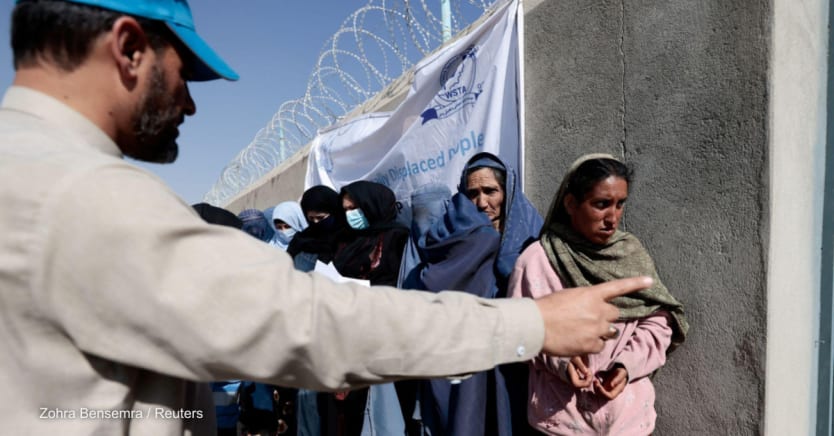
Poverty is worsening in Afghanistan. People who once had jobs are now searching trash cans for food. WFP says it is struggling to deliver support due to a funding crisis. Aid agencies are calling for the U.S. to relax sanctions further.
Several experts have speculated the decision was driven by domestic political motives, including concerns over blowback ahead of U.S. midterm elections this year if the funds were to be released directly to a country under Taliban control. The move, they tell Devex, effectively means that money arguably belonging to Afghans suffering from hunger and economic collapse under the Taliban could be paid as restitution to 9/11 victims in the U.S.
Meanwhile, the humanitarian situation in Afghanistan continues to deteriorate. The United Nations says the country is a “frozen hell” hanging by a thread, with the expectation that 97% of the population will be plunged into poverty over the next few months.
The World Food Programme, a major operator in Afghanistan, said it was in the dark about the White House’s plans to use any of the funds for humanitarian causes.
“WFP has not yet had conversations with the Administration regarding this new development. If WFP were to receive any such funds, it’s important to note that we would use that money to directly help those suffering in Afghanistan,” spokesperson Steve Taravella told Devex by email.
The Taliban remain subject to a slew of international sanctions, which are reverberating throughout the Afghan economy. The U.S. and the U.N. have made humanitarian carve-outs designed to help ease some assistance into the country. WFP, for example, received $180 million in donor funds that had been frozen, though the organization is warning it is set to run out of cash in March because Afghans so heavily rely on its handouts, with unemployment skyrocketing.
The White House’s own FAQ on Friday’s executive order makes clear nothing is certain, saying that “Even if” any funds are transferred to Afghans, $3.5 billion will stay in the U.S. amid legal suits over the 2001 attacks. Osama bin Laden, the leader of al-Qaida who orchestrated the attacks, was based out of Afghanistan, which was ruled by the Taliban at the time.
“What we’re talking about today is a process step and a step in a process that might lead to the unlocking of these funds for the benefit of the Afghan people,” a senior U.S. administration official said on a call with reporters Friday.
Adam Weinstein, an analyst with the Quincy Institute for Responsible Statecraft, a think tank in Washington, said that while earmarking any of the reserves for the benefit of Afghans was “better than nothing,” the move does little to resuscitate a dying economy in Afghanistan and get people back on their feet.
“The administration has no idea what they are going to do with the money. All they have done is cordon it off,” he said.
He also questioned the optics of taking Afghan reserves at a time when hunger rates in the country are spiking.
“To the rest of the world, it looks like theft,” he said. “The Afghan people themselves are victims of the Taliban and the war on terror, and we are saying those victims there should pay these victims here.”
The administration's legal justifications for the move stem from both the lack of recognition of the Taliban as the legitimate authority in Afghanistan, as well as ongoing legal action in the U.S. court system. Families of 9/11 victims have sued al-Qaida and the Taliban, among other parties, to get compensation for the losses they suffered in the attacks, as part of litigation that has been ongoing for nearly 20 years. Under Biden’s plan, they may finally have a chance to get a payout.
Aid workers have insisted that humanitarian assistance alone will not solve the hardships in Afghanistan and that the country needs a functioning economy, including a solution for the collapsing banking sector and the ongoing liquidity crisis.
Jason Lyall, a professor at Dartmouth College who has written extensively about Afghanistan, said the move by the Biden administration was puzzling.
“It punishes the Afghan people without challenging Taliban rule. It politicizes humanitarian aid while hurting the Afghan economy,” he said in a tweet.
About the author

Shabtai Gold
Shabtai Gold is a Senior Reporter based in Washington. He covers multilateral development banks, with a focus on the World Bank, along with trends in development finance. Prior to Devex, he worked for the German Press Agency, dpa, for more than a decade, with stints in Africa, Europe, and the Middle East, before relocating to Washington to cover politics and business.
Search for articles


Most Read
- 1
- 2
- 3
- 4
- 5