


Presented by Gates Foundation
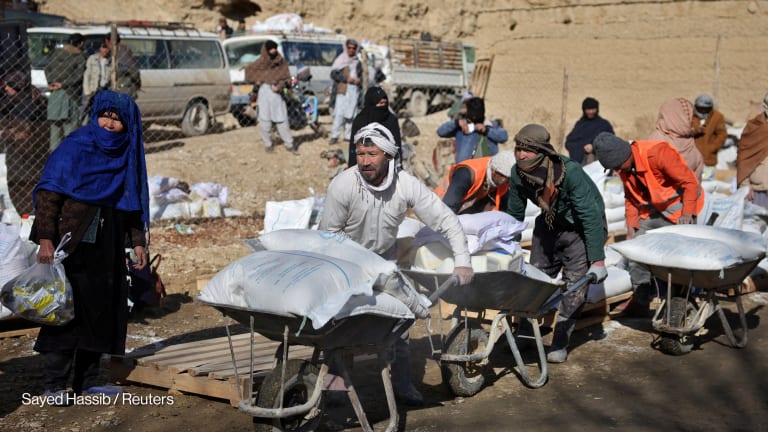
In Afghanistan’s remote mountainous regions, a catastrophic hunger and malnutrition crisis is taking shape. The country has entered its harsh six-month winter, and heavy snowfall is cutting off some high-altitude villages from the rest of the country.
This is Afghanistan’s first winter following Western donors’ cuts to their aid budgets last year. In a country that has long relied on external aid, the food parcels and cash assistance millions of people used to get are now scarce. And while the World Food Programme and NGOs used to deliver food aid ahead of the winter, severe funding shortfalls this year means they had fewer resources to do that — and some communities have been left to fend for themselves.
As a result, many people — especially those in snowbound mountain villages in provinces such as Logar and Herat — will die this winter, aid workers tell Devex contributor Rebecca Root. And some “3.7 million children's lives are in peril on account of acute malnutrition,” according to WFP Afghanistan Country Director John Aylieff. There is less food aid to go around, and across the country, many of the NGO-run health clinics that treated child malnutrition and other medical issues — such as those operated by the International Rescue Committee — have been shuttered.
Afghanistan is one of the starkest examples of the effects of aid cuts — not just from the United States, which was once a massive donor to the country, but also the United Kingdom and other European countries. WFP’s own budget picture is sobering: The largest food provider in the country only has the money to support 2 million people a month out of the 17 million in need this winter. Last year, it reached 6 million people. Now it is turning away 3 out of 4 children. The U.S. funded nearly half of WFP’s $4.4 billion budget in 2024. In 2026 it will fund far less.
Aylieff stresses that this situation is unprecedented — even despite Afghanistan’s decades of conflict, as well as economic collapse and natural disasters such as droughts and last year’s powerful magnitude 6.0 earthquake. “I've been following Afghanistan for 20 years, and we've never been unable to launch a significant winter response,” he says. To get by with much less money, WFP is “hyperprioritizing.” For food and cash assistance, WFP has “honed that down to only places where, if people don't get food in the next three months, they will fall into famine-like conditions,” he says.
Afghans themselves are resorting to drastic measures, including selling their livestock, moving to other regions, and forcing their children into work. In one particularly desperate example, Aylieff describes meeting a father who sold his kidney for $1,850 in order to feed his family.
Beyond the horrors unfolding this winter, the aid cuts are threatening to undo the country’s fragile progress since the U.S. military withdrew and the Taliban took over the country in 2021. The economy had been stabilizing and agricultural production had been improving in recent years. But, Aylieff says, “all of that has been reversed now.”
This story is part of The Aid Report, a Gates Foundation-funded, editorially independent initiative to track and document the on-the-ground impacts of the U.S. aid cuts with firsthand reporting and a verified, contributor-based data collection system. For more information and to read more stories, go to https://www.theaidreport.us.
Read: Afghans ‘desperate’ as aid cuts bring mass hunger crisis
Background: ‘We’re turning away 9 out of 10 hungry people’ — the cost of shrinking aid
And don’t miss: Aftermath of Afghan quake shows fallout of USAID withdrawal
The blacklist
“Providing food assistance to the hungry in Afghanistan and Yemen is in the U.S. national interest. It does make America safer, stronger, and more prosperous. It is also the right thing to do.”
— Michelle Jurkovich, former policy adviser at the U.S. State Department Office of Global Food SecurityAfter the Trump administration abruptly cut off all U.S. foreign aid last year, it eventually restored some emergency food assistance — except for anything that went to Afghanistan and Yemen, two of the world’s poorest and most war-affected countries. At the time, the State Department said the funding cuts were based on “credible and longstanding concerns that funding was benefitting terrorist groups including the Houthis and the Taliban.” And in the final days of 2025, when the U.S. pledged $2 billion for the United Nations to respond to humanitarian crises in 17 countries — part of an “adapt or die” mandate for the U.N. — it explicitly barred money for those two. “President [Donald] Trump will never tolerate a penny of taxpayers’ money going to terrorist groups,” Jeremy Lewin, undersecretary for foreign assistance at the State Department and a mastermind of the USAID shutdown, said in December.
But as seen in Devex’s reporting from Afghanistan’s mountain provinces, the effects of this U.S. policy is becoming more clear. Beyond the famine that the policy could bring, it has security implications that threaten U.S. interests, Jurkovich writes in an opinion piece for Devex. The food security expert and professor questions the Trump administration’s rationale, arguing that U.S. food assistance did not reach Houthi-controlled areas of Yemen and that evidence for widespread food aid diversion by the Taliban in Afghanistan is lacking.
Jurkovich calls for the State Department to reverse its termination of aid to Yemen and Afghanistan. “The humanitarian and strategic costs far outweigh any alleged savings or benefits,” she writes. “In both countries, the policy undermines rather than advances U.S. interests. It will result in unnecessary death, may create conditions favorable to terrorist groups, and risks destabilizing regions where U.S. interests depend on local stability.”
Opinion: Why ending food aid to Afghanistan, Yemen threatens national security
See also: A memo to world leaders — food security is the basis of global stability
Related: Inside US-UN plan to remake funding for humanitarian crises
DHR you ready for this?
In case 13 months of U.S. foreign aid upheaval was not enough, more changes are on the way. Last week, my colleagues Elissa Miolene and Michael Igoe obtained a proposed State Department organizational chart that shows a major reorganization of the department’s international disaster response system.
On a broad level, the new structure calls for the creation of a new Bureau of Disaster and Humanitarian Response, or DHR, that would separate international relief from the State Department’s more politically charged programs related to international migration — which currently sits within the existing Bureau of Population, Refugees and Migration, or PRM.
Bringing home the bacon
Your next job?
Director, Corporate Engagement
Sustainable Agriculture Network
Worldwide (remote)
And within DHR, there would be a new Office of International Food and Nutrition. That office, according to a congressional notification of the reorganization plans, would “serve as the U.S. government’s center of excellence for international humanitarian food assistance and security,” one that would seemingly replace the current Office of Global Food Security at the State Department. The two reporting lines beneath that office are “agricultural science” and “strategic programs.” So far we don’t have further details on what that all entails.
The news comes as the U.S. government’s flagship food aid program, Food for Peace, was recently shifted to the U.S. Department of Agriculture from the State Department, which has absorbed what little remains of USAID. Separately, the department said last week that it was awarding a $40 million grant to the International Maize and Wheat Improvement Center, or CIMMYT, a Mexico-based agricultural research institution focused on those crops primarily in the global south — and is where Norman Borlaug, father of the Green Revolution, conducted his pioneering research.
“The United States continues to strengthen U.S. food systems and secure our nation’s economic and agricultural dominance,” the press release reads. “A robust and resilient agriculture sector is essential to domestic prosperity, global market stability, and American competitiveness.”
Finally, as you’ve read in past editions of Dish, bright spots are coming into view for Feed the Future, another formerly USAID-led program that sought to strengthen agricultural systems in global south countries so that they could better withstand shocks without external aid. USAID’s shutdown curtailed the research of 17 Feed the Future innovation labs housed at American universities. Last week, the U.S. government published a solicitation for grant applications to help restore some of the labs. Up to seven applicants will get between $20 million and $40 million over the next five years “to advance global food security in alignment with U.S. policy through targeted research.”
Exclusive: US State Department proposes humanitarian overhaul
Related reading: When Feed the Future shut down, these researchers built something new (Pro)
+ A Devex Pro membership lets you get the most out of our coverage of the twists and turns in the U.S. aid sector.
+ Not yet gone Pro? Starting a 15-day free trial today gives you access to all our exclusive expert analyses and briefings into funding opportunities and philanthropy trends, career resources, industry insights on AI implementation trends, and more.
Chew on this
Big Tech is reshaping food production through artificial intelligence, raising concerns of farmer debt, dependency, and climate risks, according to a new report that challenges the promise of digital agriculture. [IPES-Food]
Should the global defense spending ramp-up also be tackling climate change? [Devex]
South Korean farmers are suing a state-owned electric utility company for financial compensation for climate-related agricultural damages in a case that asks whether a major corporate emitter can be held legally responsible for climate change. [UPI]
About the author

Tania Karas@TaniaKaras
Tania Karas is a Senior Editor at Devex, where she edits coverage on global development and humanitarian aid in the Americas. Previously, she managed the digital team for The World, where she oversaw content production for the website, podcast, newsletter, and social media platforms. Tania also spent three years as a foreign correspondent in Greece, Turkey, and Lebanon, covering the Syrian refugee crisis and European politics. She started her career as a staff reporter for the New York Law Journal, covering immigration and access to justice.