
Devex CheckUp: Fight over NCD declaration reflects tough year in global health



Presented by Sanofi
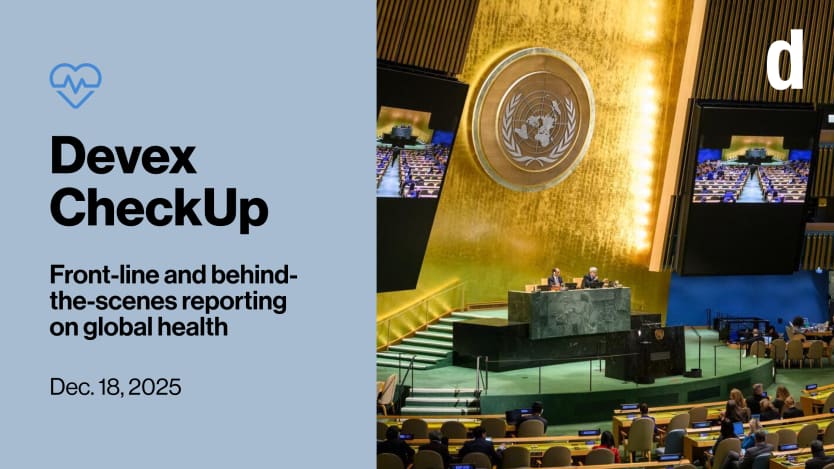
We’re leading off the last Devex CheckUp of 2025 with a story that seems perfectly emblematic of the global health space over this chaotic year.
Over the objections of the United States, the United Nations General Assembly adopted a political declaration on noncommunicable diseases and mental health. The point of the declaration is to galvanize political action on NCDs and mental health at a moment when both are having huge impacts on people’s futures. NCDs are responsible for 74% of all deaths globally, and more than 1 billion people are living with mental health conditions.
The U.S. had been on board with this plan until President Donald Trump took office in January. His administration has criticized the declaration, arguing it “pushes destructive gender ideology” and promotes abortion rights. The document does not mention abortion.
That was enough to derail consensus approval at the fourth high-level meeting on NCDs in September. And U.S. representatives tried to block this week’s vote by the UNGA. That effort ultimately failed, with 175 countries voting in favor of the declaration.
Still, it is not the rousing success that advocates were hoping would speed united global efforts to dramatically reduce NCDs by 2030. Instead, it reflects the reality of a global health community that is more fractured than ever, largely as a result of the new U.S. administration.
2025 saw the withdrawal of the U.S. and Argentina from the World Health Organization, a retreat in global support for leading health initiatives, such as Gavi, the Vaccine Alliance, and questions about how or whether countries and communities will continue to work together to fight the spread of disease.
At CheckUp, we’ll continue to focus in 2026 on what these shifts mean for the future of global health. Thanks for reading, and we’ll be back in your inbox on Jan. 8.
Read: Countries adopt political declaration on diseases despite US pushback
Looking ahead
The new global health landscape is already starting to take shape in the form of bilateral agreements that the U.S. is sealing with partner countries across Africa.
With the deals, the Trump administration is looking to subvert a traditional aid model that channels funding through nongovernmental organizations. U.S. officials criticized this system as having created high overhead costs and resulting in unnecessary parallel systems. Instead, the agreements would funnel money directly to governments, while also roping in the private sector and faith-based organizations.
That doesn’t mean NGOs are being written out entirely, though, as a panel of experts explained in a Devex Pro Briefing this week.
Countries will still have the discretion to decide who will implement health programs going forward. And with the new agreements calling for rapid transition to government ownership of complicated processes, such as supply chain management, there might still be a role for NGOs in helping to effect that transition.
And as governments take on more responsibility than ever before, civil society groups and NGOs will remain crucial in holding them accountable.
Read: NGOs must prove relevance to survive in ‘America First’ health strategy (Pro)
Related: State Dept taps African faith groups for bilateral health deal consults (Pro)
+ Elevate your development work. Begin your 15-day free trial of Devex Pro and instantly access our comprehensive suite of resources: expert analysis, insider briefings, an extensive funding database, and curated event listings. Discover all the exclusive content available to Pro members here.
Not so fast
Those bilateral agreements are also facing blowback. There is concern that unbalanced negotiating power will lead countries to accede to most U.S. demands, including sharing pathogen genetic sequencing. That may result in the U.S. developing products, such as vaccines, from this information without any obligation to share those benefits with the countries where the data originated.
In an opinion piece for Devex, Dr. Githinji Gitahi, the group CEO of Amref Health Africa, argues that while Kenya didn’t sign a specific pathogen sharing agreement, it should have negotiated explicit benefit-sharing upfront. The agreement was silent on that point, he writes. Though he acknowledges that the country had little leverage. If Washington were to revoke its support, it could put the country’s entire health system at risk.
The new bilateral health agreements have also raised concerns about the future of abortion rights. The U.S. government already reinstated the Mexico City Policy in January, which prevents federal funding to international NGOs that provide abortions or information about them.
Now abortion rights advocates are worried that measures restricting the service could be written into the bilateral health agreements, particularly in deals with countries where access to the service is already limited. The result, according to new research, would be a dramatic increase in unintended pregnancies and deaths as women seek out unsafe abortion services.
Opinion: The Kenya-US health deal is pragmatic, but it could have been done better
Plus: Are abortion rights at risk as African governments negotiate with US?
ICYMI: Kenya limits US access to disease outbreak data in new bilateral deal
Opportunity knocks
Direct Relief has historically spotted opportunities to expand its services in a crisis.
Your next job?
Health Manager, UN Clinic Physician
U.N. Development Programme
Zimbabwe
See more jobs.
Founded in 1948, the organization had primarily focused on storing and distributing charitable medicines internationally up until 2005, when Hurricane Katrina hit coastal Louisiana and Mississippi. That experience encouraged the organization to become licensed to distribute prescription medicines in the U.S.
Now, under new CEO Amy Weaver, Direct Relief is thinking about how it will plug some of the gaps left by the cuts in global health funding by the U.S. and other major donors this year.
That includes broadening the organization’s global footprint, making it more cost-effective to stockpile and distribute medicines, and raising cash specifically to fund shipping and lost-mile logistics in some of the world’s hardest-to-reach places.
Read: How Salesforce’s former CFO is scaling a humanitarian giant (Pro)
Nearly there
The Global Polio Eradication Initiative closed its funding gap from $1.7 billion to about $440 million following a pledging event in Abu Dhabi earlier this month.
New commitments totaled $1.2 billion, including $800 million from the Gates Foundation and $140 million from the Mohamed bin Zayed Foundation for Humanity, which hosted the event.
The organizers are hoping that the new funds will bring them closer to their goal of eradicating polio by 2029. Despite remarkable progress in combating the disease, there have still been 39 cases of wild poliovirus type 1 confirmed in two countries so far this year.
Read: Polio eradication secures nearly $2B in pledges at Abu Dhabi summit
Related: Global polio coalition braces for 30% budget cut
Step up
To understand the future of cancer and other diseases means investing in African genetics now, Dr. Mansoor Saleh, a cancer therapy expert, explained in a recent opinion piece for Devex.
Africa’s young and growing population means the continent will drive future disease patterns. Despite that, only 1.1% of clinical trials initiated in 2023 actually took place in Africa.
Unless this changes, there will be gaps in global understanding of the genetic causes that are causing cancers, which will mean growing numbers of patients who do not get care and treatment targeted to their disease.
But it’s not just more clinical trials that are needed. It’s also investments in local sequencing capacities and commitments from pharmaceutical companies to develop new therapeutic approaches based on any new research.
Opinion: Our work is redefining cancer care in Africa. Now we need global partners
Moving forward
African leaders have made many lofty commitments to financing health care, including the 2001 Abuja Declaration that committed them to spending 15% of their national budgets on health.
But as Dr. William Nii Ayitey Mension and Dr. Justice Nonvignon write in an opinion piece for Devex: “Fifteen percent of too little is still too little.”
Menson and Nonvignon, who are both health financing experts, are calling on governments to expand domestic revenue by strengthening their tax bases, enforcing fair taxation, and considering levies on items such as tobacco, alcohol, and sugary drinks.
That would be the beginning of a shift away from declarations and toward decisions that could improve health outcomes on the continent.
Opinion: Africa has made bold health commitments. Now it must finance them
Related: Can countries tax their way out of a global health funding crisis?
What we’re reading
Two senior WHO leaders who lost their jobs in the agency’s recent restructure have found new positions within the organization. [Health Policy Watch]
Over the objections of experts, the U.S. Centers for Disease Control and Prevention has ended a recommendation that all newborns receive the hepatitis B vaccine. [Reuters]
At the height of a flu outbreak, British doctors go on strike over concerns that their salaries are not keeping up with inflation. [NPR]
About the author

Andrew Green@_andrew_green
Andrew Green, a 2025 Alicia Patterson Fellow, works as a contributing reporter for Devex from Berlin.
Search for articles


Most Read
- 1
- 2
- 3
- 4
- 5