
Devex Newswire: Do NGOs have to come last in an ‘America First’ world?


Presented by Abt Global
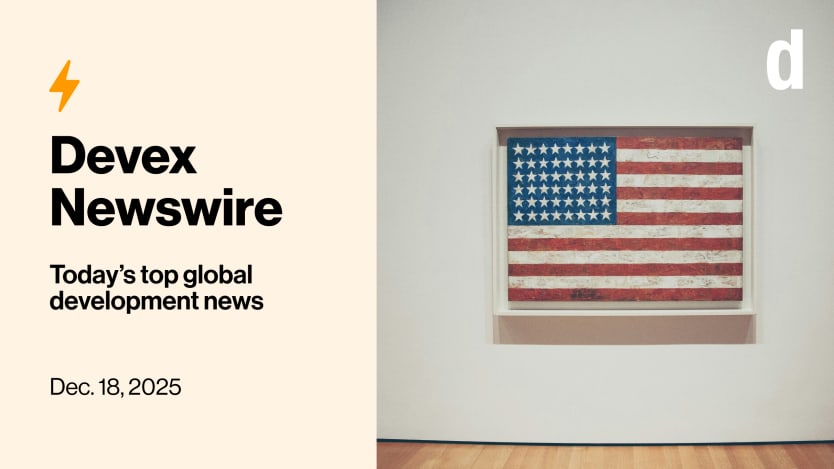
The Trump administration is retooling America’s global health machinery — largely excluding what it once considered a key cog in the system.
Also in today’s edition: IRC boss David Miliband describes a new emergent economy built on violence and destruction.
Happening today at 10 a.m. ET: Join us alongside Harvard Center for International Development’s Fatema Sumar and the Atlantic Council’s James Mazzarella to discuss the shifting currents inside the Millennium Challenge Corporation and what they mean for the agency’s role in the new U.S. foreign assistance policy landscape. Register here. We’ll send you a recording if you can’t attend live.
Whither thou NGOest
The “America First” global health strategy comes with goodies and caveats. Many people find it good that the U.S. will continue to contribute billions of dollars to global health funding — with the caveat that other governments need to significantly pitch in. What the strategy doesn’t come with: a role for NGOs.
In fact, the administration pointedly squeezed out what it derides as costly middle men that it says left governments with little agency over their countries’ health care needs. But experts at a Devex Pro Briefing said there is still a part for large NGOs to play — if they can adapt and prove their relevance in this new reality.
“This is actually an opportunity to start putting things together and actually delivering on what we’ve been promising for 25 years and haven’t delivered at all, which is supporting the countries in their sovereignty,” said Dr. Mark Dybul, former executive director of The Global Fund to Fight AIDS, Tuberculosis and Malaria.
And while the speed with which these America First bilateral compacts have been signed remains a source of controversy, it’s also quite a feat.
“This administration deserves a lot of credit for making all of this happen in such a short amount of time,” said Jirair Ratevosian of the Duke Global Health Institute, pointing to the strategy’s high risk tolerance in swiftly pushing countries to take ownership of areas such as supply chain systems and health worker salaries.
But that same level of risk also opens the door for NGOs, Ratevosian argued.
“In my mind … NGOs and implementing partners become more important, not less,” he said. “They will increasingly, I think, be more involved in helping with risk management, by listening closely to governments, working through local institutions and partners to identify what those capacity gaps are, and then being part of the delivery to ensure that no population is left behind.”
Aggrey Aluso of the Resilience Action Network Africa added that NGOs will be critical in holding governments accountable as these deals are rolled out: “The importance of driving accountability on both ends is something that NGOs, on both the American side and the local implementing NGOs, can do.”
Read: NGOs must prove relevance to survive in ‘America First’ health strategy (Pro)
+ Want more exclusive insights and guidance on the evolving aid sector from insiders and experts? Gain priority access to candid conversations with nonprofit leaders and multilateral policymakers by signing up for Devex Pro with a 15-day free trial today and get immediate access to all our exclusive Pro Briefings in addition to our expert analyses, special funding reports, members-only insider newsletters, and more.
Hard-fought consensus
Ratevosian also noted that bilateral deals shouldn’t come at the cost of multilateralism.
“Pathogens come from other countries that don’t necessarily sign [memorandums of understanding] with the United States, and that’s why we need the global system,” he said. “That’s why we need multilateral cooperation around all of this.”
But multilateralism has largely been anathema to this administration, so some countries are adopting their own strategy — namely, moving on without the U.S.
To that end, the U.N. General Assembly just adopted a political declaration on noncommunicable diseases and mental health, with 175 countries voting in favor despite strong pushback from the U.S., my colleague Jenny Lei Ravelo writes.
The main bones of contention from the U.S. side include concerns that the declaration promotes “gender ideology” and abortion rights
U.S. representative Jonathan Shrier also alleged that some World Health Organization officials “meddled in the process,” and accused the U.N. General Assembly President Annalena Baerbock of “bowing to political pressure beyond this forum.”
Baerbock volleyed, reiterating that a draft declaration in September underwent “intense outreach and extensive engagement” by all delegations. She said some states still had objections, but the draft received broad support from member states.
“As [is] also common practice, consensus does not mean unanimity,” she pointed out.
Read: Countries adopt political declaration on diseases despite US pushback
Profit over peace
“Conflict has become a sophisticated, multibillion dollar global industry.”
— International Rescue CommitteeThe International Rescue Committee’s annual emergency watch list, which identifies the 20 countries at greatest risk of worsening humanitarian crises in the year ahead, paints a stark picture of what my colleague Elissa Miolene describes as “profit-powered war.” And Sudan, which tops the watch list, is emblematic of those perverse incentives.
“Profit from conflict is being legitimized and normalized. Sudan is a case study, as gold and natural resources fuel the conflict,” said David Miliband, IRC’s president and CEO, at an event hosted by the Council on Foreign Relations in Washington, D.C. “The new economics of war are a feature of the watch list this year — probably for the first time.”
Sudan is not alone. In the Democratic Republic of Congo’s conflict economy, rebel groups tax the mineral trade to the tune of $800,000 a month. In the Sahel, it played out through armed groups trafficking goods across borders, creating an economy “built on violence.”
“The internationalization of so-called internal conflict is obviously a feature of new geopolitics,” said Miliband, noting that “every single neighbor of Sudan has chosen a side.”
Miliband also pointed out that as war becomes more lucrative, aid has become more scarce, with tens of billions of it evaporating with the demise of USAID.
Miliband’s own organization has not been immune to the cuts, with IRC losing $400 million and 6,000 staff in less than a year.
Read: Gold and guns — how the ‘economics of war’ fuels humanitarian crisis
Show me the money
IRC is certainly not alone in slashing staff due to dwindling budgets. It’s been a year of loss for so many in the aid sector. But jobs haven’t completely disappeared, nor has the demand for seasoned professionals who can manage organizations, influence policy, and deliver results.
So Devex looked to its job board to uncover the top 100 highest-paid jobs in global development from Jan. 1 to Nov. 30 of this year, breaking the salaries down by region, sector, and organization type.
From presidents to project managers — and even fisheries and aquaculture experts — we reveal who makes what.
Read: The best-paid development jobs of 2025 (Career)
+ Looking for your next job in global development or seeking insider information for a career pivot in 2026? Take advantage of the benefits a Devex Career Account membership gives you, including full access to global development’s largest job board with regularly updated opportunities, special reports and articles, and exclusive insights from recruiters and career coaches. Sign up now with a 15-day free trial.
Cash flow
Enough promises on paper. Now is the time for Africa to find the financing to pay for its own health care, according to Dr. William Nii Ayitey Menson, director of health financing for Africa at ONE, and Dr. Justice Nonvignon, technical director for health economics and financing at Management Sciences for Health.
“Leaders have stood on podiums, signed declarations, and launched strategies, ranging from the Abuja Declaration to the Accra Compact to Agenda 2063. These commitments have been powerful rallying points, reinforcing the belief that good health is a right and not a privilege,” they write in a Devex opinion piece.
But the money has not flowed alongside the rhetoric.
“Across the continent, health financing remains dangerously low. Most governments still allocate far less than the 15% target set in the Abuja Declaration more than two decades ago,” they write, arguing that 15% “of too little is still too little.”
“There is no single solution, but there is a clear path forward. It starts with mobilizing greater resources, domestically and externally, and putting health at the center of how funds are allocated,” they add, outlining strategies such as reducing inefficiencies, increasing transparency, rechanneling remittances, and instituting taxes on unhealthy products.
“The time has come not just to meet that target but to expand the entire fiscal envelope,” they argue. “Africa must grow the pie; not just slice it differently.”
Opinion: Africa has made bold health commitments. Now it must finance them
In other news
Foreign aid cuts in Bangladesh’s Rohingya refugee camps are pushing children out of school and into forced marriage, hazardous labor, trafficking, and armed group recruitment. [Associated Press]
Heavy winter rains are worsening already dire conditions for displaced families in Gaza, flooding makeshift shelters, collapsing war-damaged buildings, and exposing children to diseases as U.N. agencies warn that aid flows remain far below what is needed. [BBC]
Sign up to Newswire for an inside look at the biggest stories in global development.
About the author

Anna Gawel
Anna Gawel is the Managing Editor of Devex. She previously worked as the managing editor of The Washington Diplomat, the flagship publication of D.C.’s diplomatic community. She’s had hundreds of articles published on world affairs, U.S. foreign policy, politics, security, trade, travel and the arts on topics ranging from the impact of State Department budget cuts to Caribbean efforts to fight climate change. She was also a broadcast producer and digital editor at WTOP News and host of the Global 360 podcast. She holds a journalism degree from the University of Maryland in College Park.
Search for articles


Most Read
- 1
- 2
- 3
- 4
- 5